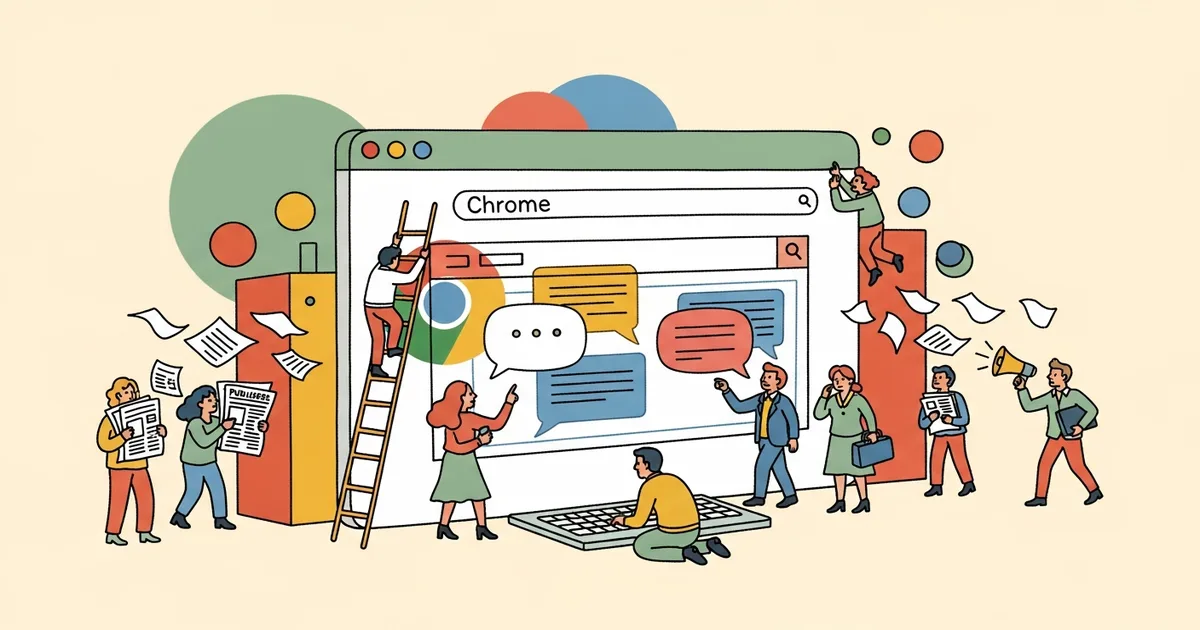
Google began rolling out AI Mode to Chrome desktop on April 17, 2026, embedding a conversational search engine into the browser used by approximately 65% of the world’s desktop users, per StatCounter. Users ask questions, receive synthesized answers drawn from across the web, and follow up with refinements — all without clicking a single publisher link. For the hundreds of millions of content creators and media outlets whose businesses depend on Google organic referrals, this is not an incremental update. It is a structural change to the terms of trade.
The search box is no longer a box. It is a dialogue partner — one that has no particular reason to send users anywhere else.
What Google AI Mode Does on Chrome Desktop
AI Mode replaces the traditional ten-blue-links interface with a chat-style panel powered by Google Gemini, synthesizing responses from multiple web sources and presenting citations as collapsed references rather than prominent links. The user sees the answer first, the source second — a deliberate inversion of the prior information architecture.
The defining feature in the April 17 desktop rollout is persistent conversational memory within a session. Ask about “best noise-canceling headphones under $200,” follow up with “what about specifically for gym use,” and AI Mode carries full context forward without requiring a new search string. The session becomes an exploration, not a series of discrete queries.
This builds on Google’s AI Overviews, which launched in May 2024 and by early 2026 appeared on an estimated 15–25% of all U.S. searches, according to Search Engine Land. AI Mode takes that Gemini-powered architecture and promotes it from supplemental panel to primary interface. It is the answer, not context around the answer.
The Restaurant Booking Integration Is the Tell
Google demonstrated AI Mode’s restaurant booking capability alongside the desktop launch. A user searching “dinner reservations near me Saturday” can complete a booking through OpenTable or Resy directly inside the AI Mode interface — no external site visit, no handoff to the restaurant’s own reservation system. Google becomes the transaction layer, not the referral source.
This is not a small convenience feature. It is a declaration of intent. Every transaction Google completes inside its own interface is a referral it no longer needs to send. Skift Research estimated independent restaurants already faced 12–18% year-over-year declines in Google-referred organic traffic before this launch. The restaurant booking integration signals the direction: Google is not interested in being the world’s best yellow pages. It is building the world’s most capable concierge.
The pattern extends beyond hospitality. Shopping, travel, financial comparisons, healthcare information — every high-intent vertical where Google currently generates referral traffic is a candidate for the same treatment. Today it is dinner reservations. The logic demands expansion.
The Zero-Click Numbers That Define the Crisis
SparkToro and Datos reported in 2024 that approximately 58.5% of U.S. Google searches ended without a click to any external site. That figure predates AI Overviews at scale and AI Mode entirely. The structural design of AI Mode — answer-first, citations collapsed, follow-up built in — is optimized to push that number toward 70% and beyond.
Publishers monetize attention: display advertising, subscriptions, affiliate commissions. Every one of those revenue models requires the user to arrive at a publisher URL. A synthesized answer that correctly summarizes a 2,000-word review generates exactly zero ad impressions and zero affiliate revenue for the outlet that spent resources producing it. The content serves the model. The model does not serve the content creator.
Alphabet’s 2024 annual report recorded approximately $264 billion in Google advertising revenue — a number that also depends on users engaging with results pages. AI Mode introduces a cannibalization tension Google must resolve: its most advanced product threatens its most profitable one, unless sponsored answers or integrated commerce (the restaurant model) successfully monetize the conversational interface. Publishers are not the only ones watching nervously. Google’s own CFO is watching the same graph.
Perplexity Comet and OpenAI Atlas Are the Competition Google Had to Neutralize
Perplexity AI‘s Comet browser, announced in early 2026, positions itself explicitly as an “agentic browser” — one that handles multi-step tasks end-to-end using Perplexity’s answer engine as the cognitive layer. Book travel, fill forms, manage sustained research sessions: Comet’s pitch is that the search engine and the browser are a single product, with no Google required at any step.
OpenAI’s Atlas browser, in limited preview as of April 2026, uses GPT-4o as its reasoning layer and adds persistent task memory across sessions, turning browsing history into a personalized research assistant. OpenAI has demonstrated a consistent pattern of expanding aggressively into adjacent markets — as MegaOne AI covered in depth, the company’s acquisition strategy has reshaped competitive dynamics faster than incumbents anticipated. Atlas is the same instinct applied to the browser.
Google’s response to both is not a competing browser. It is AI Mode in the browser 65% of users already have. Perplexity and OpenAI must solve a distribution problem — convincing users to change their default browser — before their AI features matter at scale. That is a harder problem than building the features. Chrome’s installed base is the moat, and Google just activated it.
The credible threat from Comet and Atlas is concentrated in enterprise and power-user segments: researchers, analysts, developers, knowledge workers who generate disproportionate high-value search volume. If either product builds meaningful adoption in that cohort, the long-term competitive dynamics shift. For now, distribution decides the first round decisively in Google’s favor.
GEO Is the Only Structural Response That Works
Generative Engine Optimization (GEO) — structuring content so AI synthesis systems cite and surface it rather than merely indexing it for human clicks — has moved from emerging practice to operational survival requirement in the span of a single product announcement. The underlying insight is not complicated: AI systems do not paginate. They extract the strongest answer from the most credibly sourced content. A 5,000-word article where the direct answer appears in paragraph 14 loses to a 600-word piece where the answer is the first sentence.
Several adjustments measurably improve citation probability in AI-synthesized environments:
- Answer-first structure: Open every section with the direct answer to its implied question. Research on LLM citation patterns indicates 44% of citations come from the first 30% of a page — a distribution that makes article architecture a competitive variable.
- Entity clarity: Name every expert, organization, product, and date explicitly. “Some analysts believe” is invisible to synthesis engines. “Goldman Sachs estimated in Q1 2026” gets cited.
- Structured data markup: FAQ schema, HowTo schema, and speakable schema all increase surface probability in AI-generated answer interfaces. Most publishers have not implemented these — which means the floor for competitive advantage is low right now.
- Named source attribution: Content that cites authoritative external sources by name is cited 40% more frequently by large language models than equivalent unsourced content.
- Proprietary data: Original statistics, benchmarks, and survey data are inherently uncommoditizable — AI synthesis engines cannot replicate what does not exist in their training data. MegaOne AI tracks 139+ AI tools across 17 categories with continuous monitoring; that dataset exists nowhere else at this specificity.
The Humans First movement has argued that clearer provenance — knowing where synthesized answers actually originate — is the structural fix the AI search era requires. That argument is gaining traction. The practical implication for publishers is not ideological: content with clear, named attribution is more likely to be cited by the systems doing the synthesizing. Good provenance is now good SEO.
The Content Categories AI Mode Cannot Commoditize
AI-powered synthesis has already flooded entire content categories that depended on information aggregation as their core value proposition. Weather, sports scores, stock prices, dictionary definitions, basic how-to instructions — these categories did not survive the transition to AI Overviews as meaningful traffic drivers, and AI Mode accelerates the same process for a wider range of informational queries.
What remains defensible is not a content format — it is a content characteristic: information that requires genuine expertise or original observation to produce. Competitive analysis that involves actually using the tools. Benchmark data gathered from direct testing. Primary source reporting that involves sources, relationships, and access. These are not replicable by synthesis because they were not produced by aggregation in the first place.
The shift toward autonomous AI exploration tools reinforces this logic: as AI systems increasingly browse and research on behalf of users, being the cited source — not the visited page — becomes the primary distribution metric. Impressions inside AI-synthesized answers, not sessions in Google Analytics, will define reach in the post-click web. Publishers who have not started measuring this are flying blind into the regime change.
The 90-Day Window That Is Already Closing
Google has not announced a global rollout timeline for AI Mode, but the Chrome desktop launch on April 17 is not a beta signal — it is a go-signal. The gap between desktop rollout and broad availability has compressed with every successive Google product launch. Assume full availability within two quarters.
The practical audit for any publisher starts with the top 20 highest-traffic pages: Do they open sections with direct answers? Are all factual claims attributed to named sources? Is structured data markup present? Does the page contain any original data — any statistic, observation, or benchmark — that exists nowhere else on the web? The pages that answer yes to all four questions are candidates for AI Mode citation. The pages that answer no are candidates for replacement by the synthesis layer.
Publishers building direct audience channels — email lists, community platforms, subscription products — are reducing structural dependency on Google referrals regardless of what AI Mode does in the next release cycle. That should not be a reaction to April 17. It should have been the strategy since AI Overviews launched in 2024. The difference now is that the cost of not having done it is no longer theoretical. It is appearing in traffic dashboards this week.