Google LLC (NASDAQ: GOOGL) expanded its AI Mode restaurant booking feature to Chrome desktop on April 14, 2026, enabling users to reserve tables directly from AI-generated search results — no restaurant website, no OpenTable detour, no Yelp review tab required. The search results page is now a transaction terminal.
This is not a minor UX update. It is the most direct demonstration yet of Google’s intent to own the entire consumer decision funnel — from query to completed transaction — without releasing the user to any third-party platform. Restaurant discovery was already Google’s game. Now the booking is, too.
How Google AI Mode Restaurant Booking Actually Works
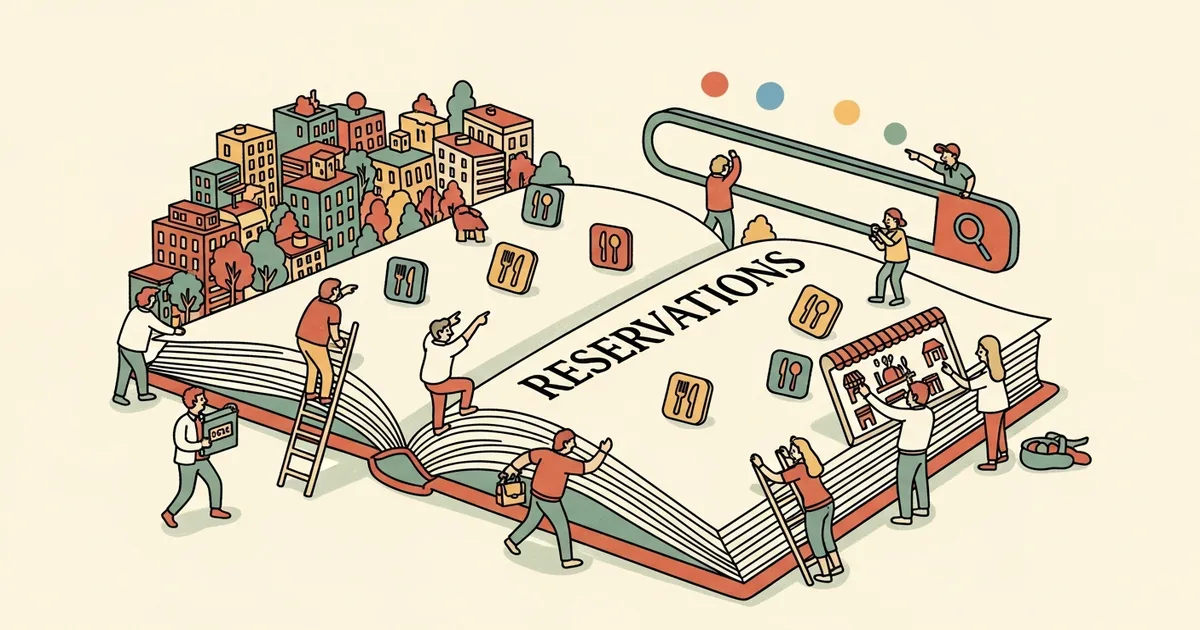
When a user in a supported city searches for a restaurant, AI Mode generates a structured response that includes an embedded reservation flow alongside recommendations and reviews. Users select a date, party size, and time — then confirm. The booking completes via a Google-managed API layer connecting directly to restaurant reservation systems, without the user navigating away from the results page.
Google confirmed the feature currently uses integrations with existing reservation infrastructure, meaning restaurants that already expose booking APIs through platforms like OpenTable or Resy. For participating locations, the entire process from search to confirmed reservation takes under 90 seconds inside the Google interface.
The Chrome desktop expansion on April 14 follows earlier limited mobile testing and marks the first time AI Mode booking has broad availability across Google’s highest-traffic surface.
Coverage: Which Cities and Restaurants Are Supported
At launch, Google AI Mode restaurant booking is live in five U.S. metros: New York, Los Angeles, San Francisco, Chicago, and Seattle. Coverage skews toward high-density urban markets where reservation culture is embedded — the same markets where OpenTable and Resy have their deepest penetration and most to lose.
Supported restaurants are primarily those already integrated with third-party reservation platforms, since Google’s booking layer currently piggybacks on existing API infrastructure. Independent restaurants without booking system integrations are invisible in the flow for now. Google has not disclosed whether direct restaurant agreements are in development.
Independent estimates suggest the launch covers several thousand restaurants across the five cities, with expansion to additional U.S. metros expected through Q2 2026.
Zero-Click Commerce: The Search Bar Becomes a Shopping Cart
Zero-click search — queries that resolve without the user visiting any external site — accounted for approximately 65% of all Google searches in 2024, according to SparkToro’s ongoing search behavior research. That figure historically covered informational queries where Google serves the answer inline. AI Mode extends the same logic to transactional queries, completing bookings without an outbound click.
The zero-click commerce thesis is straightforward: if Google completes a transaction inside its own interface, it captures the entire value chain. Discovery, consideration, and conversion all happen in one place. The external website — restaurant homepage, OpenTable listing, Yelp page — is never loaded, never tagged, never monetized by anyone other than Google.
This is the same structural shift MegaOne AI documented when AI systems absorbed the weather app category — a vertical that collapsed from multi-step app interactions into a single inline answer. Restaurant booking is the same playbook applied to commerce.
Google becomes the mandatory interface between restaurants and customers — not a referral source, but a gatekeeper. The restaurant’s own website becomes optional infrastructure in a funnel it no longer controls.
OpenTable, Resy, and Yelp Just Became Middleware
OpenTable, owned by Booking Holdings (NASDAQ: BKNG), processes roughly 1.6 billion restaurant visits annually and has built its business on a simple premise: aggregate restaurant inventory and deliver it to users who prefer not to call ahead. Resy, acquired by American Express in 2019, handles high-demand bookings for a more affluent demographic. Both platforms depend entirely on being the destination between a Google search and a confirmed reservation.
Google just built the same destination into the search interface itself. A user searching “Italian restaurant near me Saturday 7pm” is already expressing intent that Google can now convert without a redirect. OpenTable only reaches that user if Google sends them. With AI Mode booking, it has far less reason to.
Yelp’s exposure is arguably worse. The company generated $1.4 billion in net revenue in 2024, according to Yelp investor filings, with approximately 80% tied to restaurant and local service advertising that depends on Google traffic. Yelp has been contesting Google’s local search dominance since at least 2012, when it testified before the U.S. Senate Judiciary Committee about anticompetitive self-preferencing. AI Mode booking is not a new front in that dispute — it is a decisive one.
The travel sector provides the clearest precedent: Expedia and Booking.com still exist, but Google Flights and Google Hotels commoditized their discovery layer. Revenue compression followed market-by-market. Reservation platforms are entering the same dynamic, at AI acceleration speed.
What Restaurants Actually Lose
The most significant loss is not a referral fee — it is the customer relationship. When a diner books through a restaurant’s own website, the restaurant captures an email address, tracks repeat visit frequency, and builds first-party marketing lists. When a diner books through Google AI Mode, the restaurant receives a reservation and nothing else.
Google holds the diner’s identity, search history, location data, and booking record. The restaurant becomes a vendor fulfilling a transaction it did not initiate and cannot own. Loyalty programs, re-engagement emails, and direct upsell opportunities all depend on first-party data collected at the moment of highest intent — and AI Mode removes that moment systematically.
There is also a structural dependency risk. Once discovery and booking are both Google-controlled, any change in Google’s ranking algorithms, API terms, or commission structures becomes existential rather than marginal. Amazon marketplace sellers spent a decade learning this dynamic: the platform sets the rules, and the merchant adapts or exits. Restaurants would be entering the same arrangement, most without full awareness of having done so.
This consolidation mirrors patterns MegaOne AI has tracked across AI-mediated commerce — parallel to the consumer resistance documented in growing pushback against AI systems capturing the full interaction layer between businesses and their customers.
The Template for Every Service Category Google Enters Next
Restaurants are the proof of concept for a structurally larger ambition. The same AI Mode booking architecture handling a dinner reservation can, with minimal modification, handle a dental appointment, a hotel room, a haircut, a car rental, or a contractor estimate. Any category where a transaction can be expressed in structured data — date, time, quantity, preferences — is technically eligible for in-search booking treatment.
Google has been building toward this across multiple verticals: appointment booking for medical providers in Search, direct contact through Local Service Ads for home services, and end-to-end booking in Google Hotels and Flights. AI Mode does not invent the strategy — it accelerates execution by replacing browse-and-click navigation with direct intent capture. The platform consolidation dynamics reshaping AI industry structure in 2025 and 2026 follow the same logic: whoever owns the first interaction owns the entire value chain.
Google Search processes approximately 8.5 billion queries per day globally. Even a 1% capture rate on transactional service queries represents tens of millions of monthly booking opportunities — without Google needing to build consumer trust from scratch, because it already owns the discovery relationship that precedes every transaction.
Three Signals Worth Watching in the Next 90 Days
First, whether OpenTable and Resy pursue distribution agreements with Google — accepting a subordinate integration role in exchange for continued booking volume — or invest in differentiated CRM and loyalty infrastructure that a search interface cannot replicate.
Second, whether EU regulators classify AI Mode booking as an extension of existing Digital Markets Act obligations. The DMA’s interoperability and self-preferencing provisions were drafted with search in mind, not in-search commerce. The European Commission will need to determine whether the current framework covers it — and that determination will shape how aggressively Google can expand the feature internationally.
Third — and most consequentially for independent operators — whether a market emerges for first-party booking infrastructure specifically designed to recapture the customer relationship that AI Mode removes. The mechanism does not currently exist in any scalable form. The demand will grow fast.
MegaOne AI tracks 139+ AI tools across 17 categories, including the expanding set of AI-native commerce interfaces reshaping how consumers transact with service businesses. The restaurant vertical is the first to experience in-search booking at this scale. It is the template, not the exception.
Restaurants and reservation platforms treating this as a distribution upgrade are misreading it. This is a disintermediation event dressed as a convenience feature — the kind that looks harmless until the customer relationship is permanently gone.