- Anthropic bans AI tools during job interviews unless explicitly stated otherwise, per Bloomberg Businessweek, to see how candidates actually think.
- Candidates go through up to five rounds, including a ‘culture interview’ on values, worldview, and ethical dilemmas; failing the culture round effectively ends the application.
- Salaries reach $850,000 plus equity. Some applicants pay $4,600 on average for prep coaching run anonymously by current OpenAI and Anthropic employees.
- The policy lands amid broader anxiety in the AI labor market as both OpenAI and Anthropic mint multimillionaires while developers at other firms — even those with solid salaries — sit on the sidelines.
What Happened
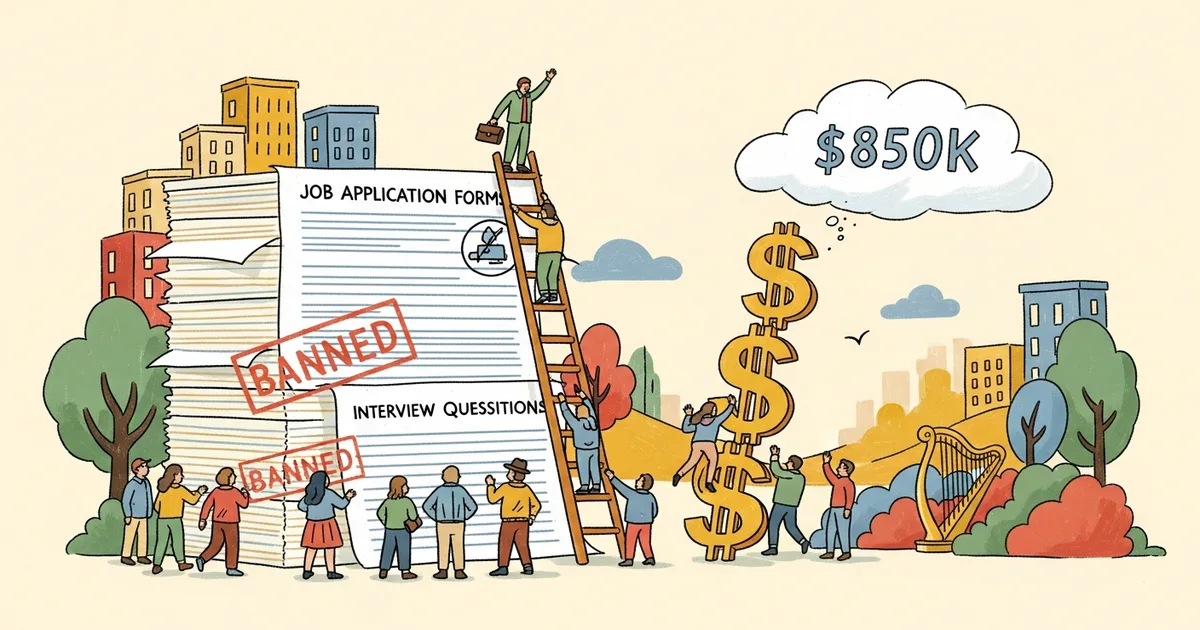
Anthropic now bans candidates from using AI tools during job interviews unless explicitly stated otherwise, The Decoder reported, citing Bloomberg Businessweek. The company runs candidates through up to five rounds of interviews and tests, including a so-called “culture interview” focused on values, worldview, and ethical dilemmas.
Why It Matters
Anthropic is one of the most aggressive users of AI inside its own company — its CEO Dario Amodei has publicly discussed using Claude across internal workflows, and Anthropic’s product organization is widely cited as a heavy AI-tool consumer. That the same company bans AI tools in candidate interviews tells a specific story about what Anthropic believes matters in hiring: the ability to reason through novel problems without LLM scaffolding.
The policy also addresses a hiring-process problem that every AI-adjacent company now faces. As frontier LLMs become more capable, take-home coding challenges, system-design questions, and behavioral interviews are all increasingly contaminated by AI-generated answers. Anthropic’s bet is that to actually evaluate how a candidate thinks, you have to make sure the candidate is the one doing the thinking. Other AI labs and large tech companies are likely watching this experiment closely.
Technical Details
The five-round structure includes technical depth interviews and the culture interview. According to the Bloomberg Businessweek reporting summarized by The Decoder, the culture interviews are reportedly more intense than at other companies. Anthropic expects candidates to think critically about the company itself — fitting for a founder like Amodei, who is known for discussions about AI as both a positive force and an existential risk. Failing the culture interview pretty much kills the candidate’s chances of getting the job.
Compensation is high: salaries reach up to $850,000 plus equity. The eye-watering pay reflects the broader frontier-lab labor-market tightening. Both OpenAI and Anthropic are currently minting dozens of multimillionaires through funding rounds and secondary-share sales — which is, per the reporting, triggering anxiety even among developers with solid salaries at other firms, who are watching the AI-lab millionaire-making from the sidelines.
A parallel ecosystem has formed around the interview gauntlet: some applicants spend an average of $4,600 on prep coaching, run anonymously by current OpenAI and Anthropic employees. That coaching cost — roughly equivalent to a quarter of US median monthly take-home for a senior engineer — is a marker of how high the stakes are for candidates trying to break in.
Who’s Affected
Candidates applying to frontier AI labs gain a clearer picture of what to prepare for. Hiring teams at competing AI labs and large tech companies face the question of whether they should adopt similar AI-tool-restricted interview formats — and how to handle the inevitable candidate-experience friction. Interview-prep coaches and platforms (LeetCode, AlgoExpert, Interviewing.io) face a new market segment for AI-restricted prep. Compensation benchmarking services and the broader senior-engineer labor market get another data point showing frontier-AI total compensation now competes with hedge-fund quant comp.
What’s Next
Expect other frontier AI labs — OpenAI, Google DeepMind, Mistral, Meta FAIR, xAI — to either confirm similar AI-tool policies or publicly differentiate themselves with AI-allowed interviews. Broader tech employers face a slower-burn question: how to evaluate engineering candidates in a world where AI coding agents handle most production work. Anthropic’s policy is one answer; expect at least one major counter-experiment from a company that decides to interview candidates with full AI tooling enabled, treating that as the more realistic test of working capability. The hiring debate will likely intensify as both labor markets and AI capability levels keep shifting through 2026 and 2027.