- MCP (Anthropic‘s Model Context Protocol) connects AI agents to tools and data. It is the most mature and widely adopted protocol — with 10,000+ servers — and the one most developers need first.
- A2A (Google‘s Agent2Agent) connects agents to other agents. It is the leading standard for cross-agent and cross-vendor coordination.
- ACP (IBM’s Agent Communication Protocol) merged into A2A under the Linux Foundation in September 2025. In 2026 it is historical context, not a fresh decision.
- They are layers in a stack, not rival products: use MCP for tool access, and add A2A when agents must coordinate across systems or organizations.
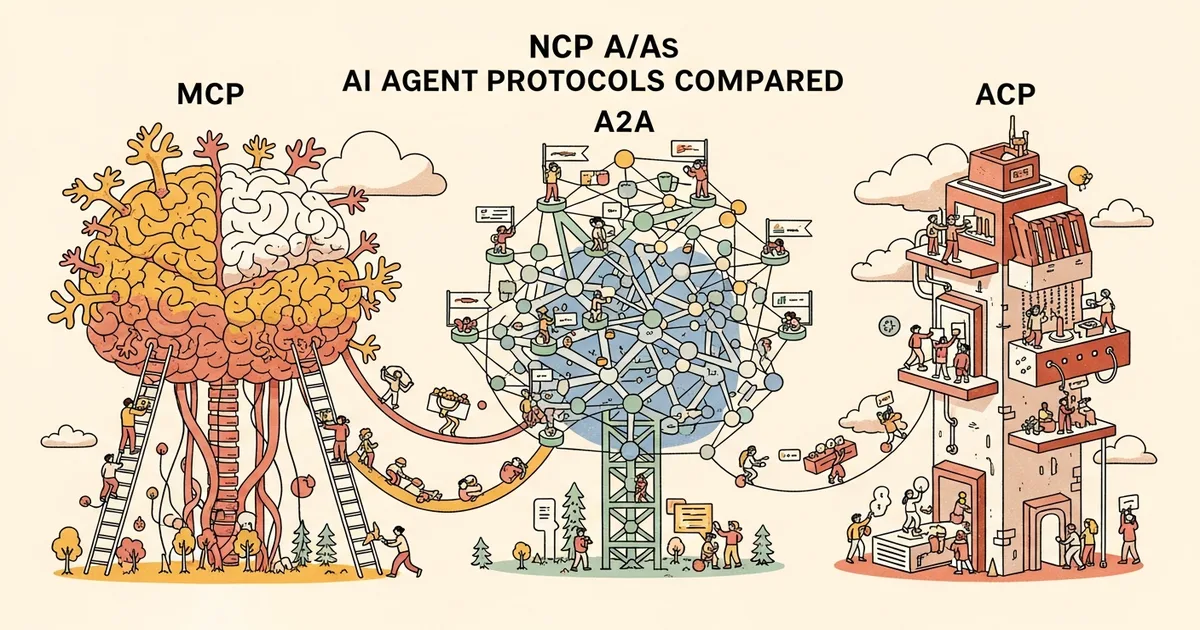
If you are building AI agents in 2026, you have almost certainly run into three acronyms — MCP, A2A, and ACP — and the common confusion that they compete with each other. They do not. The simplest way to hold them in your head: MCP connects agents to tools, A2A connects agents to other agents, and ACP has been folded into A2A. This guide explains each one, how they fit together, and which you actually need.
Quick comparison
| Protocol | Created by | Connects agents to… | 2026 status | Use it for |
|---|---|---|---|---|
| MCP (Model Context Protocol) | Anthropic | Tools & data sources | Most mature; 10,000+ servers; production-ready | Giving an agent access to tools, APIs, files, and databases |
| A2A (Agent2Agent) | Other agents | Leading inter-agent standard; broad enterprise backing | Coordinating multiple agents across vendors or organizations | |
| ACP (Agent Communication Protocol) | IBM / AGNTCY | (REST-native agent messaging) | Merged into A2A (Linux Foundation, Sept 2025) | Historical — its REST-simplicity ideas now live in A2A |
What is MCP?
The Model Context Protocol (MCP), introduced by Anthropic, is an open standard for connecting AI agents to external tools, data, and services. Instead of every application building a bespoke integration for every tool, MCP defines one consistent way for a model to discover and call tools — file systems, APIs, databases, SaaS apps, and more.
MCP has become the default. As of 2026 it has critical mass: 10,000+ MCP servers, near-universal tool support across the major AI platforms, and a specification stable enough for production. For most developers, MCP is the only agent protocol they need to touch immediately. You can browse working servers in our MCP Server Directory. A helpful analogy: MCP is the power strip — it is how an agent plugs into the tools it needs.
What is A2A?
Google’s Agent2Agent (A2A) protocol solves a different problem: how do independent agents — possibly built by different vendors, running in different clouds — talk to each other, delegate tasks, and coordinate? A2A is the leading standard for this inter-agent layer, with broad enterprise partner participation. If MCP is how an agent reaches its tools, A2A is the phone line agents use to call colleagues. You need A2A when a workflow spans multiple agents that don’t share a single runtime.
What is ACP — and is it still relevant?
IBM’s Agent Communication Protocol (ACP) was a REST-native approach to agent messaging, favored by teams wanting minimal friction and compatibility with existing HTTP toolchains. The key 2026 fact: in September 2025, IBM announced ACP would merge with A2A under the Linux Foundation. Its best ideas — REST simplicity and lightweight messaging — are being folded into A2A’s roadmap. If you are starting fresh in 2026, treat ACP as historical context, not a current architectural choice.
How they fit together (the agent stack)
The clearest mental model is a stack, not a contest. One widely used analogy: MCP is the power strip (tools), ACP was the desk (workspace), and A2A is the phone line (coordination). They operate at different layers:
- Tool layer → MCP: the agent accesses tools and data.
- Coordination layer → A2A: agents delegate and collaborate with each other.
Governance reflects this convergence. The Linux Foundation launched the Agentic AI Foundation (AAIF) — co-founded by OpenAI, Anthropic, Google, Microsoft, AWS, and Block — as the permanent, vendor-neutral home for both A2A and MCP. The ecosystem is consolidating around these two complementary standards rather than fragmenting.
Which protocol should you use?
The standard 2026 recommendation for enterprise architectures is straightforward:
- Use MCP for all tool access. It is the most mature, most broadly supported, and production-ready today. Start here.
- Add A2A when you need cross-vendor or cross-organization agent coordination — i.e., when multiple independent agents must work together.
- You do not need to choose ACP. It is converging into A2A.
For most teams, the honest answer is: start with MCP, add A2A only when a multi-agent workflow demands it. Explore the tooling in our MCP directory and keep up with protocol developments in our AI launches coverage.
Frequently asked questions
What is the difference between MCP and A2A?
MCP connects an AI agent to tools and data (APIs, files, databases). A2A connects agents to other agents for coordination. They operate at different layers and are commonly used together.
Is ACP still used in 2026?
ACP merged into A2A under the Linux Foundation in September 2025. New projects should use A2A; ACP is now historical context.
Which AI agent protocol should I start with?
Start with MCP — it is the most mature, with 10,000+ servers and production-ready tool support. Add A2A when you need cross-agent coordination.
Who governs MCP and A2A?
The Linux Foundation’s Agentic AI Foundation (AAIF) — co-founded by OpenAI, Anthropic, Google, Microsoft, AWS, and Block — is the neutral home for both MCP and A2A.
Sources: Morph: ACP vs MCP vs A2A, Zylos Research: Agent Interoperability Protocols 2026. Last updated June 2026.