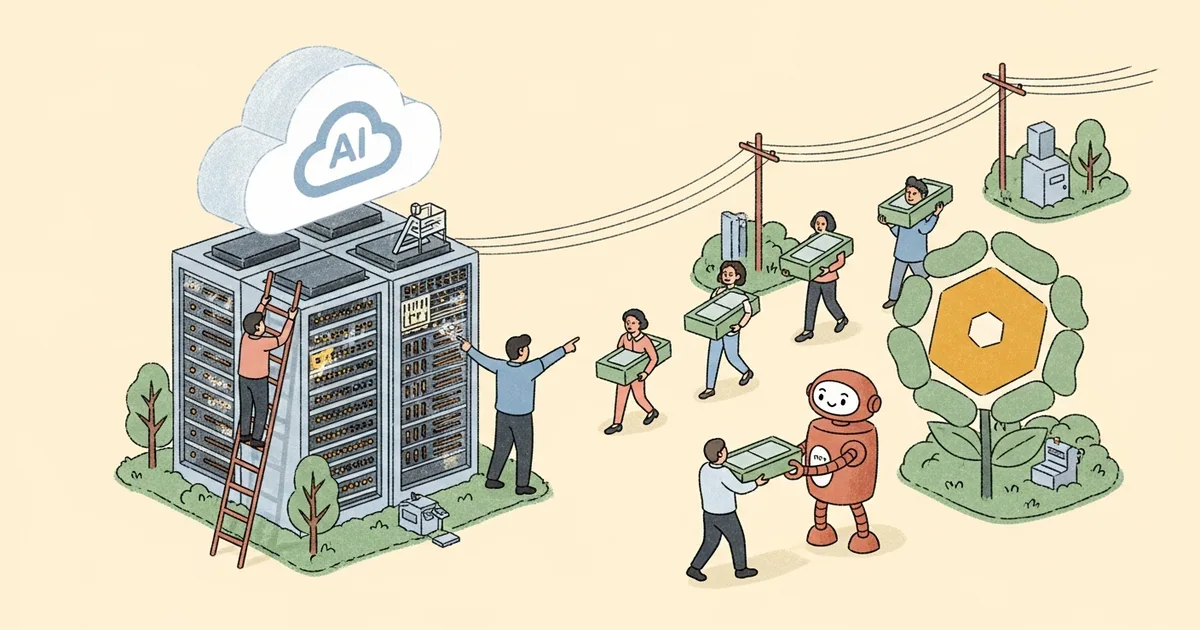
Oracle Corporation (NYSE: ORCL) closed a $16 billion project-finance package for a single AI data center campus in Michigan on April 25, 2026 — the largest single project-finance transaction in the history of technology infrastructure, according to Bloomberg. Bank of America underwrote and sold $14 billion in bonds to institutional investors to fund the build-out, with the campus designated to run compute workloads for OpenAI.
This is not a routine capital markets event. Structuring $16 billion in project finance for a single compute campus is what you do when AI infrastructure has become operationally indistinguishable from a regulated utility asset.
The Billion Financing Structure
Project finance is the mechanism used to fund toll roads, LNG export terminals, and nuclear plants — assets with long-duration, contracted cash flows that can service debt independently of the parent company’s balance sheet. Oracle applied that same structure to AI compute. The debt is secured against the Michigan campus’s revenue contracts, not Oracle’s broader enterprise balance sheet.
Bank of America acted as lead underwriter, syndicating $14 billion in bonds to institutional buyers — pension funds, insurance companies, and infrastructure-focused asset managers. The remaining $2 billion comes from equity or subordinated debt, though Oracle has not disclosed the full capital stack breakdown. According to Bloomberg, investor demand was sufficient to complete the syndication without distress pricing.
For historical context: the largest U.S. project-finance deal before this was a $12 billion LNG export terminal closed in 2015. AI data centers have crossed into energy-megaproject territory on deal size alone.
The Michigan Campus: What Is Actually Known
Oracle has not released full technical specifications for the Michigan campus. What is confirmed: this is a single-site campus, not a distributed portfolio — which makes the $16 billion figure more striking. At that price point, full build-out likely implies 1+ gigawatt of IT power capacity, though Oracle has not confirmed power figures publicly.
Michigan’s appeal is practical: lower land costs than Northern Virginia, access to Great Lakes cooling infrastructure, a state government offering data center tax incentives, and a power grid with more available headroom than the constrained markets in Loudoun County, Virginia, or suburban Phoenix. The campus joins a growing cluster of hyperscale AI compute facilities relocating to the Midwest to escape the capacity and power bottlenecks of the coasts.
Oracle Data Center Michigan: The OpenAI Anchor Tenant Arrangement
OpenAI functions here as an anchor tenant in commercial real estate terms: it commits to purchasing compute from the Michigan campus, and that contracted revenue is precisely what makes a $14 billion bond sale viable. Project-finance lenders do not fund speculative capacity. They fund contracted cash flows from creditworthy counterparties.
OpenAI is simultaneously expanding its commercial footprint aggressively across media, enterprise, and infrastructure sectors, with compute demand that continues to outpace what any single cloud provider can supply. The Michigan campus adds dedicated, locked-in capacity — a structurally different proposition than purchasing spot or reserved compute from a shared cloud environment.
Oracle and OpenAI’s partnership dates to 2024, when both companies joined with SoftBank to form the Stargate Joint Venture, committing up to $500 billion over four years to build AI infrastructure in the United States. The Michigan deal represents the first project-finance close under that umbrella at this scale.
How This Compares to Other AI Infrastructure Mega-Deals
The AI infrastructure financing market has moved from single-digit billions to the tens of billions in under 18 months. A comparison of the largest recent deals:
| Deal | Amount | AI Tenant | Structure |
|---|---|---|---|
| Oracle Michigan Campus | $16B | OpenAI | Project finance / bond sale |
| CoreWeave (Meta) | $35B | Meta | Multi-year compute contract value |
| Fluidstack (Anthropic) | $50B | Anthropic | Long-term committed contract value |
The Fluidstack and CoreWeave numbers represent total committed contract value over multiple years, not single financing closes — making Oracle’s $16 billion in a single transaction the more significant capital markets milestone. Nebius’s $10 billion Finnish data center illustrates the same underlying dynamic: AI infrastructure build-out is now happening at the speed and scale of energy megaprojects, including in geopolitically complex locations. The Oracle deal simply reached a size that required project finance — the instrument of last resort for very large, long-duration capital commitments.
Why Project Finance Investors Are Treating AI Like a Utility Asset
The $14 billion bond sale answers a specific question: are institutional investors — pension funds with 30-year liability matching requirements, insurance companies managing regulated capital — willing to hold AI data center debt at scale? The answer is yes. The reasoning mirrors infrastructure bond underwriting logic:
- Contracted revenue: AI compute agreements, like power purchase agreements, are multi-year commitments with creditworthy counterparties. OpenAI, backed by Microsoft and generating over $3 billion in annualized revenue, is a serviceable credit for most institutional buyers.
- Tangible asset backing: Physical data centers with power infrastructure are real property — depreciable, insurable, and recoverable in default in ways that software assets or API contracts are not.
- Visible demand curve: Model training requires ever-larger clusters; inference at frontier scale requires persistent, dedicated capacity. Bondholders can underwrite a demand thesis across a 10-year horizon, not just a technology cycle bet.
This reframing of AI compute as infrastructure-grade collateral is what enables a $14 billion bond market. It also creates a structural competitive moat: companies that can raise project finance at this scale can build capacity that pure-equity-funded competitors cannot match at any reasonable cost of capital.
Oracle’s AI Infrastructure Pivot Is Working
Oracle stock jumped more than 4% earlier this month when the company announced a partnership with Bloom Energy to bring fuel cell power directly to data centers — eliminating grid dependency and compressing power procurement timelines from years to months. The market is re-rating Oracle not as a legacy database and ERP vendor, but as an AI infrastructure company with a differentiated power strategy.
Oracle Cloud Infrastructure (OCI) revenue grew 49% year-over-year in its most recent fiscal quarter, with CEO Safra Catz identifying data center capacity as the primary constraint on faster growth. The Michigan campus directly addresses that constraint. MegaOne AI tracks 139+ AI tools across 17 categories, and OCI now appears as a primary deployment target for multiple frontier model providers — a position OCI did not hold 24 months ago.
The build-to-suit, project-finance model lets Oracle scale AI infrastructure without the balance sheet pressure weighing on smaller compute providers. It is, structurally, a real estate developer model applied to compute: design to tenant specification, finance on the asset’s contracted cash flows, collect long-duration revenue. The escalating infrastructure activity around OpenAI — including its aggressive expansion into dedicated compute partnerships — gives Oracle an anchor client with secular demand growth built in.
The Risk the Bond Market Is Pricing
Project-finance investors have priced in AI success. If frontier AI models fail to monetize at the scale the revenue contracts imply, the infrastructure debt does not evaporate — it lands on bondholders’ balance sheets. The $14 billion sold by BofA represents institutional capital’s explicit bet that OpenAI generates sufficient cash flows to service that debt across a decade-plus horizon.
According to The Wall Street Journal, infrastructure investors evaluating AI data center debt are applying underwriting frameworks similar to regulated utilities — assuming long-term demand stability rather than technology-cycle volatility. That assumption is untested at $16 billion in a single asset.
Oracle is no longer competing to be the fourth cloud. It is positioning as foundational compute infrastructure for the AI era — and at $16 billion a campus, the capital markets are financing that ambition at a scale that makes the position structurally difficult to dislodge.