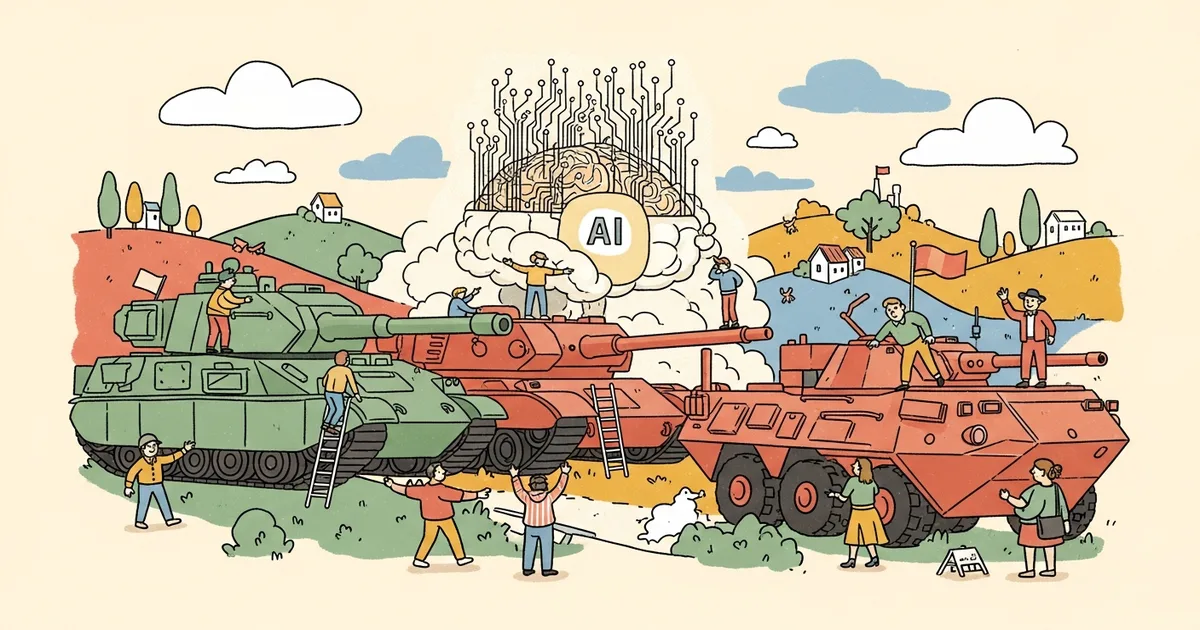
- Scout AI, co-founded in 2024 by Colby Adcock and Collin Otis, raised $100 million in a Series A round led by Align Ventures and Draper Associates, bringing total funding to $115 million.
- The company is training a military AI model called “Fury” using Vision Language Action (VLA) architecture on autonomous ATVs at an undisclosed U.S. military base in central California.
- Scout holds $11 million in government contracts from DARPA, the Army Applications Laboratory, and other DoD customers, and is one of 20 autonomy firms being tested by the U.S. Army’s 1st Cavalry Division.
- Its planned first product, “Ox,” is designed to let a single soldier issue natural language commands to control multiple drones and autonomous ground vehicles simultaneously.
What Happened
Scout AI, a defense-focused AI startup co-founded in 2024 by Colby Adcock and CTO Collin Otis, announced on April 29, 2026 that it has raised $100 million in a Series A round led by Align Ventures and Draper Associates. The round follows a $15 million seed raise completed in January 2025, bringing total disclosed funding to $115 million. The company describes itself as a “frontier lab for defense” and is currently training AI models to operate autonomous military all-terrain vehicles at an undisclosed U.S. military base in central California, which TechCrunch visited exclusively.
Why It Matters
Scout is among a new class of defense AI startups applying large language model architectures to military robotics — a domain where conventional rule-based autonomy systems have historically struggled with unpredictable terrain and dynamic environments. The company is one of 20 autonomy firms whose technology is being evaluated by the U.S. Army’s 1st Cavalry Division during its standard training cycle at Fort Hood, Texas, with that unit expected to deploy in 2027. Competitors Field AI and Overland AI were both spun out of DARPA’s RACER high-speed off-road autonomy program; Scout participated in RACER as well.
Technical Details
Scout’s core model, called “Fury,” is built atop existing large language models using Vision Language Action (VLA) architecture — a robotics-control approach first introduced by Google DeepMind in 2023 and subsequently adopted by startups including Physical Intelligence and Figure AI, the humanoid robotics company led by Colby Adcock’s brother Brett. VLAs translate visual inputs and natural language instructions into physical machine actions. “If I handed you the controller of a drone right now and I strapped a headset on you, you could learn to fly that thing in minutes,” Otis, a former engineer at autonomous trucking firm Kodiak, told TechCrunch. “That’s the way to think about VLAs and why they’re such an unlock.”
Training takes place at Scout’s internal range, called “Foundry,” where former soldiers run eight-hour driver shifts in autonomous ATVs over steep hills, loose sand, and narrow unmarked trails, logging human takeover events through a reinforcement learning feedback loop. The program has run for approximately six weeks as of publication. During a 6.5 km autonomous test loop observed by TechCrunch, the vehicle demonstrated lane-hugging on wide trails, center-line tracking on narrow ones, and speed reduction when encountering ambiguous intersections — though full off-road capability has not yet been demonstrated.
Who’s Affected
The near-term operational application is automated military resupply: carrying water or ammunition to distant observation posts, or enabling convoys where one crewed truck leads six to ten autonomous followers. Brian Mathwich, an active-duty infantry officer serving as a military fellow at Scout, cited a recent Alaska exercise conducted in total darkness as a scenario where autonomous resupply would have provided direct value. Scout’s planned first product, “Ox,” bundles command-and-control software with hardened hardware — including GPUs, cameras, and communications gear — to allow a single soldier to direct multiple autonomous ground vehicles and drones via prompts such as “Go to this waypoint and watch for enemy forces.”
What’s Next
Scout expects “Ox” to be its first widely deployed product. Stuart Young, a former DARPA program manager who managed the RACER ground vehicle autonomy program before joining Field AI this month, stated that VLA technology is “good enough to be doing that experimentation in the field with soldiers to figure out how to most be effective to U.S. forces.” The 1st Cavalry Division’s 2027 deployment represents the first potential real-world operational context for Scout’s systems. The company has also stated plans to move into autonomous weapons applications following its initial logistics-focused deployments.