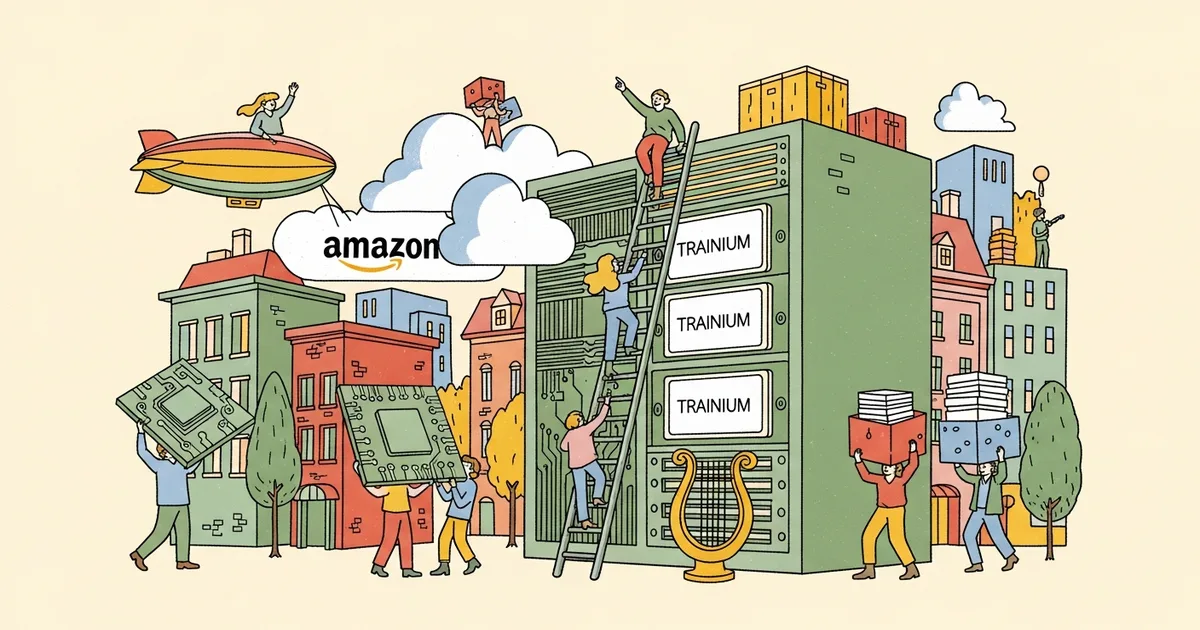
Amazon (NASDAQ: AMZN) announced a $5 billion investment in Anthropic on April 25, 2026, pushing Amazon’s total commitment to the Claude-maker to $9 billion — the largest single-investor stake in any frontier AI lab. The deal includes expanded access to Amazon’s custom Trainium 2 chips, a hardware provision that may matter more than the equity check for Anthropic’s long-term compute economics.
This is not passive capital at work. Amazon is embedding Anthropic inside AWS infrastructure at a depth that changes the competitive calculus for every enterprise customer evaluating AI platform choices in 2026.
What the Amazon Anthropic Billion Investment Actually Means
Amazon’s relationship with Anthropic started in 2023 with an initial investment, expanded in 2024, and now totals $9 billion across multiple tranches. The latest $5 billion round — reported by Yahoo Finance — arrives as Anthropic is simultaneously navigating valuation discussions reportedly placing the company at $800 billion or more.
For comparison, Google has committed approximately $2 billion to Anthropic, primarily structured around Google Cloud infrastructure credits. Combined outside institutional investment now exceeds $11 billion in a company that has never disclosed public revenue figures. The concentration of Amazon’s position — $9 billion versus Google’s $2 billion — makes this a controlling strategic relationship, not a diversified portfolio allocation.
What matters is the operational mechanism attached to the capital. Anthropic’s API access, model hosting, and training infrastructure increasingly route through AWS. The investment deepens that dependency — and gives Amazon the first credible claim on Anthropic’s enterprise distribution.
Trainium Is the Real Prize, Not the Equity
Buried inside most coverage of this deal is the chip access provision. Amazon’s Trainium 2 accelerator — designed specifically for large-scale AI training workloads — is AWS’s direct answer to NVIDIA’s H100 and H200 GPUs. Until this investment, Trainium’s external production adoption was minimal.
Training frontier-class models costs between $50 million and $200 million per run at current NVIDIA GPU market rates, based on training compute analyses from Epoch AI, an AI research organization that tracks compute trends across frontier labs. Anthropic trains Claude models at a scale where compute cost is the primary constraint on iteration speed. Expanded Trainium access is compute insurance — and potentially the difference between training two model generations per year or three.
NVIDIA’s dominance in AI silicon is a pricing liability for every lab that relies on it. AWS, Google (TPUs), and Microsoft (Project Maia) are all building proprietary accelerators precisely because GPU dependency is an existential supply-chain risk. Anthropic becoming Trainium 2’s first major external production customer validates AWS silicon at a scale no internal AWS application has demonstrated — and that validation is worth more to Amazon than any equity return.
CoreWeave, Fluidstack, and the Multi-Cloud Compute Strategy
Anthropic has not concentrated all its compute with one vendor. Active agreements with CoreWeave — the NVIDIA-backed GPU cloud provider that completed its IPO in March 2025 — and Fluidstack, a distributed compute aggregator, provide GPU-dense inference capacity and geographic redundancy that AWS Trainium clusters cannot yet match at scale.
The emerging compute architecture is intentionally fragmented: Trainium for large training runs where AWS pricing offers structural advantages, CoreWeave for NVIDIA GPU inference and fine-tuning, and Fluidstack for burst capacity on distributed workloads. MegaOne AI tracks 139+ AI tools across 17 categories, and compute diversification has become a universal strategy among frontier lab operators — a deliberate hedge against supply shocks and vendor pricing leverage.
This mirrors the rationale behind Nebius’s $10 billion AI data center buildout in Finland, where supply-chain independence from US-controlled GPU infrastructure was cited explicitly as the primary strategic motivation — not proximity to customers.
OpenAI‘s CRO Called Anthropic’s AWS Demand “Staggering”
The clearest competitive intelligence on this deal came not from Amazon or Anthropic, but from OpenAI. Internal communications widely reported as the “Dresser memo” included OpenAI’s Chief Revenue Officer acknowledging that Anthropic-AWS enterprise demand was “staggering.”
That phrase — from a competitor’s own internal document — signals that Anthropic’s enterprise revenue through AWS Marketplace and direct Claude API sales has reached a scale that OpenAI’s commercial team considers a primary threat, not a niche competitor. The memo’s context was examined alongside other strategic documents revealing OpenAI’s growing anxiety about enterprise AI market share entering 2026.
Amazon investing another $5 billion into the company whose enterprise demand its chief rival finds “staggering” is a calculated amplification of a competitive advantage that already exists — not a speculative bet on a future one.
Amazon Is Betting More on Anthropic Than on Its Own Alexa AI
Amazon has spent billions on Alexa AI development over the past three years — including the Alexa+ generative AI rebuild announced in 2024. The product has not delivered the market position Amazon anticipated. The company’s investor communications in 2025 acknowledged that Alexa monetization had underperformed expectations, and Alexa’s third-party developer ecosystem remains far below its 2019 peak activity levels.
The capital allocation logic is direct. Amazon has committed $9 billion to an external AI lab while its own flagship consumer AI assistant has ceded ground to Google Assistant and Apple Intelligence. Amazon’s implicit conclusion: Anthropic will generate more AWS revenue and compute-infrastructure credibility than any model Amazon could build internally.
This is not a failure of internal ambition. It is a $2 trillion company correctly identifying that its moat is infrastructure and distribution — not foundation model architecture. Amazon doesn’t need to win the model race. It needs frontier model winners to run on AWS.
The 0 Billion Valuation and Its Structural Logic
An $800 billion valuation for Anthropic — if confirmed in its current funding round — would place it among the most valuable private companies ever, exceeding most Fortune 100 firms by market capitalization. The number appears detached from conventional revenue multiples, but its structural logic is defensible on two grounds.
First, there are effectively four frontier model providers operating at global commercial scale: OpenAI, Google DeepMind, Anthropic, and Meta AI. Scarcity at that tier commands extraordinary premiums. Second, when the world’s largest cloud provider has committed $9 billion and has direct commercial incentive to route enterprise AI spend through Anthropic-powered AWS services, the revenue projection is less speculative than it appears from outside.
Anthropic’s ability to maintain strategic investment relationships with both Amazon and Google simultaneously — something no other frontier lab has managed — is positioning the company has worked to cultivate carefully, even through operational turbulence. Dual cloud patron status reduces platform dependency risk in a way that makes enterprise procurement decisions significantly easier for Anthropic’s sales team.
What to Watch in Q3 2026
The Trainium integration timeline is the most actionable near-term signal from this deal. Anthropic publicly confirming Trainium-trained model variants by Q3 2026 would validate AWS silicon at frontier scale and immediately trigger procurement conversations at enterprises currently locked into NVIDIA GPU reservation agreements.
The second signal is AWS Marketplace revenue attribution. Amazon has direct commercial incentive to route Claude API access through Marketplace channels — which count against customers’ existing AWS committed spend agreements. That mechanism converts Anthropic enterprise sales into an AWS-native sales motion, turning $9 billion in equity into a force multiplier on cloud infrastructure revenue rather than a standalone financial position.
Trainium benchmark disclosures and AWS Marketplace pricing updates in Q3 2026 will confirm whether this investment is delivering on its compute infrastructure thesis — or whether Amazon is paying $9 billion to ensure that Anthropic doesn’t run its next model generation on Azure.