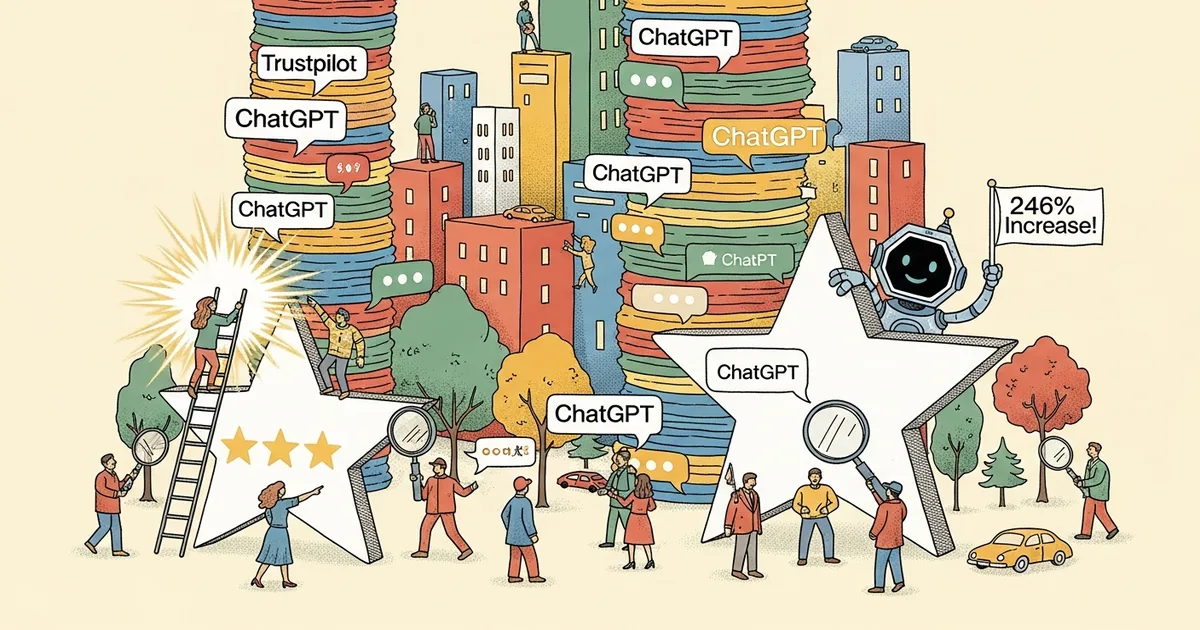
Trustpilot, the Denmark-based consumer review platform founded in 2007, recorded a 246% surge in ChatGPT citations between June and August 2025 — and by January 2026, it ranked as the fifth most-cited external page across ChatGPT responses globally. The catalyst is a statistic that reframes every brand’s digital strategy: 58% of consumers now use generative AI tools to research products and services before purchase. For marketers still optimizing for click-through rates, that number is a structural warning.
The Data Behind the 246% Citation Surge
Trustpilot’s citation surge in ChatGPT is one of the clearest documented signals that answer engine optimization (AEO) has moved from theoretical framework to measurable commercial outcome. The 246% increase in just three months — June through August 2025 — represents one of the sharpest citation spikes recorded for any consumer-facing platform during that period, according to Trustpilot’s own traffic and referral analysis.
The mechanism is structural. ChatGPT and competing large language models like Perplexity and Google Gemini prioritize structured, third-party, evidence-dense content when constructing answers about brands and products. Trustpilot pages deliver exactly that architecture: named reviewers, verified purchase status, star ratings, specific complaint and praise data, company response timestamps, and aggregate scoring. A brand’s owned homepage — however well-optimized for traditional SEO — lacks every one of these signals.
By January 2026, Trustpilot’s position as the fifth most-cited page placed it ahead of most mainstream news outlets and substantially ahead of brand-owned content in product recommendation queries.
58% of Consumers Are Asking AI Before They Buy
The demand side of this shift is accelerating faster than most brand teams have anticipated. Trustpilot’s 2025 consumer research found that 58% of consumers use generative AI tools — ChatGPT, Perplexity, Google Gemini — when researching products and services before making a purchase decision. That figure represents a consumer behavior shift that reached majority penetration in under three years.
These are not casual queries. Consumers are posing specific purchase questions: “Is [brand] reliable?”, “What do customers say about [product]?”, “Which [category] should I buy?” The AI synthesizes a verdict — citing Trustpilot as primary evidence — and delivers it directly. The consumer acts without ever reaching the brand’s homepage, paid ads, or SEO-optimized landing pages.
As AI has permeated consumer applications across every category, from utility tools to product discovery, the channel through which brands communicate with prospective customers has shifted upstream. The intermediary is no longer a search engine. It is a language model with citation preferences.
Why Review Platforms Are Built for Answer Engines
Large language models are not neutral about what they cite. Research into LLM citation behavior consistently identifies three dominant signals: named sources (specific people, verified buyers), quantified claims (star ratings, percentages, concrete feedback), and recency (content updated within the last 90 days). Review platforms hit all three at scale.
Trustpilot’s structural advantage is not accidental. Its pages combine high review volume, reviewer-specific attribution, consistently updated content that triggers freshness signals, and third-party independence — the critical factor being that no brand controls the page. LLMs treat independently-hosted review content as evidentiary, not promotional.
The same pattern holds across verticals. G2 and Capterra dominate B2B software recommendation queries. Yelp outperforms brand-owned content in local service searches. Glassdoor shapes employer reputation responses. The consistent winner in every category is the platform built around structured, third-party, evidence-dense content with named attribution.
What Answer Engine Optimization Actually Requires
AEO is not SEO with a new acronym. The mechanics diverge fundamentally. SEO optimizes for crawlers that rank pages and deliver clicks. AEO optimizes for language models that synthesize information into direct verbal answers — no click required, no conversion tracking possible. A top-ranked SEO page generates visits. A top-cited AEO page generates verdicts.
The core AEO playbook for brand managers in 2026 centers on five priorities:
- Review volume and recency: ChatGPT and Perplexity weight recent, high-volume review data. A brand with 3,000 Trustpilot reviews updated in Q1 2026 outperforms one with 500 reviews from 2022, regardless of average rating.
- Entity consolidation: Every reference to a brand across the web should use the full legal name or primary identifier consistently. LLMs aggregate entities — inconsistency creates retrieval noise that reduces citation frequency and accuracy.
- Public response metadata: Dated, public company responses to reviews signal accountability. LLMs parse these as behavioral evidence about how a brand operates — a material input into recommendation synthesis.
- Structured data on owned properties: Schema.org AggregateRating, Review, and FAQPage markup makes brand content directly parseable to models with real-time retrieval capability. Low implementation cost, widely underdeployed.
- Third-party corroboration: Citations compound. A brand mentioned consistently across Trustpilot, industry press, and structured directories receives substantially higher citation frequency than one referenced in isolation — named sources get cited measurably more often than anonymous content.
OpenAI’s Content Architecture Is Cementing the Transition
The structural reasons for Trustpilot’s citation surge are being reinforced by OpenAI’s expanding content infrastructure. OpenAI’s reported $1 billion content licensing agreement and a growing portfolio of similar partnerships signal that ChatGPT is building real-time retrieval into its architecture as a core function, not an experimental feature. The platforms whose content is licensed, retrieved, or structurally compatible with LLM consumption will dominate citation share going forward.
This is not a static competitive landscape. As OpenAI integrates deeper retrieval and more structured data partnerships, the citation environment will become simultaneously more competitive and more predictable. Brands establishing strong, consistent review profiles in 2026 are building a citation moat. Brands delaying are ceding it.
The emerging category of autonomous AI discovery agents will amplify this effect further — systems designed to research and recommend will preferentially draw from the same structured, third-party sources that currently lead in LLM citations.
The Competitive Reset: Winners and Casualties
Trustpilot’s 246% citation surge represents a competitive reset, not an incremental shift. Brands that have actively managed their review presence — soliciting reviews consistently, responding publicly, maintaining content recency — are receiving citation dividends they did not specifically plan for. Brands that treated review platforms as low-priority customer service channels are finding themselves absent from AI-generated product recommendations.
As consumers increasingly route purchase research through AI systems rather than search engines or peer networks, the third-party review ecosystem has become the primary front line of brand perception. Not the homepage. Not paid social. Third-party reviews that AI systems cite directly and verbatim in response to purchase queries.
MegaOne AI tracks 139+ AI tools across 17 categories. The brands and platforms gaining citation share in 2026 share a consistent architecture: structured, third-party, named-source content with high recency signals. Trustpilot at 246% growth is the headline — the underlying pattern applies to every review platform and structured directory in the ecosystem.
What Brands Must Do in the Next 90 Days
Three immediate, measurable actions for any brand with a commercial digital presence:
Audit your third-party review footprint. Pull current data from Trustpilot, Google Business Profile, G2, and any category-specific review platforms. Identify recency gaps — no new reviews in 90+ days — and response gaps: unanswered reviews sitting on the page. Both are negative signals in LLM retrieval weighting.
Implement structured data on owned properties. Add AggregateRating and FAQPage schema markup to product and service pages. This requires minimal development time and directly increases the probability of citation in AI-generated answers that include real-time retrieval.
Consolidate your entity graph. Audit Wikidata, Crunchbase, LinkedIn company pages, and industry directories for name consistency and data completeness. Fragmented or inconsistent entity data is the single most commonly overlooked factor in poor AEO citation performance.
The measurement framework needs to evolve alongside the tactics. Click-through rate is an SEO metric. The AEO equivalent is citation frequency — how often AI systems reference a brand when answering relevant purchase queries. Monitoring capability for this metric now exists across Perplexity’s API and dedicated AEO tracking services.
Every brand with a commercial digital presence is now operating in a marketplace where 58% of purchase research runs through AI systems that cite third-party reviews as primary evidence. The 246% Trustpilot surge is the data point. The takeaway is operational: treat review presence as an AEO asset, build it systematically, and measure it accordingly. The brands that do will own the answer.