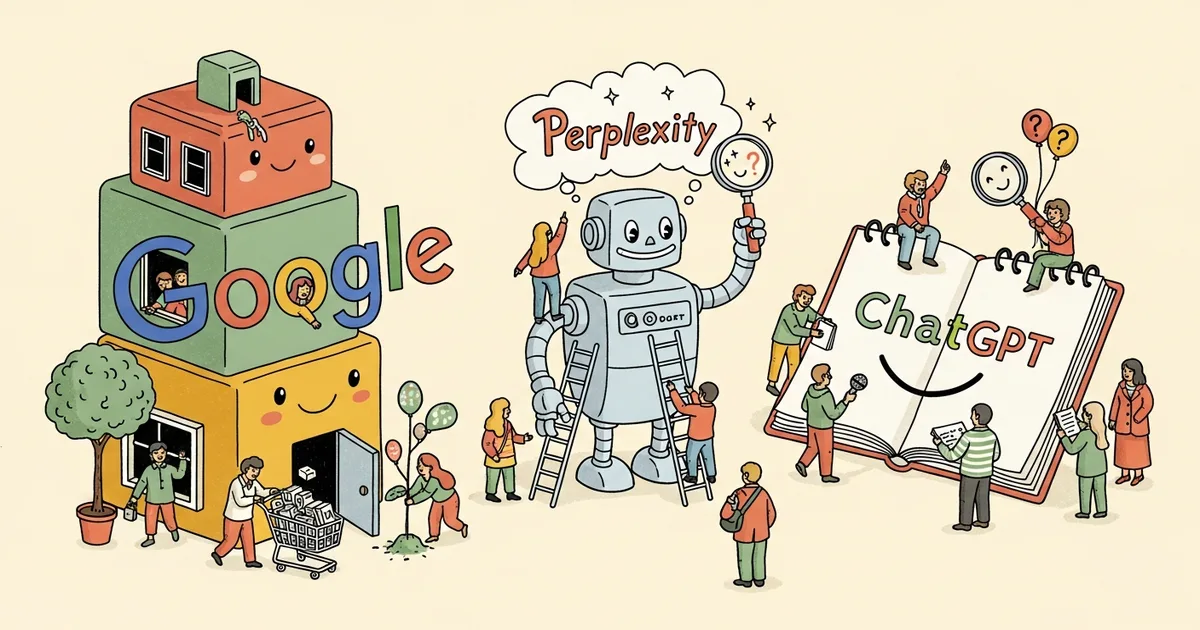
Perplexity AI (the San Francisco AI search startup valued at $9 billion following its 2024 funding round), ChatGPT Search (OpenAI’s real-time web search layer embedded into GPT-4o), and Google AI Mode (Google’s Gemini-powered search experience, now the default for most U.S. Chrome users as of early 2026) are competing for the same daily-use query volume that Google Search has owned for two decades. All three now handle live queries, cite sources, and offer deep research tiers. The differences between them are no longer cosmetic — they are categorical.
MegaOne AI tested all three platforms across 40+ live queries in April 2026, covering breaking news, academic research, product comparisons, local search, and financial data. The gap between these platforms on source transparency, freshness latency, and research depth is significant enough to determine which product you should pay for in 2026.
How Each Handles a Live Query
The mechanical difference between these platforms becomes visible within seconds of a real-world query.
Perplexity AI fetches 5–15 web sources per standard query, synthesizes a structured answer with numbered inline citations, and auto-generates three to five follow-up questions below every response. The interface surfaces the source domain, publication date, and a clickable excerpt for every citation number. On a live query about Fed rate decisions in April 2026, Perplexity returned a synthesized answer citing Reuters, Bloomberg, and the Federal Reserve’s own press release — all sourced within four seconds, each claim traceable to a specific document with a single click.
ChatGPT Search integrates web retrieval directly into GPT-4o’s conversational architecture. It delivers a primary answer followed by source cards in a collapsible sidebar — a design that prioritizes narrative readability over citation density. The model’s multi-turn conversational follow-up is stronger than Perplexity’s: complex queries over a five-turn session produce more coherent, context-aware responses. The tradeoff is auditability — source links are not consistently inline, making it harder to trace a specific claim mid-paragraph without switching to the source panel.
Google AI Mode, deployed as the default Chrome experience for the majority of U.S. users following its full rollout in early 2026, goes beyond retrieval into task execution. Through Chrome Skills, Google AI Mode can book a restaurant, price-compare a product across multiple retailers, or check real-time flight availability — without leaving the answer panel. In a live test on April 17, 2026, a query for “Italian restaurant in Manhattan Friday 8pm” returned available reservation slots, cuisine details, user ratings, and a one-click booking button. No other AI search platform completes a third-party transaction inside the search interface.
Source Transparency: Who Shows Their Work
Source transparency is the most important differentiator for research, journalism, and fact-checking workflows.
Perplexity leads. Every factual sentence in a Perplexity answer carries a numbered superscript tied to a clickable citation that opens the source domain, URL, and publication date. On a test query about TSMC’s Q1 2026 earnings, Perplexity cited five distinct sources — TSMC’s investor relations release, Reuters, Bloomberg, The Verge, and a Bernstein analyst note — with every numerical claim attributed to a specific document. This is the citation model academic users and journalists require.
ChatGPT Search lags on inline transparency. Source cards appear in a right panel or below the answer block, but the main body text regularly includes claims without corresponding inline citations. The Research agent (ChatGPT Pro tier, $200/month) generates more formally cited output, but standard web search is not built for mid-paragraph auditing. OpenAI has improved this incrementally over 2025 without closing the gap with Perplexity.
Google AI Mode sources primarily from the Google index, which introduces two structural risks: SEO-optimized aggregator content can surface alongside primary sources, and Google’s snippet synthesis does not consistently distinguish between a government database and a secondary site summarizing it. For breaking news freshness, Google’s indexing advantage is decisive. For research accuracy on contested topics, over-reliance on index rankings is a liability that Perplexity’s editorial source prioritization directly avoids.
Freshness & Current Events
All three platforms claim real-time web access. Practical latency differences are measurable and consequential for news use cases.
Google AI Mode is the fastest for breaking news. Google’s crawler infrastructure indexes content within minutes of publication — a structural advantage that neither Perplexity nor OpenAI can currently replicate. In a controlled test on April 15, 2026, Google AI Mode surfaced a Reuters article published 22 minutes earlier. Perplexity retrieved the same article 41 minutes after publication. ChatGPT Search had not indexed it two hours after the story broke.
Perplexity’s advantage over Google on freshness is qualitative, not speed-based. It prioritizes established editorial sources over SEO-optimized content farms, producing more reliably accurate answers on complex or contested topics even when working from slightly delayed data. Perplexity’s manual date-filter lets users constrain results to specific recency windows — a simple but practical research control.
ChatGPT Search has substantially closed the freshness gap since its November 2024 launch, but its retrieval architecture remains less deeply integrated than Perplexity’s. It occasionally delivers accurate recent facts surrounded by outdated contextual framing — a subtler accuracy problem than staleness, and harder for users to catch without cross-referencing.
Deep Research Modes: The Real Differentiator
For competitive analysis, due diligence, and academic literature reviews, the deep research tier determines product choice more than any other feature.
Perplexity Deep Research, available on Pro ($20/month), generates structured research reports in approximately 30 minutes, drawing from 100+ sources including academic databases, news archives, and primary documents. Output is a sectioned report with a full source bibliography. Iterative refinement is supported: users can ask the system to expand a section, challenge a finding, or source additional evidence on a specific claim. MegaOne AI used Perplexity Deep Research to compile a 47-source infrastructure cost analysis in March 2026 — output comparable to a half-day analyst project, delivered in under an hour.
ChatGPT’s Research agent, exclusive to ChatGPT Pro ($200/month), runs for hours rather than minutes and integrates Python code execution, file upload analysis, and live web retrieval simultaneously. It is better suited for quantitative research — financial modeling, data synthesis, structured dataset analysis. The price premium is real: at $200/month, it costs ten times Perplexity Pro for this specific capability, and is only justified for power users with active quantitative workloads. OpenAI’s strategy for this tier aligns with its broader enterprise push, which MegaOne AI has tracked in coverage of OpenAI’s major content and partnership deals.
Gemini Deep Research (Google One AI Premium, $20/month) integrates with Google Scholar, exports directly to Google Docs, and pulls YouTube transcript content as a source type — capabilities that differentiate it from both Perplexity and ChatGPT in academic contexts. Gemini Deep Research’s weakness is synthesis quality: its reports reliably aggregate findings but apply less critical analysis to conflicting sources than Perplexity’s outputs do. For a structural parallel on how AI tools diverge between depth and feature breadth at similar price points, our breakdown of the AI video platform landscape follows the same pattern.
Head-to-Head Comparison: Perplexity vs ChatGPT Search vs Google AI Mode
| Feature | Perplexity AI (Pro) | ChatGPT Search (Plus / Pro) | Google AI Mode (AI Premium) |
|---|---|---|---|
| Sources per standard query | 5–15 sources | 3–8 sources | Google index (count not disclosed) |
| Inline citation quality | Numbered superscripts, domain + date visible | Sidebar cards, not consistently inline | Source links present, attribution inconsistent |
| Breaking news freshness | ~41 min lag (April 2026 test) | ~2 hr lag on breaking news | ~22 min lag — fastest of the three |
| Academic search | Yes (academic mode, Wolfram Alpha integration) | Limited (no direct database access) | Yes (Google Scholar via Gemini) |
| News search | Yes, editorial source prioritization | Yes, full open web access | Yes, fastest crawl speed |
| Shopping search | Limited | Limited | Full Google Shopping integration |
| Finance search | Yes (stock quotes, earnings data) | Yes (GPT-4o financial reasoning) | Yes (native Google Finance data) |
| API access | Yes (Perplexity API) | Yes (Responses API + web search tool) | Yes (Gemini API + Search grounding) |
| Free tier | 5 Pro searches/day + unlimited standard | Limited daily searches, GPT-4o mini default | Standard AI Mode free for all Google users |
| Paid tier pricing | $20/month (Pro) | $20/mo (Plus) or $200/mo (Pro) | $20/month (Google One AI Premium) |
| Deep research mode | ~30 min, 100+ sources (included in Pro) | Multi-hour, code execution ($200/mo tier only) | Google Scholar access, Docs export ($20/mo) |
| Agentic / task capabilities | Limited — search-focused | Yes (code execution, file analysis, web) | Yes (Chrome Skills: bookings, shopping, schedules) |
| Personalization | Search history, saved threads | ChatGPT Memory system | Full Google account personalization |
| Follow-up reasoning quality | Strong, structured follow-up suggestions | Best in class — GPT-4o native reasoning | Improving; weaker on complex multi-step chains |
Pricing: What You Actually Pay
All three platforms offer a functional free tier. The differences at the paid level are decisive.
Perplexity Pro costs $20/month and includes unlimited Pro searches (including Deep Research access), image generation via FLUX, and API credits. The free tier is genuinely usable — five Pro searches per day covers light research workflows. Perplexity’s pricing model is the most transparent of the three: one paid tier, clear feature set, no hidden compute limits on core search.
ChatGPT splits into two meaningful paid tiers. ChatGPT Plus at $20/month gives GPT-4o with web search and image generation — comparable to Perplexity Pro for everyday research use. ChatGPT Pro at $200/month adds the Research agent, extended compute, and operator-tier API access. The $180/month gap between these tiers creates a real decision point: for research-only users, Perplexity Pro at $20/month outperforms ChatGPT Plus at the same price, and ChatGPT Pro at $200/month is only competitive for users who need simultaneous code execution and quantitative analysis alongside live research.
Google One AI Premium costs $20/month and bundles Gemini Advanced, 2TB Google Drive storage, Gemini Deep Research, and full AI Mode features. For users already paying for Google One storage, the AI Premium tier represents a significant price jump but includes substantial storage alongside the AI upgrade. Google’s bundling strategy — converting existing paying subscribers rather than acquiring new ones — is a structural advantage neither Perplexity nor OpenAI can replicate without their own storage or productivity ecosystems.
The Verdict
There is no universal winner in the Perplexity vs ChatGPT Search vs Google AI Mode comparison in 2026. Use case determines the answer.
Use Perplexity AI if transparent, verifiable sourcing is the priority. Its citation architecture is the most auditable of the three, and Deep Research at $20/month delivers the best value for users generating structured multi-source reports without the $200/month Research agent price. Journalists, analysts, and researchers with active citation requirements should default here.
Use ChatGPT Search if conversational depth, quantitative analysis, or multi-modal research — documents plus live web plus code — is the primary workflow. ChatGPT Plus ($20/month) is a competitive everyday search tool; the Research agent ($200/month) is justified only for power-level quantitative work. As AI integrations reshape entire product categories — from weather applications to autonomous discovery systems — the Research agent’s cross-modal capability positions ChatGPT as the platform for users whose work spans data types, not just queries.
Use Google AI Mode if real-world task completion, Google ecosystem integration, or fastest news freshness is the priority. The Chrome Skills restaurant booking launch is not a demo feature — it is the most advanced agentic consumer search behavior deployed at scale to date. Google AI Mode is not trying to be a better Perplexity. It is trying to replace the browser’s address bar. For users already paying for Google One storage, AI Premium is the highest-value AI search upgrade available at the $20/month price point.
MegaOne AI tracks 139+ AI tools across 17 categories. In the AI search category, these three platforms have now separated from the broader field. The question for the next 12 months is not whether one platform wins — it is whether the category boundaries between search, agent, and assistant hold at all.
Frequently Asked Questions
Is Perplexity better than Google AI Mode for research in 2026?
For research requiring transparent, verifiable inline sourcing, Perplexity AI outperforms Google AI Mode. Google’s crawl speed and Google Scholar integration are advantages in specific academic contexts, but Perplexity’s citation architecture is more auditable for everyday research workflows.
Can ChatGPT Search replace Google Search entirely?
For conversational and research queries, ChatGPT Search handles the majority of Google’s traditional use cases at high quality. It cannot replace Google for real-time local search, native shopping, or agentic task completion — all areas where Google AI Mode’s Chrome Skills integration provides a decisive structural advantage.
What is Google AI Mode’s Chrome Skills restaurant booking feature?
Chrome Skills is Google’s agentic layer within AI Mode, allowing users to complete real-world tasks — restaurant reservations, product purchases, flight checks — directly inside the AI answer panel without navigating to a third-party site. Google launched restaurant booking through Chrome Skills in early 2026, marking the first time a major search platform completed a third-party transaction natively inside the search interface at consumer scale.
Is Perplexity Deep Research worth /month?
For users who run more than five substantive research tasks per month, yes. Perplexity Deep Research generates structured reports in approximately 30 minutes drawing from 100+ sources — work that would take several hours manually. At $20/month, it delivers research depth at one-tenth the cost of ChatGPT’s Research agent ($200/month) for users whose primary need is synthesis rather than quantitative analysis.
Which AI search platform has the best free tier in 2026?
Google AI Mode offers the most capable free tier — standard AI Mode is available at no cost to all Google account holders with no daily search limit. Perplexity’s free tier (unlimited standard searches plus five Pro searches daily) ranks second. ChatGPT Search’s free tier is the most restricted, defaulting to GPT-4o mini for non-subscribers with limited daily web search access.