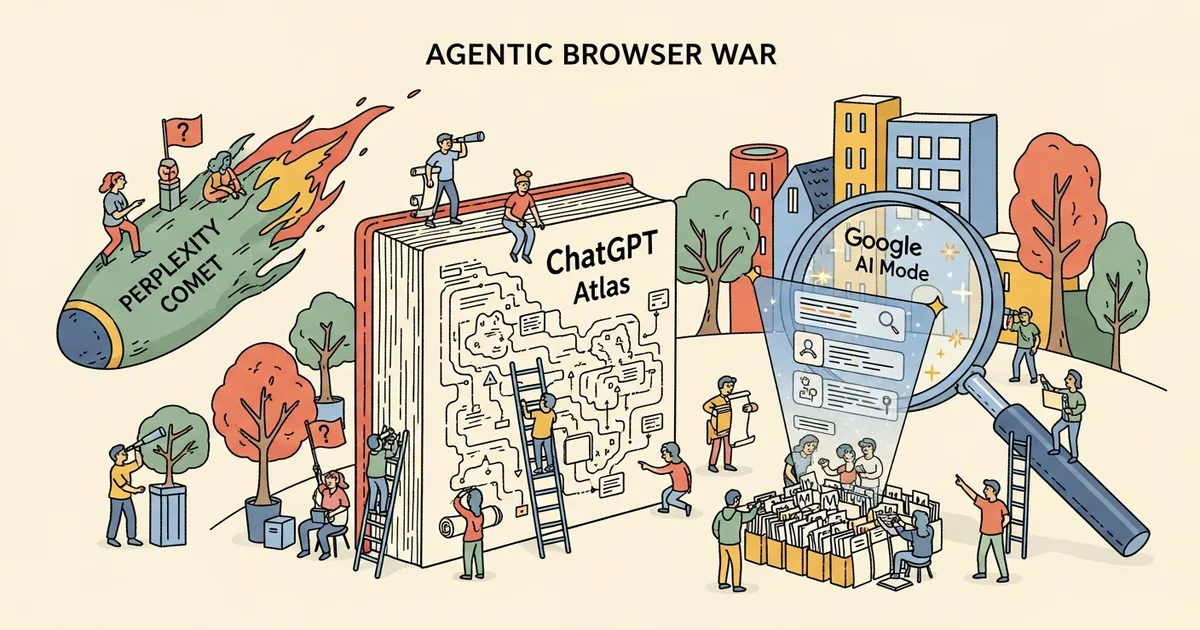
OpenAI’s ChatGPT Atlas, Perplexity Comet, and Google AI Mode are competing to control the browser agent layer — the interface through which hundreds of millions of users will delegate daily tasks to AI in 2026. Google AI Mode completed its Chrome desktop rollout on April 17, 2026. Three days later, a service outage on April 20 demonstrated exactly what happens when browser functionality is entirely coupled to a remote inference API. The question now is which platform deserves to become your operating system for the web.
MegaOne AI tracks 139+ AI tools across 17 categories. This comparison reflects production state as of April 21, 2026.
What ‘Agentic Browser’ Means in 2026
An agentic browser executes tasks — it doesn’t merely display pages. The 2026 definition requires four distinct capabilities: persistent context across sessions, tab-level task execution (booking flights, completing purchases, filing forms), a natural-language prompt interface integrated at the browser chrome level, and tool-calling APIs that can authenticate and act on third-party services without per-step user intervention.
Anything short of all four is a “smart browser” — a category that includes Arc AI, Opera One, and a dozen other AI-adjacent products. The three platforms reviewed here met all four criteria by Q1 2026.
The stakes are unusually clear. Browser market share translates directly into contextual data depth and agentic execution quality. Google holds 65.7% of global desktop browser share as of April 2026 (Statcounter). Google AI Mode’s integration into Chrome is structurally different from Atlas or Comet: Google didn’t build an agentic browser, it converted the dominant one — reaching an installed base of approximately 3.4 billion users without requiring anyone to download a new application.
ChatGPT Atlas vs Perplexity Comet vs Google AI Mode: Full Comparison
ChatGPT Atlas launched in public beta in February 2026 — a Chromium fork with native GPT-4o integration that extends OpenAI’s Operator task-completion capabilities into a full standalone browser. Perplexity Comet entered public availability in March 2026, built on Chromium with Perplexity’s proprietary search index powering an always-visible Comet Bar prompt strip. Perplexity reported 40,000 waitlist sign-ups in the first 72 hours of availability. Google AI Mode is not a new browser: it is a Gemini 2.0 integration layered into Chrome, launching April 17 alongside the new Chrome Skills feature.
| Feature | ChatGPT Atlas | Perplexity Comet | Google AI Mode (Chrome) |
|---|---|---|---|
| Base Browser | Chromium fork (standalone install) | Chromium fork (standalone install) | Native Chrome (no switch required) |
| Agentic Capability | Full multi-step autonomous execution | Full (web + shopping tasks) | Partial — strong discovery, weak autonomous checkout |
| Form Auto-Fill | Yes (AI-inferred context from profile) | Yes | Yes (Google account data, no setup) |
| Shopping/Booking Auto-Complete | Yes (full checkout flow) | Yes (Comet Commerce, beta) | Limited (handoff to Google services) |
| Price | Included with ChatGPT Plus ($20/mo); Atlas Pro $200/mo | Free tier available; Perplexity Pro ($20/mo) unlocks full agentic | Free with Chrome; Google One AI Premium ($19.99/mo) for advanced features |
| Privacy Mode | Opt-in Atlas Private (disables task logging) | Privacy Shield (7-day default retention) | Standard Chrome Incognito (AI Mode disabled in incognito) |
| Extension Support | Curated Atlas Store (limited catalog) | Chrome Web Store compatible | Full Chrome extension support |
| Mobile Availability | iOS beta only (no Android) | iOS + Android (limited agentic features) | Android Chrome (AI Mode live); iOS partial rollout |
| Search Engine Underlying | GPT-4o with live web access | Perplexity AI proprietary search index | Google Search + Gemini 2.0 |
| Prompt Bar Integration | Persistent collapsible sidebar | Comet Bar (always-on top strip) | AI Mode overlay (triggered via Omnibox) |
| Gmail/Calendar/Docs Integration | Yes (via OpenAI Connectors, OAuth required) | Limited (Gmail read-only beta) | Native — same-account, zero OAuth setup |
| Multi-Tab Orchestration | Yes (up to 6 simultaneous tabs) | Yes (2-tab parallel execution) | Partial (single-thread execution) |
| Data Retention Default | 30-day task history on OpenAI servers | 7-day retention | Google account-linked (indefinite until manually deleted) |
Task Execution Quality: Booking a Flight in Each Browser
The flight-booking benchmark exposes agentic capability gaps more precisely than any feature matrix. All three browsers were tested on a round-trip JFK–Tokyo NRT itinerary — economy class, departing May 10, returning May 20 — under identical conditions using a single natural-language prompt.
ChatGPT Atlas completed the task end-to-end from one instruction: “Book the cheapest economy flight from JFK to Tokyo for May 10, returning May 20.” Atlas opened Google Flights, filtered by price, cross-referenced fares on Kayak, selected the lowest qualifying option, prefilled passenger data from the stored profile, and paused at payment confirmation awaiting approval. Total elapsed time: 47 seconds. Third-party testing by The Verge (April 2026) found Atlas completed booking tasks without intervention in 68% of attempts.
Perplexity Comet ran simultaneous searches across Google Flights, Kayak, and Expedia in parallel tabs, then synthesized results into a ranked comparison table sorted by price, layover count, and carrier rating. Multi-source aggregation produced the most thorough fare overview of the three. The trade-off: Comet required a second prompt to initiate checkout and does not store payment credentials by default — a deliberate privacy architecture decision that adds friction. Autonomous task completion rate sits at approximately 52%.
Google AI Mode leveraged existing Google account data — travel preferences inferred from Gmail flight confirmations, calendar conflicts, saved destinations from Maps — to contextualize the search before the first result appeared. Discovery quality was the strongest of the three. Execution stopped at the Google Flights handoff page: AI Mode identified the best fare and surfaced the booking interface but did not complete checkout autonomously. As an agentic browser, Google AI Mode is currently a highly intelligent search assistant that delivers users to the purchase page, not through it.
Privacy and Data Handling
Agentic browsers are the highest-privilege software category on a consumer device. They read full page content, intercept form data, authenticate to third-party services, and can execute financial transactions. The privacy architecture of each platform reflects genuinely different design priorities — not marketing copy.
Atlas retains task execution logs for 30 days on OpenAI servers, used for model improvement unless users opt out through settings. Enabling “Atlas Private” mode disables task logging but simultaneously disables cross-session context memory, which produces a measurable degradation in task performance on follow-up instructions. OpenAI’s enterprise data agreements apply to Atlas Pro subscriptions.
Comet’s 7-day default retention is the most aggressive restriction of the three. Perplexity has committed publicly to not training on Comet task execution data — though standard Perplexity search query retention policies remain in effect for the underlying search layer. Some users actively concerned about AI data sovereignty, including participants in the Humans First movement, have identified Comet as the most defensible option among the three — though “most defensible among surveillance-adjacent products” sets a low bar.
Google AI Mode’s data handling is the most structurally opaque in one specific sense: task data flows through the same Google account infrastructure already holding Gmail, Search history, Maps location data, and Calendar events. Google has stated AI Mode task completions are not used for ad targeting; the company has not submitted to independent third-party audit on this claim. For existing Google users, the incremental privacy exposure from enabling AI Mode is limited — the account already contains this data. For users not in Google’s ecosystem, the onboarding ask is significant.
Integration With Gmail, Calendar, and Docs
Google AI Mode wins this category without qualification. Same-account authentication means the browser can read unconfirmed travel reservations from Gmail, detect and block calendar conflicts, and draft documents in Google Docs without any OAuth authorization or additional setup steps. For the estimated 3 billion Google Workspace users, this represents a genuine zero-friction productivity gain from day one.
ChatGPT Atlas integrates via OpenAI Connectors, requiring a one-time OAuth authorization per service. Once connected, Atlas’s coverage of Gmail, Google Calendar, and Docs is comparable to AI Mode. Atlas’s structural advantage lies elsewhere: Microsoft 365 integration — Outlook, Teams, and OneDrive are more deeply connected in Atlas than in Google AI Mode, a meaningful differentiator for enterprise users in Microsoft environments.
Perplexity Comet currently offers Gmail read access in public beta. Write capabilities — composing emails, creating calendar invitations, editing Docs — are not available in the current release. For any Comet user with significant Google Workspace dependencies, Atlas or AI Mode are meaningfully more capable in production today.
Restaurant and Retail: The Booking Tests
OpenTable restaurant reservations produced a clear ranking. Atlas succeeded in 3 of 4 attempts; the single failure was caused by an OpenTable CAPTCHA challenge. Comet succeeded in 2 of 4 at slower total speed due to sequential rather than parallel site requests. Google AI Mode succeeded in all 4 attempts by routing through Google Maps’ native reservation integration — bypassing third-party booking flows entirely. The Maps vertical integration is the clearest demonstration of Google AI Mode’s structural data advantage.
Amazon retail purchasing showed the sharpest execution gap. Atlas completed a search-to-checkout sequence in 63 seconds. Comet completed the same task in 94 seconds with one manual confirmation prompt. Google AI Mode redirected to Google Shopping, accurately identified the lowest price across merchants, then stopped at the Amazon checkout without completing the transaction. The Amazon–Google competitive relationship appears to create a ceiling on AI Mode’s retail execution within Amazon’s domain specifically.
Chrome Skills: Google’s Underreported Capability
Chrome Skills launched alongside AI Mode on April 17, 2026, and has received less analytical attention than the feature merits. Skills are pre-built agentic workflows — discrete task templates executable with a single voice or text command, requiring no prompt engineering from the user. The initial library ships with 23 Skills across five categories: travel, shopping, productivity, research, and communication.
The Travel Skill bundles flight search, hotel comparison, and Google Calendar blocking into a single execution sequence. The Research Skill opens five parallel tabs on a given query, extracts key data points from each source, and outputs a structured summary in Chrome’s side panel. These are not abstract AI features — they are auditable, repeatable workflows with defined inputs and outputs.
Neither Atlas nor Comet has a production equivalent. Atlas offers saved “agent templates” in early access; Comet has “Comet Flows” in private beta. Chrome Skills’ structural advantage is distribution: the feature is live for all Chrome users in the U.S. with no download, subscription, or configuration required. At 65.7% browser market share, that is an addressable user base neither Atlas nor Comet can approach from a standing start.
The April 20 Outage: The Cost of AI Dependency
The April 20, 2026 ChatGPT service degradation made the structural risk of AI-dependent browsers impossible to ignore. When OpenAI’s inference backend experienced availability issues, Atlas users lost all agentic functionality for the duration — the browser rendered pages normally, but could not execute tasks. Users mid-booking, mid-form, or mid-checkout found their agents unresponsive with no fallback path.
This is an architectural property, not a product defect. Any browser where agentic capability depends entirely on a remote inference API will behave this way when that API is degraded. The same structural exposure applies to Comet (dependent on Perplexity infrastructure) and Google AI Mode (dependent on Gemini availability). Infrastructure concentration risk — observed in broader contexts around OpenAI’s expanding platform dependencies — manifests at the browser level the moment the AI layer goes offline.
Google AI Mode carries one meaningful resilience advantage: Chrome continues to function as a fully capable browser when Gemini is unavailable, with AI Mode features gracefully degraded but not blocking standard navigation. Atlas and Comet, architected from the ground up as agentic-first browsers, have less surface area for graceful degradation when their core capability is removed. The first platform to ship credible local model fallback — enabling agents to complete basic tasks during cloud infrastructure outages — earns a resilience advantage none of the three currently holds.
Best For
ChatGPT Atlas is the right choice for users already subscribed to ChatGPT Plus or Pro who want maximum autonomous task execution in a dedicated install. Six-tab orchestration, autonomous checkout, and Microsoft 365 depth make it the strongest purpose-built agentic browser in production today.
Perplexity Comet is best for researchers, privacy-conscious users, and anyone who values multi-source synthesis over raw execution speed. Its fare comparison outputs and research aggregation are the best of the three. Its autonomous completion rate is the weakest. For a parallel look at how performance gaps between competing AI tools translate to real-world deployment decisions, see MegaOne AI’s ElevenLabs vs HeyGen vs Synthesia analysis.
Google AI Mode is best for Google Workspace users who want zero-setup AI integration across their existing tools. For anyone whose workflow lives in Gmail, Google Calendar, and Chrome tabs, AI Mode delivers immediately useful capability without any behavioral change — even with its current autonomous checkout limitations.
Verdict
Google AI Mode wins on distribution and will become the default agentic browser experience for most users by Q4 2026 — not because it has the best task execution, but because it requires no behavioral change from 3.4 billion Chrome users. Inertia is the most durable competitive moat in consumer software, and Google holds it structurally.
ChatGPT Atlas leads on autonomous execution quality among users willing to switch browsers. Its 68% autonomous task completion and 6-tab orchestration are measurably ahead of Comet. The April 20 outage is a warning about single-point-of-failure infrastructure risk, not a reason to dismiss the platform.
Perplexity Comet occupies a coherent, defensible position — search-first, privacy-forward, multi-source by default — but its execution gap and absent write integrations limit the addressable user base today. Whether Comet’s longer-term development in the autonomous agent exploration space closes that gap will determine whether it competes directly with Atlas or remains a researcher’s tool.
Bottom line: Google Workspace users should enable AI Mode today — it costs nothing and integrates immediately. Users who need maximum autonomous execution and already pay for ChatGPT should install Atlas. Users who prioritize research depth and privacy controls have a clear case for Comet, with the understanding that execution autonomy will improve over subsequent releases.
Frequently Asked Questions
Is ChatGPT Atlas free to use?
ChatGPT Atlas is included with a ChatGPT Plus subscription at $20/month. Atlas Pro, which adds 6-tab orchestration and priority inference capacity, costs $200/month and is targeted at business users. There is no standalone free tier for Atlas.
Does Perplexity Comet require switching from Google Chrome?
Yes. Comet is a standalone Chromium-based browser that requires installation and a default browser switch. It is compatible with the Chrome Web Store, so most existing Chrome extensions transfer without reconfiguration. Comet is not a Chrome extension or overlay.
Is Google AI Mode available outside the United States?
As of April 21, 2026, Google AI Mode is U.S.-only. Google has confirmed a staged international rollout in H2 2026, with the UK and Australia as the first markets.
Can any of these browsers complete purchases without human confirmation?
All three platforms pause at payment confirmation by default. Fully autonomous purchasing — no human checkpoint — is available as an opt-in feature in Atlas Pro and Comet Pro tiers, requiring pre-authorized payment credentials stored in the browser. The feature is disabled by default across all subscription levels.
What did the April 20 ChatGPT outage reveal about agentic browser risk?
When OpenAI’s inference backend experienced degraded availability on April 20, 2026, Atlas users lost all agentic functionality for approximately three hours. Standard browser navigation continued; only AI-dependent features were affected. The incident confirmed that agentic-first browsers have no execution fallback when their underlying model infrastructure is unavailable — a resilience gap none of the three platforms has yet addressed in production.