As of April 2026, three AI frameworks dominate production deployments — LangChain, LlamaIndex, and Vercel AI SDK 5. Each has diverged sharply enough that calling them interchangeable is no longer accurate. The langchain vs llamaindex vs vercel ai sdk question now has a different answer depending on whether you’re building agents, enterprise RAG pipelines, or AI-native web applications.
This comparison covers the 10 dimensions that define production suitability: language support, core abstractions, RAG depth, agent architecture, MCP compatibility, streaming, community scale, GitHub stars, enterprise adoption, and pricing.
The Three Frameworks at a Glance
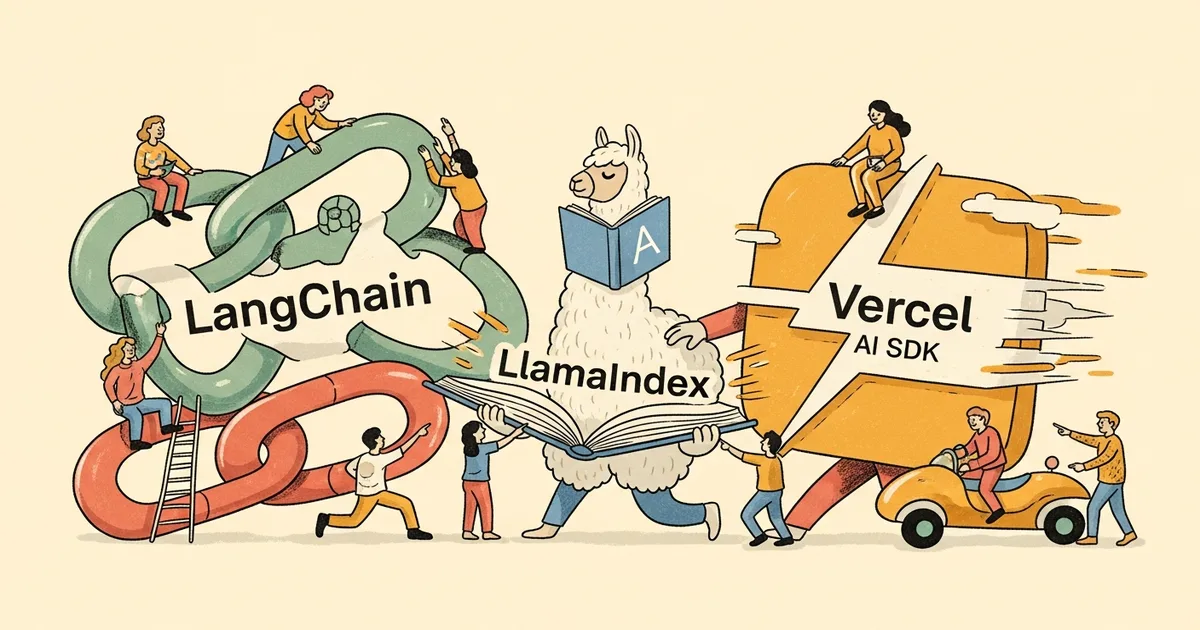
LangChain, launched in late 2022, built the largest AI developer ecosystem by shipping fast and supporting every model, vector store, and retrieval pattern on the market. Its Python repository has crossed 95,000 GitHub stars, and LangGraph — its graph-based, stateful agent runtime — is now the default choice for complex multi-agent orchestration in production. LangSmith, its observability and evaluation platform, is where LangChain monetizes; the core library remains open source and free.
LlamaIndex started as a document indexing utility and scaled into the leading framework for enterprise data pipelines. After raising a $40 million Series B in 2024, the company invested in LlamaCloud — a managed ingestion and retrieval service that handles hybrid search across structured and unstructured enterprise data at scale. The core library sits at approximately 38,000 GitHub stars. Its strategic advantage is focus: one problem, executed better than any general-purpose framework.
Vercel AI SDK 5, released in early 2026, is the most opinionated entrant. TypeScript-only, built around React and Next.js, and designed with streaming as a first-class primitive rather than an afterthought. Vercel’s distribution through its hosting platform gives it production reach that its roughly 12,000 GitHub stars understate considerably. For teams building AI-native web products, no framework in this comparison matches its developer experience.
2026 Head-to-Head: 10 Features Compared
| Feature | LangChain | LlamaIndex | Vercel AI SDK 5 |
|---|---|---|---|
| Language | Python + TypeScript | Python + TypeScript | TypeScript only |
| Core abstraction | Chains / LangGraph | Index + Query Engine | streamText / generateText |
| RAG support | Via loaders + chains | Native, best-in-class | Minimal (provider-level) |
| Agent support | LangGraph (stateful graphs) | AgentRunner (ReAct / plan-execute) | generateText tool loops |
| MCP support | Community packages | Native (first-class) | Native (first-class) |
| Streaming | Supported | Supported | First-class, built-in |
| Community size | Largest | Large | Growing fast |
| GitHub stars | ~95,000 | ~38,000 | ~12,000 |
| Enterprise adoption | High | Medium-high | Medium |
| Pricing | Free (LangSmith paid) | Free (LlamaCloud paid) | Free (Vercel hosting costs) |
Hello-World Complexity
Building the same RAG pipeline in all three frameworks exposes their design philosophies immediately.
In LangChain (Python), a basic retrieval chain means initializing a vector store, wrapping it in a retriever, composing a prompt template, and chaining components via LCEL: retriever | prompt | llm | output_parser. The explicit composition is powerful and fully auditable. It also runs 30 to 50 lines before you have handled edge cases — that verbosity is the cost of granular control, and most teams eventually decide it is worth paying.
In LlamaIndex (Python), the same pipeline requires three meaningful lines: load documents into a VectorStoreIndex, call as_query_engine(), and query. LlamaIndex abstracts ingestion and retrieval plumbing aggressively. The abstraction leaks when you need custom chunking strategies, re-ranking, or hybrid search — but for roughly 80% of production RAG use cases, it eliminates complexity that LangChain requires you to manage explicitly.
In Vercel AI SDK 5 (TypeScript), there are no built-in RAG primitives. Context is assembled externally and passed via the system prompt or tool results. streamText() handles token streaming, abort signals, and provider switching with minimal boilerplate. For frontend streaming interfaces, it is the cleanest API in this comparison. For RAG, the retrieval layer is entirely your responsibility to build and maintain.
Agent Depth
LangGraph is the most capable agent framework in this comparison — and it is not close. It models agents as directed graphs with cycles, enabling branching, retrying failed tool calls, pausing for human approval, and persisting state across sessions. Engineering teams at Fortune 500 companies have deployed LangGraph-based systems that orchestrate dozens of specialized agents across multi-hour document processing pipelines. The tradeoff is real: LangGraph has a steep learning curve, a heavy dependency surface, and a documented history of API churn as the team iterated toward the current graph architecture.
LlamaIndex’s AgentRunner supports ReAct and plan-and-execute patterns with clean, well-documented tool integration. It is less powerful than LangGraph but substantially more approachable, and its native MCP tool support means any MCP-compliant tool server plugs in without adapter code. For agents that call external APIs, read file systems, or query databases without needing full stateful graph execution, AgentRunner covers the common cases without the overhead LangGraph carries.
Vercel AI SDK 5’s agent pattern is a generateText loop with tool calls. It handles multiple rounds of tool use cleanly for single-agent workflows, and requires no manual orchestration for common patterns. Multi-agent systems require external state management on top. For a customer-facing chatbot with search and calculation tools, it is more than sufficient. For anything requiring branched execution paths, loop control, or runtime longer than a single request, LangGraph is the only qualifying option in this comparison.
MCP in 2026: Who Got It Right
The Model Context Protocol (MCP) — released by Anthropic in late 2024 and closely examined following Anthropic’s unintentional source code disclosure that revealed MCP’s internal agent architecture — became the de facto standard for AI tool interoperability by mid-2025. OpenAI, Google, and Microsoft all adopted the specification. MegaOne AI now tracks over 139 MCP-compatible tools across 17 categories, and MCP server compatibility has become a baseline expectation for any serious AI tooling.
LlamaIndex and Vercel AI SDK 5 both ship native MCP support with no additional packages required and no version synchronization lag. LangChain’s MCP integration relies on community-maintained adapters that typically trail the official MCP specification by 2 to 4 weeks per update cycle. For teams actively building on the MCP ecosystem, that lag introduces a recurring category of integration bugs that community adapters reliably reintroduce with each spec revision.
Best Framework for Each Use Case
Choose LangChain if your team works in Python and you need stateful multi-agent systems, fine-grained control over every retrieval and prompt step, or complex workflows with human-in-the-loop interrupt requirements. LangGraph has no real competitor in this comparison for production-grade agentic orchestration. If your system needs to branch, retry, persist state across sessions, or coordinate multiple specialized agents — LangGraph is the answer, and migrating away from it later is harder than building on it from the start.
Choose LlamaIndex if your core problem is reliable data ingestion and retrieval at scale. Enterprise search over internal document repositories, hybrid retrieval across relational and vector stores, and knowledge graph construction are LlamaIndex’s strongest territory. The $40M Series B is being deployed directly into these data layer capabilities. LlamaCloud’s managed pipeline further reduces the infrastructure burden for teams without dedicated ML engineering resources who still need production-grade retrieval.
Choose Vercel AI SDK 5 if you’re building a TypeScript-first web application where the AI features live primarily in the UI layer. Streaming chat interfaces, AI-assisted form flows, real-time reasoning displays, and Next.js-based AI SaaS products are where it definitively leads. Its gaps in RAG and agent depth are irrelevant if the retrieval layer is already separated from the UI layer — which good architecture requires regardless of framework. The same use-case-first principle that applies to AI video tool selection holds here: framework decisions made on GitHub stars consistently underperform decisions made on actual workload requirements.
Verdict
There is no universal winner — and the gap between these three frameworks widened in 2026, not narrowed. LangChain deepened its agent capabilities with LangGraph’s graph execution model. LlamaIndex deepened its data infrastructure with LlamaCloud’s managed pipelines. Vercel AI SDK 5 deepened its frontend streaming primitives with a ground-up SDK rewrite. Each is now definitively the strongest option in its lane.
The highest-risk choice is mismatching framework to problem type. Using LangChain for a pure UI streaming project adds unnecessary complexity, Python-to-TypeScript friction, and a dependency surface sized for problems you don’t have. Using Vercel AI SDK 5 for complex enterprise RAG creates retrieval gaps that require substantial custom engineering to fill — engineering that LlamaIndex provides out of the box. Build the architecture diagram first, identify where the actual complexity lives, then pick the framework that solves that specific problem.
Frequently Asked Questions
Can LangChain and LlamaIndex be used together in the same system?
Yes. LlamaIndex provides an official LangChain integration that exposes its indexes as LangChain-compatible retrievers. Many production architectures combine LlamaIndex for ingestion and retrieval with LangGraph for agent orchestration — the two frameworks complement rather than compete in that configuration, and it is one of the more common patterns in enterprise AI deployments as of 2026.
Is Vercel AI SDK 5 production-ready for enterprise use?
For frontend-layer AI features, yes without reservation. Vercel AI SDK 5 ships production-grade token counting, error handling, multi-provider switching, and streaming reliability. Enterprise limitations appear specifically at the agent orchestration and RAG layers — not at the streaming or model-integration layers where the SDK was designed to excel.
Which framework has the best MCP support in 2026?
LlamaIndex and Vercel AI SDK 5 both offer native, first-class MCP support in current releases — no extra packages, no synchronization lag. LangChain relies on community-maintained adapters that trail official MCP specification updates by 2 to 4 weeks per cycle, creating integration friction for teams tracking fast-moving MCP ecosystem changes.
Is LangChain still safe to build on given its API deprecation history?
New projects should use LCEL and LangGraph from the start — the legacy chain syntax is deprecated, and eventual removal is on the public roadmap. Both current APIs are stable and well-documented. LangChain is actively maintained and venture-backed, but teams inheriting codebases built on the older API surface face real migration work before accessing current capabilities including LangGraph’s full feature set.