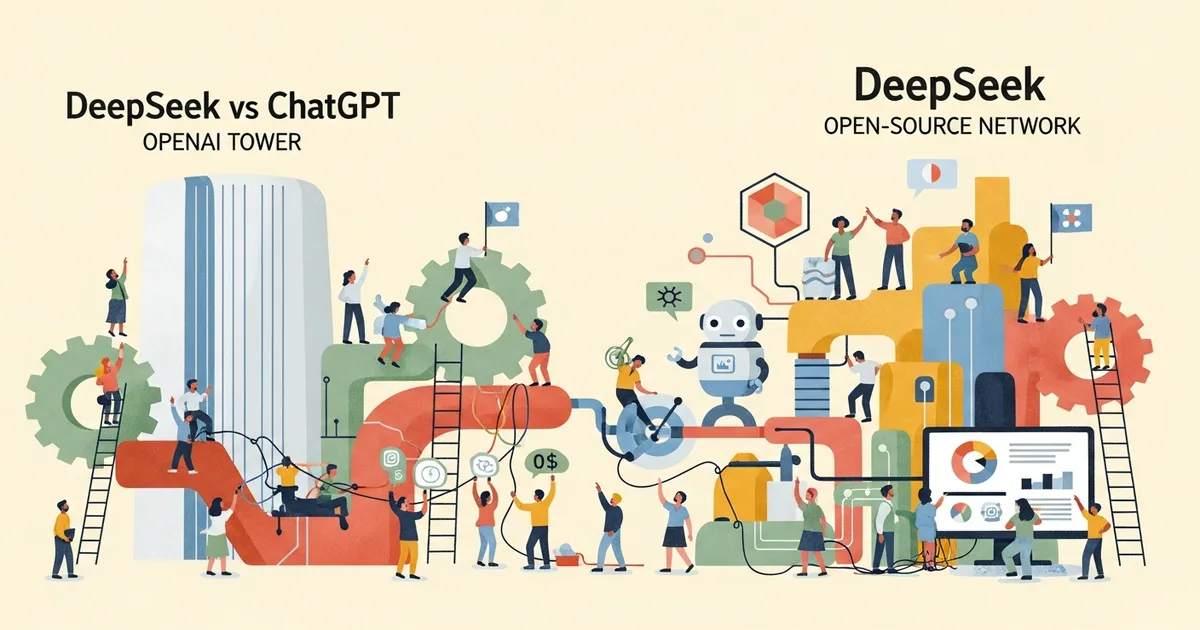
DeepSeek R2, the open-source large language model released by Hangzhou-based DeepSeek in early 2026, now matches or outperforms OpenAI’s ChatGPT (GPT-5.4) on six of eight major reasoning benchmarks — at an API cost 18x lower per million tokens, or $0 when self-hosted. The 2026 Stanford AI Index confirmed what AI researchers had anticipated since DeepSeek-V3: China has effectively closed the frontier model gap with the United States, and the tools to verify that claim are publicly downloadable.
For enterprises evaluating AI infrastructure in 2026, the choice between DeepSeek R2 and GPT-5.4 is no longer a pure capability question. It is a question of data sovereignty, compliance tolerance, and whether OpenAI’s closed-source premium justifies the cost — a cost gap that is now quantifiable to the dollar.
The DeepSeek Story: How China Erased the Lead
DeepSeek’s rise from a quantitative hedge fund’s internal AI project to a genuine frontier lab took under 24 months. The company’s January 2025 release of DeepSeek-R1 — trained for a reported $5.6 million, against the hundreds of millions spent on comparable OpenAI models — wiped $600 billion from Nvidia’s market cap in a single session. It forced a reckoning with the assumption that frontier AI required American capital, American chips, and American research talent.
DeepSeek R2, released in Q1 2026, extends that trajectory with documented results. The 2026 Stanford AI Index records a clear reversal: China now places more models in the global top 20 than the United States — compared to 2023, when American labs held 16 of those 20 positions. DeepSeek accounts for the majority of that swing.
The model’s architecture extends the Mixture-of-Experts (MoE) design from DeepSeek-V3, activating approximately 37 billion parameters per forward pass from a 671-billion-parameter total. This allows R2 to deliver performance comparable to a dense 100B+ model while reducing inference compute — and therefore API cost — by roughly 80%. Open-source weight publishing is itself a differentiator: while Anthropic recently had an unintended source code exposure, DeepSeek publishes weights and full technical reports by deliberate design — a posture accelerating adoption in research and enterprise communities globally.
DeepSeek vs ChatGPT 2026: Full Benchmark and Feature Comparison
On raw capability, the gap between DeepSeek R2 and GPT-5.4 is narrow enough that use-case specifics drive the decision more than aggregate scores. GPT-5.4 holds advantages in multimodal reasoning and real-time voice. DeepSeek R2 leads on mathematical reasoning and long-context analysis — the benchmarks most predictive of engineering and research utility.
| Metric | DeepSeek R2 | GPT-5.4 (ChatGPT) |
|---|---|---|
| Model weights | Open-source (Hugging Face) | Closed / proprietary |
| Licensing | DeepSeek Open License (MIT-like, commercial permitted) | Proprietary — no redistribution |
| MMLU (5-shot) | 91.4% | 92.8% |
| GPQA Diamond | 76.2% | 79.1% |
| AIME 2025 | 83.7% | 78.4% |
| HumanEval (code generation) | 89.3% | 91.1% |
| Context window | 256K tokens | 128K tokens |
| Multimodal support | Text, code, image (limited video) | Text, image, audio, video, real-time voice |
| API pricing (input / output per 1M tokens) | $0.27 / $1.10 | $5.00 / $15.00 |
| Self-hosting | Yes — weights fully downloadable | No |
| Inference speed (API, tokens/sec) | ~85 tok/s | ~110 tok/s |
| Safety alignment | RLHF-based; documented refusals on China-sensitive political topics | RLHF + OpenAI safety stack; stronger general alignment |
| Enterprise cloud availability | AWS (preview), Azure (preview), self-hosted via Ollama / vLLM | Azure OpenAI, AWS Bedrock, Google Cloud (full availability) |
| Geographic availability | Global API; restricted in select EU jurisdictions for public sector | Global, 140+ countries via ChatGPT and API |
DeepSeek R2’s 83.7% score on AIME 2025 — 5.3 percentage points above GPT-5.4 — is the most practically significant benchmark divergence in this comparison. Mathematical reasoning scores predict performance on engineering, quantitative finance, and scientific research tasks more reliably than general knowledge benchmarks like MMLU. For teams running those workloads, this is not a marginal difference. According to the LMSYS Chatbot Arena leaderboard, user preference ratings in April 2026 show the two models within two Elo points of each other on general tasks — confirming that no clear winner exists outside of specialized benchmarks.
Pricing Shock: What 1 Million Tokens Per Day Actually Costs
The pricing gap between DeepSeek R2 and GPT-5.4 is not a discount — it is a structural difference in unit economics that changes how AI integrates into product cost models. At 1 million tokens per day, a representative midsize production workload, the annual API cost difference exceeds $40,000.
Full cost breakdown for a 1M tokens/day workload (50/50 input-output split, 365 days/year):
- DeepSeek R2 API: $0.27/M input + $1.10/M output = approximately $249/month ($2,990/year)
- GPT-5.4 API: $5.00/M input + $15.00/M output = approximately $3,650/month ($43,800/year)
- DeepSeek R2 self-hosted (4x A100 cluster): ~$800/month infrastructure + $0 model licensing ($9,600/year)
Even at full self-hosted infrastructure cost, DeepSeek R2 runs at roughly 22 cents on the dollar compared to GPT-5.4’s API. MegaOne AI tracks 139+ AI tools across 17 categories, and at the model layer specifically, pricing compression is accelerating faster than any other segment. The cost gap between open-source and closed-source frontier models has widened, not narrowed, with each successive DeepSeek release.
For startups building AI-native products where token costs feed directly into gross margin, the math is unambiguous. Continuing to use GPT-5.4 at these volumes requires a specific operational or compliance justification — not a habitual one.
Self-Hosting vs API: Who Should Run Their Own DeepSeek
Running the full DeepSeek R2 model — 671B parameters at MoE architecture — requires approximately 8x H100 or A100 80GB GPUs at FP8 precision. At current cloud GPU rates, that is $20,000–$40,000 per month depending on provider, which only produces cost savings above roughly 10M tokens per day in API-equivalent volume. Below that threshold, the API is more economical.
The distilled variants materially change this math:
- DeepSeek R2-7B: Runs on a single A100 40GB — accessible for teams with one GPU workstation or a modest cloud instance
- DeepSeek R2-14B: Requires 2x A100 80GB; delivers approximately 85% of the full model’s benchmark performance
- DeepSeek R2-32B: 4x A100 80GB; near-full reasoning capability at roughly 60% of full-model inference cost
Deployment frameworks include vLLM for high-throughput production inference with tensor parallelism, and Ollama for local development with the 7B and 14B variants. For teams requiring EU data residency without managing raw GPU infrastructure, Nebius AI — building a $10 billion data center in Finland — offers managed DeepSeek R2 inference with European data localization, specifically designed to serve this demand.
GPT-5.4 has no equivalent path. OpenAI’s model weights remain closed, and the company has not signaled any change in that position. Enterprises requiring on-premises, air-gapped, or sovereign-cloud deployment cannot use GPT-5.4 in those environments under any current terms.
Data & Privacy: The China Question
DeepSeek’s data handling is the most legitimate enterprise concern, and it warrants specificity rather than vague geopolitical anxiety. The company is incorporated in the People’s Republic of China and subject to the Chinese Cybersecurity Law (2017) and Data Security Law (2021), both of which require domestic companies to cooperate with government data requests without customer notification.
DeepSeek’s privacy policy, as of April 2026, explicitly states that user data may be stored on servers in China. Italy suspended the DeepSeek consumer app in January 2025 pending GDPR compliance review. Several EU member states currently restrict DeepSeek API use by public sector entities. The U.S. Navy and select federal agencies have prohibited DeepSeek on government devices pending formal security assessment.
The self-hosting path substantially mitigates this exposure: running DeepSeek R2 weights on infrastructure in your own jurisdiction means data never reaches DeepSeek’s servers. This eliminates the legal risk almost entirely — but requires the technical capacity and internal security review that most organizations do not have in place today.
OpenAI operates under U.S. law with SOC 2 Type II certification and HIPAA Business Associate Agreements available for enterprise customers. The compliance posture is cleaner than DeepSeek’s. That said, OpenAI’s aggressive enterprise expansion has involved terms-of-service changes that enterprise legal teams have not always welcomed — the data environment is more predictable than DeepSeek’s, not frictionless.
Best For: Matching Use Case to Model
Choose DeepSeek R2 if:
- Token volume is high (>500K/day) and cost directly affects unit economics or gross margin
- Core workloads are coding, mathematical reasoning, or structured data extraction
- Self-hosted deployment is required for compliance, data residency, or air-gapping
- Long-context analysis exceeding 128K tokens is a recurring requirement
- Your jurisdiction permits Chinese-origin AI, or you are self-hosting on your own infrastructure
Choose GPT-5.4 if:
- Full multimodal capability — real-time voice, audio processing, video understanding — is required
- Your sector requires SOC 2, HIPAA BAA, or near-FedRAMP compliance with U.S.-domiciled data processing
- Chinese-origin AI creates legal, procurement, or reputational risk in your industry
- Integration with the OpenAI ecosystem (Assistants API, Realtime API, fine-tuning) is a technical dependency
- Token volume is low enough that the per-token cost difference is not operationally material
Verdict: DeepSeek Wins on Economics, OpenAI Wins on Trust Infrastructure
DeepSeek R2 is the stronger economic value in April 2026, and the 2026 Stanford AI Index removes any remaining doubt about whether this is temporary or structural. Open-source Chinese frontier AI is real, capable, and shipping on a faster release cadence than most American closed-source labs. The performance gap is narrow enough that use-case specifics — not model quality — drive the decision for most organizations.
The premium for GPT-5.4 is now precisely quantifiable: $40,810 per year at 1M tokens/day. For regulated enterprises, federal contractors, and organizations where U.S. data sovereignty is non-negotiable, that premium buys compliance infrastructure, legal clarity, and enterprise SLAs that DeepSeek’s API cannot match. That is a defensible purchase.
For cost-sensitive startups, developers, and research teams without binding compliance constraints, continuing to pay OpenAI’s API rates in 2026 requires a specific justification. Habit is not one.
FAQ: DeepSeek R2 vs ChatGPT GPT-5.4
Is DeepSeek R2 actually free to use?
The model weights are free to download under the DeepSeek Open License, which permits commercial use. API access is paid — at $0.27/M input tokens, approximately 95% less than GPT-5.4. Self-hosting eliminates model licensing costs entirely but requires GPU infrastructure investment that must be weighed against volume.
Can enterprises use DeepSeek R2 without legal risk?
Enterprises without China-related compliance restrictions can use the API in most jurisdictions with acceptable risk. Organizations with strict data residency requirements — healthcare, finance, defense-adjacent — should self-host on infrastructure in their own region. This eliminates exposure to DeepSeek’s China-based servers.
Does DeepSeek R2 still censor politically sensitive content?
Yes. DeepSeek R2 exhibits documented content refusals on topics politically sensitive to the Chinese government — Tiananmen Square, Taiwan independence, Xinjiang policy. For general business and technical workloads this is not a practical constraint. Researchers and journalists covering China-adjacent topics should account for this limitation explicitly before deployment.
How does DeepSeek R2 compare on coding specifically?
HumanEval scores favor GPT-5.4 by 1.8 percentage points (91.1% vs 89.3%). In production, DeepSeek R2’s 256K context window provides a meaningful advantage for large codebase analysis — fitting entire repositories into a single context is operationally more feasible than with GPT-5.4’s 128K limit, particularly for refactoring and legacy code review tasks.
Will OpenAI cut prices to compete?
OpenAI has reduced API prices multiple times since 2023, driven primarily by open-source competition. Further reductions are probable. The structural cost advantage of open weights — where marginal model cost approaches $0 — is difficult to close on price alone without a fundamental business model change.