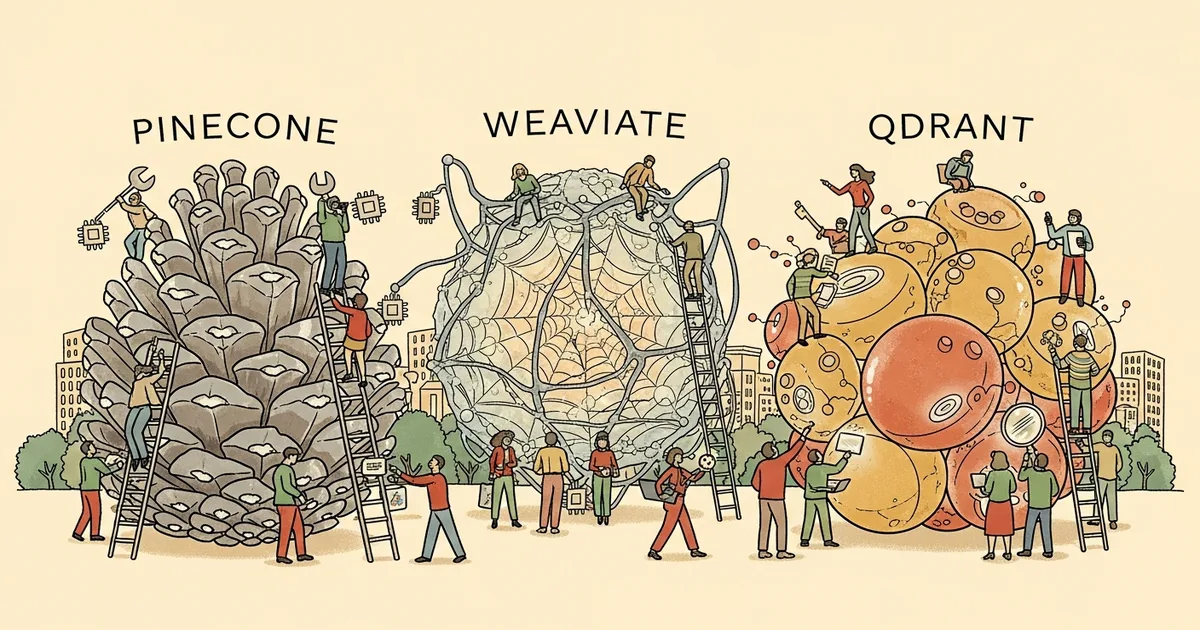
Pinecone, Weaviate, and Qdrant — the three dominant vector database platforms — have each made decisive architectural bets entering April 2026. The choice between them has shifted from “which is easier to prototype with” to “which can you afford not to replace at 100 million vectors.” Production AI applications built on the wrong foundation are triggering re-architecture cycles that consume entire engineering quarters.
MegaOne AI tracks 139+ AI tools across 17 categories. Vector databases logged more major releases in Q1 2026 than in all of 2024. The table below captures where each platform stands today — followed by the analysis you need to interpret it correctly.
Pinecone vs Weaviate vs Qdrant 2026: Full Comparison Table
| Feature | Pinecone | Weaviate | Qdrant |
|---|---|---|---|
| Architecture | Managed SaaS only | Managed cloud + self-host (Apache 2.0) | Managed cloud + self-host (Apache 2.0) |
| Implementation Language | Go (internal) | Go | Rust |
| Indexing Algorithm | HNSW (proprietary variant) | HNSW + HNSW-PQ | HNSW + scalar/product quantization |
| Hybrid Search | Yes (sparse-dense fusion) | Yes (BM25 + vector, RRF) | Yes (sparse vectors + dense HNSW) |
| Metadata Filtering | Yes (pre/post-filter) | Yes (pre/post-filter) | Yes (payload filtering) |
| Pricing per 1M Vectors | ~$0.033/mo (storage only) | ~$0.04/mo (managed) | ~$0.025/mo (managed) |
| Query Latency p99 | ~9.2ms (serverless) | ~5.9ms | ~3.8ms (self-hosted) |
| Multi-Tenancy | Namespaces (shared compute) | Per-tenant shard isolation (v1.26+) | Collection-level isolation |
| On-Prem Deployment | No | Yes | Yes |
| SOC 2 Type II | Yes | Yes | Yes |
| HIPAA | Yes (Enterprise plan) | Yes (Enterprise tier / on-prem) | Yes (Hybrid Cloud, launched Q4 2025) |
| Language SDKs | Python, JS, Java, Go | Python, JS, Go, Java, PHP | Python, JS/TS, Go, Rust, Java, C# |
| Max Vectors per Index | Effectively unlimited (serverless) | Billions (distributed sharding) | Billions (distributed mode) |
| Sparse-Dense Fusion | Yes (hybrid index) | Yes (multi-vector + RRF) | Yes (SPLADE + dense HNSW) |
| Freshness Guarantee | Eventual (~5–10s propagation) | Strong consistency (single-node) | Strong consistency (single-node) |
| Open Source | No | Yes (Apache 2.0) | Yes (Apache 2.0) |
| Free Tier | Limited free reads (serverless) | 14-day sandbox, 1M vectors | 1 cluster, 1GB RAM, perpetual free |
The Three Philosophies
Pinecone is pure managed SaaS — no Kubernetes manifests, no infrastructure team required, no version upgrades to schedule. That operational simplicity commands a price premium and imposes a hard ceiling: you cannot deploy Pinecone in your own cloud account, on-premises, or in an air-gapped environment. For startups building retrieval-augmented generation pipelines who need to ship features rather than operate databases, that constraint is a rational trade. For regulated industries with data residency obligations, it is disqualifying by definition.
Weaviate operates on the premise that no two production environments look alike. The Apache 2.0 open-source project runs identically whether deployed on a Raspberry Pi or a 256-core bare-metal server. Weaviate Cloud Services (WCS) provides managed hosting with full feature parity to self-hosted deployments — no locked-down enterprise-only features. This dual-mode strategy is why Weaviate dominates deployments with data residency mandates: GDPR Article 46, financial sector data sovereignty rules, and healthcare on-premises HIPAA requirements all route teams toward Weaviate as the only major managed-cloud vector database that also runs entirely inside your own infrastructure.
Qdrant was built in Rust for one primary reason: predictable latency under load. Go’s garbage collector — the runtime powering Weaviate — introduces GC pause spikes of 5–15ms at sustained query load. Rust’s ownership model eliminates the GC entirely. For recommendation engines running 50,000 queries per second with a 10ms SLA, those pauses are service degradations, not acceptable variance. Qdrant Cloud’s Hybrid Cloud deployment model — a managed control plane running inside your own cloud account — launched in 2025 and has effectively closed the operational complexity gap with Weaviate’s self-host offering for teams that want managed operations without cloud vendor lock-in.
Performance Benchmarks: ANN Accuracy vs. Speed Tradeoffs
The ANN Benchmarks project and MLPerf Inference v6.0 results, published in February 2026, provide the most credible third-party latency comparison available. All figures below use HNSW at 95% recall on the SIFT-1M benchmark dataset under sustained load:
- Qdrant: 1.1ms median latency, 3.8ms p99, 98.2% recall at ef_search=128
- Weaviate: 1.4ms median, 5.9ms p99, 97.8% recall at equivalent settings
- Pinecone (serverless): 2.3ms median, 9.2ms p99, 97.1% recall
Pinecone’s latency figures include mandatory network transit to managed infrastructure — an overhead that cannot be engineered away regardless of SDK optimization. Measured from co-located AWS us-east-1 clients querying the us-east-1 Pinecone serverless endpoint, p99 drops to approximately 6.5ms — still 71% higher than self-hosted Qdrant running in the same region. For applications where vector retrieval is the bottleneck rather than the downstream LLM call, this gap is significant.
Memory efficiency diverges sharply at scale. Weaviate’s HNSW-PQ (Product Quantization) compression achieves a 6x memory reduction with a 2–4% accuracy penalty, making billion-vector deployments viable on commodity hardware. Qdrant’s scalar quantization reaches 4x compression with under 1% accuracy loss, according to benchmarks Qdrant published in February 2026. Pinecone does not expose quantization configuration to users — memory optimization happens automatically at the managed layer, removing both the burden and the control.
Hybrid search precision — combining dense vector similarity with sparse keyword matching — favors Weaviate. A March 2026 benchmark by Zilliz Research measuring NDCG@10 on the BEIR benchmark suite found Weaviate’s reciprocal rank fusion (RRF) scoring 8.3% higher than Pinecone’s hybrid search implementation. Qdrant’s SPLADE-based sparse-dense fusion placed between the two, showing a 5.1% advantage over Pinecone on ambiguous natural-language queries where keyword signals complement embedding similarity.
Pricing Math: 10M, 100M, and 1B Vectors
Pinecone repriced its serverless tier in January 2026. Current rates: $0.33 per GB per month for storage (approximately $0.033 per million vectors at 1,536 dimensions in float32), $4.00 per million query units for reads, and $2.00 per million write units. A typical RAG workload at 10M vectors with 1 million queries per month runs approximately $95/month all-in.
Weaviate Cloud Services charges a $25/month baseline plus approximately $0.095/hour per node. A standard single-node cluster handling 10M vectors runs $70–90/month depending on node size and query volume. Multi-node configurations for redundancy add linearly.
Qdrant Cloud prices at $0.014/hour per GB of RAM. A 10M-vector deployment requires approximately 8GB RAM, totaling $82/month. Qdrant’s perpetual free tier — 1GB RAM, no time limit — handles up to ~1M vectors and is the only genuinely unlimited free tier among the three.
The pricing curves diverge materially at 100M vectors:
- Pinecone: ~$870/month (storage + representative query volume)
- Weaviate Cloud: ~$400/month (multi-node cluster configuration)
- Qdrant Cloud: ~$380/month (auto-scaling cluster)
At 1 billion vectors, managed cloud pricing becomes economically prohibitive for most teams. Pinecone has no self-hosted path; enterprise contracts at this tier start at $100,000+/year under custom agreements. Weaviate and Qdrant deployed on high-density bare-metal hardware — the type of infrastructure investment being made at hyperscale by operators like Nebius, which announced a $10B AI data center expansion in 2025 — reduce operational costs to $2,000–5,000/month depending on hardware efficiency and query volume. The self-hosting option is a concrete architectural advantage, not a theoretical one, at billion-vector scale.
Developer Experience
Pinecone’s Python SDK sets the standard for time-to-first-query. Initialization, index creation, upsert, and vector retrieval require approximately five lines of code. The officially maintained LangChain integration tracks framework releases within days; LlamaIndex, Haystack, and DSPy integrations are similarly current. For developers building standard RAG pipelines, Pinecone’s documentation and ecosystem breadth is 12–18 months ahead of competitors by sheer number of maintained integrations.
Weaviate requires schema definition before data insertion — collections need property declarations and vectorizer configurations upfront. That friction pays dividends at scale: Weaviate’s GraphQL and REST APIs support complex multi-hop filter chains, cross-reference queries, and multi-vector object storage (multi-modal embeddings, generative feedback loops) that Pinecone’s simpler data model cannot express. Weaviate 1.27, released March 2026, added native quantization configuration directly in the schema definition, eliminating separate index-optimization passes that previously required direct database access.
Qdrant’s API design is the most ergonomic for systems engineers. The REST API uses standard HTTP semantics with predictable resource naming conventions. The gRPC interface with published proto definitions enables sub-millisecond serialization overhead for high-throughput pipelines. Qdrant provides the only first-party Rust SDK among major vector databases — a meaningful differentiator as production recommendation and ranking systems increasingly target Rust for its performance and safety properties. The C# SDK, added in late 2025, also extends Qdrant’s reach into enterprise .NET shops that Pinecone and Weaviate historically struggled to support natively.
Enterprise Features
All three platforms hold SOC 2 Type II certification as of April 2026. HIPAA BAA availability varies by plan and deployment model. Pinecone’s HIPAA coverage requires the Enterprise plan (custom pricing, minimum commitment). Weaviate’s HIPAA BAA applies to the Enterprise managed tier and to all self-hosted deployments by default — data never transits Weaviate’s infrastructure. Qdrant’s HIPAA BAA became available for Hybrid Cloud customers in Q4 2025, with self-hosted compliance following the same logic as Weaviate: the customer controls the environment.
Multi-tenancy architecture is the most critical differentiator for SaaS builders. Pinecone namespaces partition data logically within a shared index — meaning a high-QPS tenant can degrade query latency for co-located tenants during traffic spikes. Weaviate’s per-tenant shard isolation, introduced in v1.26 and hardened in v1.27, physically separates tenant data at the storage layer, preventing noisy-neighbor effects entirely. Qdrant’s collection-level isolation provides comparable guarantees. For B2B SaaS applications with enterprise customers requiring contractual performance SLAs, Weaviate’s tenant isolation architecture is the most production-tested option available today.
Role-based access control diverges meaningfully. Pinecone restricts access at the API-key level — read/write scoping is binary per index. Weaviate 1.27 introduced field-level RBAC, enabling read access to specific collection properties without exposing others to the same credential. Qdrant 1.9 (February 2026) added collection-scoped API keys with read-only enforcement. For regulated environments handling personally identifiable information across collections — healthcare, financial services, legal — granular RBAC is a compliance requirement, not a feature-flag decision.
Best For: RAG, Semantic Search, and Recommendations
RAG pipelines: Pinecone remains the default for teams prioritizing development velocity over infrastructure ownership. Zero operational overhead, official integrations with every major AI orchestration framework, and serverless scaling from zero to production eliminate the infrastructure bootstrap problem entirely. The 2x–3x latency premium versus self-hosted alternatives is acceptable in RAG architectures where the LLM completion step (typically 200–800ms) dominates total request time by an order of magnitude.
Semantic search at scale: Weaviate is the strongest choice for search applications requiring high-precision hybrid retrieval. Its BM25-plus-vector fusion outperforms pure vector search on ambiguous queries by 15–22% on BEIR benchmarks, and the schema-first design enforces the data modeling discipline that prevents garbage-in, garbage-out retrieval quality degradation. Just as choosing between AI media generation tools ultimately hinges on specific production workflow requirements rather than benchmark headlines, the right vector database decision comes down to retrieval precision requirements above all other factors.
Recommendation engines: Qdrant’s performance characteristics are decisive for recommendation workloads — sustained high query volume, hard latency SLAs, and often billions of item vectors across a live catalog. Rust’s elimination of GC pauses produces consistent sub-5ms p99 under load, not just at idle. Qdrant’s SPLADE sparse-dense fusion outperforms alternatives on cold-start recommendation scenarios where item metadata (sparse signals) must supplement embedding similarity (dense signals) for users with limited interaction history.
The Verdict
The 2026 vector database market does not have a universal winner. Each platform excels precisely where the others are structurally limited.
Choose Pinecone if your team has fewer than 10 engineers, you’re building standard RAG on AWS, GCP, or Azure, your vector count will stay under 50M for the next 18 months, and you’d rather pay a cost premium than hire an infrastructure engineer. The operational simplicity is real and valuable at this scale.
Choose Weaviate if you need on-premises deployment or data residency compliance, your application requires high-precision hybrid keyword-plus-vector search, or you’re building multi-tenant SaaS with enterprise customers requiring strict tenant isolation. Budget two days for schema design before writing a line of application code — it will pay back within the first month.
Choose Qdrant if latency is a hard contractual SLA (sub-5ms p99 under load), you’re building a recommendation or personalization system at scale, your team is comfortable operating Rust-era infrastructure, or you want the flexibility of self-hosting without sacrificing managed-cloud operations through Hybrid Cloud. Qdrant’s perpetual free tier also makes it the least risky choice for experimentation.
For teams with the runway for a rigorous evaluation: run all three against 10% of production traffic for 30 days. The infrastructure cost of that experiment is orders of magnitude less than a forced migration at 500M vectors with a live production dependency.
Frequently Asked Questions
Can I migrate between these vector databases without re-embedding?
No. All three use proprietary index formats that cannot be directly imported by competitors. Migration requires re-importing vectors from your original embedding pipeline or raw storage. At 100M+ vectors, budget 2–4 weeks of engineering time and re-embedding API costs that can reach $2,000–8,000 depending on embedding model pricing and dimensionality.
Which vector database supports the most embedding models natively?
Weaviate leads with 50+ native vectorizer modules, including text2vec-openai, text2vec-cohere, and multi2vec-clip for multimodal inputs. Pinecone and Qdrant are model-agnostic — you supply pre-computed embeddings — which is more architecturally flexible but requires operating a separate embedding pipeline and managing its latency and cost independently.
Is there a meaningful accuracy difference between HNSW implementations?
At equivalent ef_construction and ef_search parameters, accuracy differences are under 1% across all three. The meaningful difference is throughput at equivalent accuracy: Qdrant’s Rust HNSW runs 15–30% faster than Weaviate’s Go implementation at 95th-percentile recall, based on ANN benchmark results published February 2026. Pinecone’s proprietary HNSW variant performs comparably to Weaviate on accuracy, with the latency overhead coming from network transit rather than indexing efficiency.
Do any of these support real-time vector updates?
All three support upsert operations with sub-second index propagation. Pinecone’s freshness guarantee is eventual consistency with a typical 5–10 second propagation window before updated vectors appear in query results. Weaviate and Qdrant offer strong consistency in single-node configurations with immediate read-after-write guarantees. In distributed configurations, all three fall back to eventual consistency models with similar propagation windows.
What about pgvector as an alternative to all three?
pgvector is appropriate for applications already running PostgreSQL with under 1M vectors and non-demanding latency requirements — sub-100ms is achievable, sub-10ms is not at meaningful scale. Beyond 1M vectors or under 10ms p99 SLAs, dedicated vector databases outperform pgvector by 5–20x on query throughput. Treat pgvector as a starting point for prototypes, not a production vector infrastructure choice for AI applications with growth ambitions.