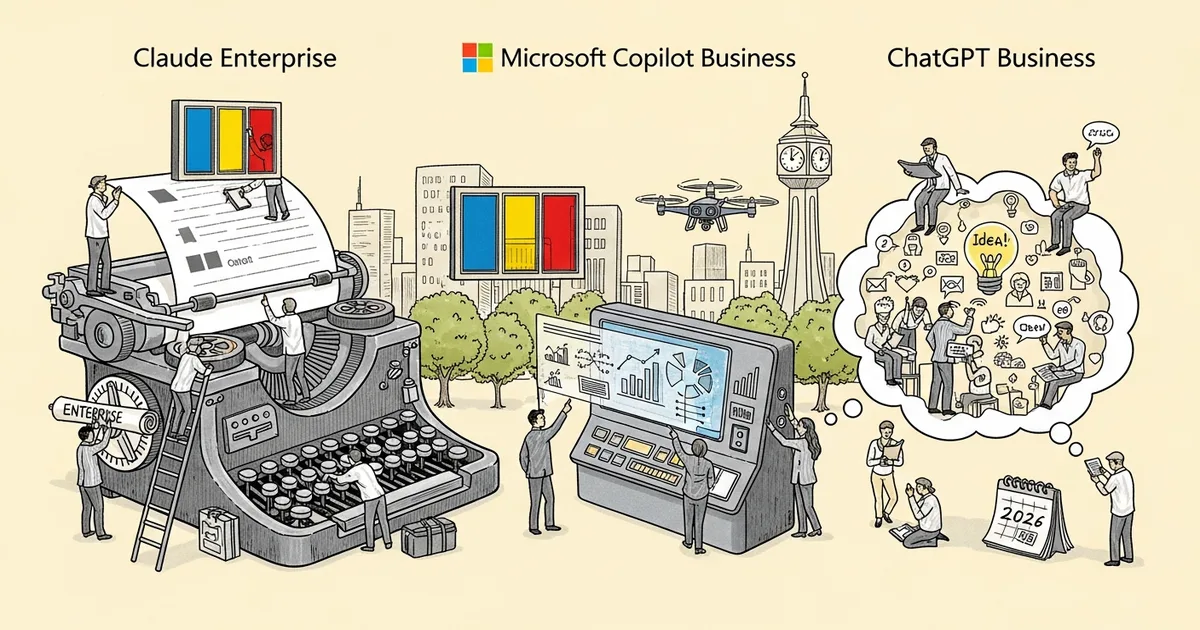
Three enterprise AI platforms are competing for budget authority in April 2026: Microsoft 365 Copilot Business at $30 per seat per month, OpenAI ChatGPT Business at $30 per seat per month, and Anthropic Claude Enterprise at negotiated pricing that typically opens between $35 and $55 per seat at 100-seat scale. The strategic landscape shifted materially this quarter — a Microsoft CRO memo, first reported by The Information in February 2026, revealed internal directives to limit OpenAI’s direct enterprise reach as the two companies’ commercial interests diverge; Anthropic’s $5 billion cloud commitment to Amazon altered data residency options significantly; and OpenAI’s acquisition of Hiro added autonomous agent infrastructure to ChatGPT Business. This comparison covers what enterprise buyers actually need to evaluate before committing.
Microsoft Copilot Business vs Claude Enterprise vs ChatGPT Business: Full Feature Comparison
The table below reflects verified specifications as of April 2026. Claude Enterprise pricing is custom and varies by contract size; ranges shown reflect reported deal structures for 100–500 seat agreements. Treat Claude’s rates as a floor for negotiation, not a fixed schedule.
| Feature | Microsoft 365 Copilot Business | Anthropic Claude Enterprise | OpenAI ChatGPT Business |
|---|---|---|---|
| Price per seat/month | $30 | Custom (~$35–55 at 100 seats) | $30 |
| Minimum seats | 1 | 25 | 1 |
| SSO / SAML | Azure AD / Entra ID (native) | Okta, Azure AD, custom SAML 2.0 | SAML 2.0, SCIM provisioning |
| Data retention policy | 30 days default (configurable to 0) | 0 days (default no retention) | 30 days default (configurable to 0) |
| Admin console depth | High (M365 Admin Center + Purview) | Medium (Anthropic Console) | Medium-High (redesigned Jan 2026) |
| SharePoint connector | Native (Microsoft Graph) | Via third-party (Power Automate) | Via third-party / API |
| Notion connector | Via Power Automate | Native beta (Feb 2026) | Native (Connector Store, Jan 2026) |
| Google Drive connector | Via Graph API (limited) | Native beta (Feb 2026) | Native (Connector Store) |
| Audit logs | Full (Microsoft Purview) | Full (configurable export) | Standard (90-day default) |
| Token limit per user/day | ~2M tokens | ~5M tokens (500K context window) | ~1M tokens |
| Model access | GPT-5 (via Copilot stack) | Claude 4.7 (full capability) | GPT-5.4 (latest) |
| SOC 2 Type II | Yes | Yes | Yes |
| FedRAMP | Moderate (authorized) | In progress (IL2, Q3 2026 target) | Moderate (authorized) |
| HIPAA BAA | Yes (requires admin config) | Yes (zero-retention default) | Yes (requires admin config) |
| EU / UK data centers | Yes (West EU, UK South) | Yes (AWS EU-West-1, EU-Central-1) | Yes (EU-West, UK South via Azure) |
| Custom model deployment | Limited (via Azure AI Studio) | No (policy-level customization) | Yes (GPT-5.4 fine-tuning available) |
Pricing Math: 100, 1,000, and 10,000 Seats
At 100 seats, Copilot and ChatGPT Business both total $3,000 per month ($36,000 annually). Claude Enterprise at this scale runs approximately $4,200–5,500 per month based on reported deal structures — a 40–83% premium over the flat-rate alternatives. That delta buys default zero-data-retention and Claude 4.7’s 500,000-token context window, which can process roughly a 400-page legal agreement in a single pass. For teams that routinely work with large document sets, that is measurable operational value, not a feature on a spec sheet.
At 1,000 seats, the picture shifts:
- Microsoft 365 Copilot Business: $30,000/month base. Add M365 Business Standard ($12.50/seat) or Business Premium ($22/seat) if not already licensed — bringing the true cost for organizations licensing Microsoft 365 from scratch to $42,500–52,000/month.
- OpenAI ChatGPT Business: $30,000/month. Developer Codex seats cost an additional $19/seat/month — a 100-developer team adds $1,900/month, totaling $31,900/month.
- Anthropic Claude Enterprise: Negotiations at 1,000 seats typically land between $28,000 and $32,000/month, closing the per-seat gap with the flat-rate competitors substantially.
At 10,000 seats:
- Copilot: $300,000/month base. Microsoft frequently bundles Copilot with M365 E5 at volume, creating pricing opacity that requires side-by-side contract comparison. Do not model off headline rates alone.
- ChatGPT Business: $300,000/month. Enterprise agreements at this scale include SLA credits and dedicated capacity allocation — operationally relevant for high-volume agentic workflows.
- Claude Enterprise: Reported pricing at 10,000+ seats targets $22–27/seat/month, representing a 10–27% discount versus Copilot and ChatGPT Business at their published maximum scale rates.
The critical hidden cost in Copilot: Microsoft 365 Business Standard ($12.50/seat/month) or higher is a licensing prerequisite. M365 Business Basic does not qualify. Organizations not already on Microsoft 365 face a minimum $42.50/seat/month floor — 41% more expensive than the advertised price.
Security and Compliance
All three platforms hold SOC 2 Type II certification and ISO 27001. The meaningful differentiation is in regulated industry coverage and implementation defaults.
FedRAMP: Copilot holds FedRAMP Moderate authorization under Microsoft’s Government Cloud umbrella. ChatGPT Business holds Moderate authorization via its Azure-hosted enterprise infrastructure. Claude Enterprise is pursuing IL2 authorization, targeting Q3 2026 — federal contractors in regulated procurement cycles should factor this 6-month gap into their vendor timelines.
HIPAA: All three provide Business Associate Agreements. Claude Enterprise’s zero-retention default is the cleanest HIPAA posture out of the box. Both Copilot and ChatGPT Business default to 30-day conversation retention and require explicit admin configuration to disable model improvement data usage — a step that compliance teams frequently miss during rushed deployments.
EU AI Act: Microsoft’s conformity documentation is the most complete, reflecting three decades of EU regulatory experience. Anthropic published a preliminary EU AI Act conformity assessment in March 2026. OpenAI’s documentation remains in draft form. For financial services firms operating under DORA in the EU, only Microsoft has completed a formal third-party technical audit against the Digital Operational Resilience Act’s ICT risk management standards as of April 2026.
Integration With Your Existing Stack
Integration depth is where Copilot’s Microsoft moat is most tangible — and where the cost of that moat becomes clearest. The SharePoint Online connector reads directly from the Microsoft Graph, pulling documents, Teams conversations, emails, and calendar data natively. No middleware, no sync delays, no third-party credentials to manage. For organizations that live inside M365, this is a genuine workflow advantage.
ChatGPT Business now has the broadest third-party connector coverage of the three. The Connector Store, launched in January 2026, delivers native integrations for Notion, Google Drive, Slack, GitHub, Jira, Confluence, and Salesforce. OpenAI’s Hiro acquisition brought structured project memory to the platform — context persists across sessions at the project level, which is operationally critical for long-running workflows: litigation support, product launch planning, ongoing financial analysis.
Claude Enterprise added native Google Drive and Notion connectors in beta in February 2026. For organizations running Google Workspace, Claude’s integration story is now competitive with ChatGPT Business. SharePoint integration still requires third-party middleware — Power Automate, Zapier, or a custom API layer — adding implementation overhead and recurring middleware cost. Anthropic’s roadmap includes a native SharePoint connector in H2 2026. M365 shops evaluating Claude today should model that gap rather than building on third-party bridges that will become redundant.
Admin UX: Who Actually Uses the Console
Admin console quality determines whether IT governance is real or theoretical. Weak tooling produces shadow deployments; overly complex tooling produces under-governed enterprise rollouts.
Microsoft M365 Admin Center combined with Microsoft Purview is the most powerful administrative environment in this comparison. Granular data loss prevention policies, conditional access integration, exportable audit trails piped to Microsoft Sentinel — it is enterprise-grade. The cost: it requires a trained M365 administrator to configure effectively. Mid-market organizations without dedicated IT staff routinely leave Purview DLP policies at defaults, negating much of the platform’s security value.
ChatGPT’s admin console was redesigned in January 2026 following sustained user feedback about the previous interface’s poor discoverability. Seat management, domain verification, per-department usage analytics, and data policy controls now occupy a clean single-page layout. Non-technical administrators can complete onboarding, policy configuration, and usage review in under 20 minutes.
Anthropic Console covers the essentials — SSO configuration, project workspaces, usage dashboards — but lacks the audit depth of Purview and the UX polish of ChatGPT’s redesigned interface. Anthropic’s Q1 2026 enterprise roadmap explicitly flagged admin tooling as a 2026 H1 priority. Procurement teams evaluating Claude Enterprise now should build console improvements into their multi-year expectations rather than treat current tooling as the final state.
Developer Experience and ChatGPT Business Codex Seats
For software engineering organizations, developer experience is a first-order evaluation criterion — and the three platforms have meaningfully different propositions.
ChatGPT Business Codex seats at $19/seat/month give developers access to the Codex IDE plugin, a GPT-5.4 function optimized against SWE-bench software engineering benchmarks, and a 10M-token-per-day limit for autonomous agent tasks. As MegaOne AI has covered in its analysis of OpenAI’s acquisition strategy, OpenAI’s infrastructure acquisitions are systematically building toward a full autonomous software development stack. Codex seats are the enterprise packaging of that trajectory.
Microsoft 365 Copilot Business does not include GitHub Copilot. That is a separate SKU — $19/seat/month for GitHub Copilot Individual, $39/seat/month for GitHub Copilot Enterprise (which adds PR summaries and repository-aware chat). Enterprise buyers frequently conflate these products: they do not share licensing. A developer using both M365 Copilot Business and GitHub Copilot Enterprise pays $69/seat/month — more than three times the Codex seat add-on.
Claude Enterprise’s API access provides programmatic access to Claude 4.7 with the full 500,000-token context window — well-suited for codebase security reviews, large-repository analysis, and agentic workflows processing extensive technical documentation. Anthropic’s Workspaces feature (added November 2025) enables system prompt configuration at the project level without developer involvement, reducing the friction of deploying Claude across non-technical business units.
Data Residency
Data residency is a material procurement requirement for EU and UK organizations operating under GDPR Article 46 and UK GDPR. All three platforms offer regional options — the differences are in implementation granularity and contractual enforceability.
Microsoft offers the most granular data residency controls through its Multi-Geo Compliance framework: EU West (Amsterdam, Dublin), EU Central (Frankfurt), UK South (London), and additional regional options for E5 subscribers. The M365 residency tooling integrates with Purview for visibility into where specific data types are processed, simplifying GDPR Article 30 record-of-processing obligations.
Anthropic routes Claude Enterprise traffic through AWS infrastructure. The $5 billion Amazon deal, finalized in March 2026, expanded available processing regions to EU-West-1 (Ireland), EU-Central-1 (Frankfurt), and AP-Southeast-1 (Singapore). Customers specify their required region in the enterprise contract. The hyperscaler infrastructure race — exemplified by investments like Nebius’s planned $10 billion AI data center in Finland — has materially expanded regional compute options for cloud-hosted AI platforms over the past 18 months. Anthropic is the beneficiary of that expansion through its AWS partnership.
OpenAI’s ChatGPT Business uses Azure infrastructure exclusively for enterprise traffic, with EU options including EU-West (Netherlands), EU-North (Ireland), and UK South. OpenAI’s concurrent AWS compute arrangement — used for research and API traffic — has created confusion in enterprise procurement teams about which cloud processes their data. ChatGPT Business enterprise traffic does not traverse AWS; confirm this in writing with OpenAI’s enterprise sales team before signing a GDPR-sensitive contract.
The OpenAI–Microsoft Fracture and What It Means for Enterprise Buyers
The Microsoft CRO memo, first reported by The Information in February 2026, instructed the enterprise sales organization to position Copilot as a Microsoft-native alternative to ChatGPT Business and to actively avoid co-selling arrangements that generate direct revenue for OpenAI. Microsoft continues to license GPT-5 for Copilot under its existing partnership — but the commercial relationship is being managed to constrain OpenAI’s independent enterprise growth. For buyers, this creates a concrete vendor roadmap risk: Microsoft has structural incentive to deepen Copilot’s dependency on M365 in ways that increase switching costs over time.
OpenAI’s acquisition of Hiro — an AI memory and workflow orchestration startup — adds persistent cross-session project memory to ChatGPT Business, directly addressing its most cited enterprise limitation. The Hiro integration is rolling out in phases through Q2 2026. When complete, a legal team’s ongoing matter will retain document summaries, key findings, and task context without manual re-upload each session — a workflow improvement worth evaluating before finalizing a contract with a competing platform.
Anthropic’s structural position is comparatively clean. The Amazon deal is a compute and distribution arrangement — Amazon holds no equity in Anthropic and no content licensing rights under its terms. As MegaOne AI has previously reported on Anthropic’s security posture, Anthropic’s enterprise business remains operationally independent of its cloud infrastructure partnership. For procurement teams modeling vendor dependency risk, Anthropic’s arrangement is the least entangled of the three.
The broader enterprise AI adoption curve is accelerating past the organizational resistance that slowed deployment in 2024. That resistance has not disappeared — it has shifted from blocking deployment to demanding governance. Platform selection today carries multi-year lock-in implications: SSO configurations, prompt libraries, connector development, and staff training create switching friction that compounds annually.
Verdict: Which Platform Wins for Which Buyer
MegaOne AI tracks 139+ AI tools across 17 categories. In enterprise productivity platforms, the correct answer is not a universal winner — it is a function of stack, use case, and risk tolerance.
Choose Microsoft 365 Copilot Business if your organization already runs on M365 and SharePoint, your IT team has capacity to manage M365 Admin Center complexity, and native Microsoft Graph integration — reading from SharePoint, Teams, and Outlook without middleware — justifies the operational coupling. Model the prerequisite licensing costs before purchasing. Copilot is a compelling $30 add-on for existing M365 customers and an expensive proposition for organizations that are not.
Choose OpenAI ChatGPT Business if you need the broadest third-party connector coverage, your development team will actively use Codex seats for autonomous coding tasks, or GPT-5.4 access — the strongest all-purpose model in this comparison — is a priority. The Hiro memory integration, completing in Q2 2026, will further strengthen ChatGPT Business for knowledge work requiring long-running context continuity.
Choose Anthropic Claude Enterprise if your team regularly processes large documents (legal, finance, research, compliance), your regulatory posture demands default zero-data-retention without admin configuration overhead, or your primary use cases — contract review, technical specification analysis, research synthesis — benefit measurably from a 500,000-token context window. Google Workspace organizations will find Claude’s integration story competitive as of early 2026. M365 organizations should track the native SharePoint connector release before committing.
Evaluate total cost of ownership including prerequisite licenses, map connector requirements before deployment, and build a 12-month platform review into any enterprise AI contract signed today.
Frequently Asked Questions
Can I use Claude Enterprise without my data processing on AWS?
All current Claude Enterprise regions are AWS-hosted — the Amazon deal determines which regions are available, not the underlying cloud provider. Organizations with strict cloud-provider contractual restrictions should confirm options directly with Anthropic’s enterprise team before signing. A non-AWS option is not currently available.
Does ChatGPT Business include GPT-5.4 or only GPT-5?
As of April 2026, GPT-5.4 is the default model for ChatGPT Business subscribers. GPT-5 remains selectable for legacy integrations via the model selector in the API and the ChatGPT interface.
Is Microsoft 365 Copilot Business available without an existing Microsoft 365 subscription?
No. A qualifying Microsoft 365 Business Standard ($12.50/seat/month), Business Premium ($22/seat/month), or Enterprise E3/E5 license is required as a prerequisite. Microsoft 365 Business Basic does not qualify for the Copilot add-on.
What does the Hiro acquisition specifically add to ChatGPT Business?
Hiro’s persistent memory architecture integrates into ChatGPT Business’s Projects feature, enabling context — document summaries, key findings, task state — to persist across user sessions at the project level. Rollout completes Q2 2026. This directly addresses the context-reset limitation that has been ChatGPT Business’s most frequently cited enterprise drawback.
Which platform is best for HIPAA-regulated healthcare organizations?
All three provide Business Associate Agreements. Claude Enterprise’s default zero-retention posture is the lowest-friction HIPAA implementation — no admin configuration required to disable data retention. Copilot and ChatGPT Business default to 30-day conversation retention and require explicit admin steps to disable model-improvement data use. Audit those settings at deployment and on a quarterly compliance schedule.