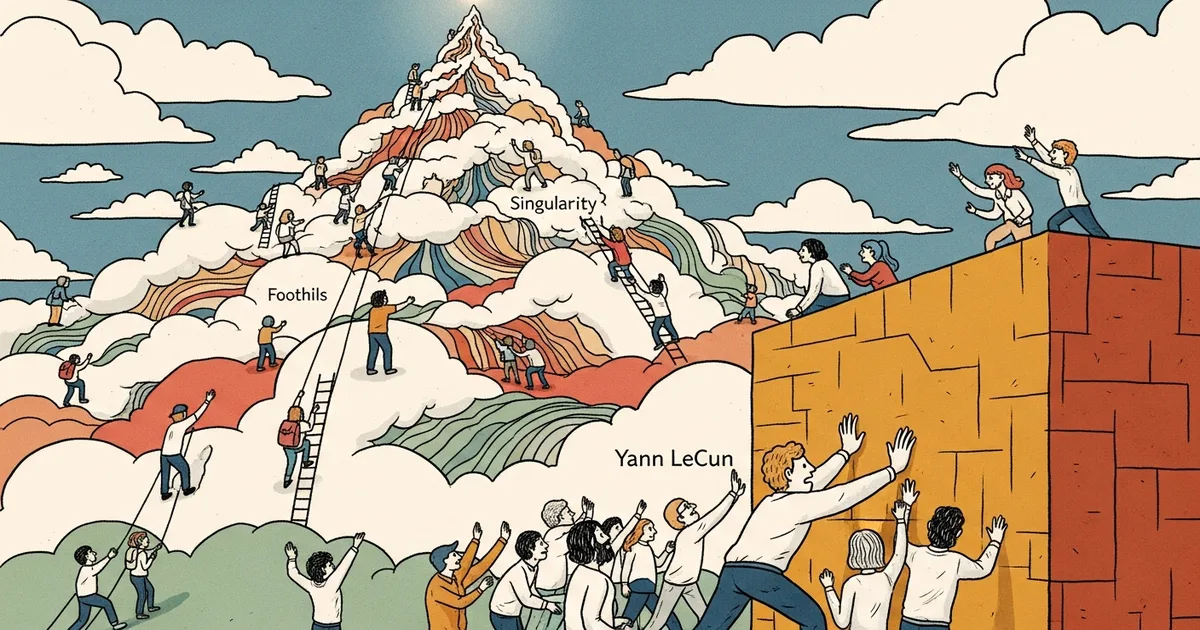
- DeepMind co-founder Demis Hassabis said at Google I/O 2026 that humanity is ‘in the foothills of the singularity.’
- Hassabis believes AGI is possible within the next five years and would be ’10 times the industrial revolution at 10 times the speed.’
- Yann LeCun (AMI Labs) argues current LLMs aren’t intelligent — ‘real intelligence shows up when you solve new problems without any prior training.’
- Oriol Vinyals, co-lead of Google’s Gemini program, takes a middle view — strong on code and math, but learning from experience is still missing.
What Happened
Three of the most prominent AI researchers presented sharply different views on where AI stands right now, The Decoder reported. DeepMind co-founder Demis Hassabis closed his Google I/O 2026 keynote saying humanity is “in the foothills of the singularity,” expecting a “profound moment for humanity.” Yann LeCun, AI researcher at AMI Labs, argued current LLMs are not intelligent. Oriol Vinyals, co-lead of the Gemini program, took a middle position.
Why It Matters
The three positions sketch the current frontier-AI intellectual landscape. Hassabis, usually known for restraint, has shifted toward more aggressive AGI framing — consistent with Bloomberg’s May 16 segment that titled the era as “The Oppenheimer of the AI Era.” His specific claim is concrete: AGI within five years, with effects “10 times the industrial revolution at 10 times the speed.”
LeCun’s counter-position has been consistent for years but its framing has hardened. He cites a paraphrase of psychologist Jean Piaget: “Intelligence is not what you know, it’s what you do when you don’t know.” His core argument: LLMs accumulate knowledge and learned skills but real intelligence shows up when solving new problems without prior training. LeCun is working on AI technology that goes beyond Transformer LLMs.
Technical Details
Hassabis’s comment was made at 1:50:17 in his Google I/O 2026 keynote close. He stated AGI is possible within five years and that when it happens, it will be “10 times the industrial revolution at 10 times the speed.” The same I/O keynote disclosed that Google now processes 3.2 quadrillion tokens per month across its surfaces.
LeCun’s working position at AMI Labs centres on AI architectures beyond Transformer-based LLMs — what he has previously described as child-like learning, which itself would be a precursor for true intelligence. He has argued publicly, including in debates with DeepMind researchers, that LLMs cannot be the path to AGI. Vinyals’s position — that today’s models are strong at code and math, that reasoning keeps getting more general, but that the ability to learn from experience and produce real breakthroughs is still missing — is the most empirically calibrated of the three.
Who’s Affected
The frontier-AI policy and investment community gets three distinct framings to weigh — bullish (Hassabis), bearish (LeCun), and middle (Vinyals). Google DeepMind’s strategy continues to align with the bullish framing through 2026 product launches. Meta’s AI strategy, which LeCun has shaped substantially, retains the architectural-skeptic positioning. AI investors and analysts gain three named anchors for forward-looking models. The general public reading mainstream coverage sees the framings filter through media outlets — Bloomberg’s “Oppenheimer” coverage and similar.
What’s Next
Hassabis’s five-year AGI timeline is testable. LeCun’s beyond-Transformer architecture work will continue at AMI Labs; meaningful product disclosures are expected through 2026-2027. Vinyals’s Gemini work continues at Google. Industry watchers should track whether the AGI five-year framing remains consistent across the next two Google I/O cycles, and whether LeCun’s alternative architectures produce competitive empirical results.