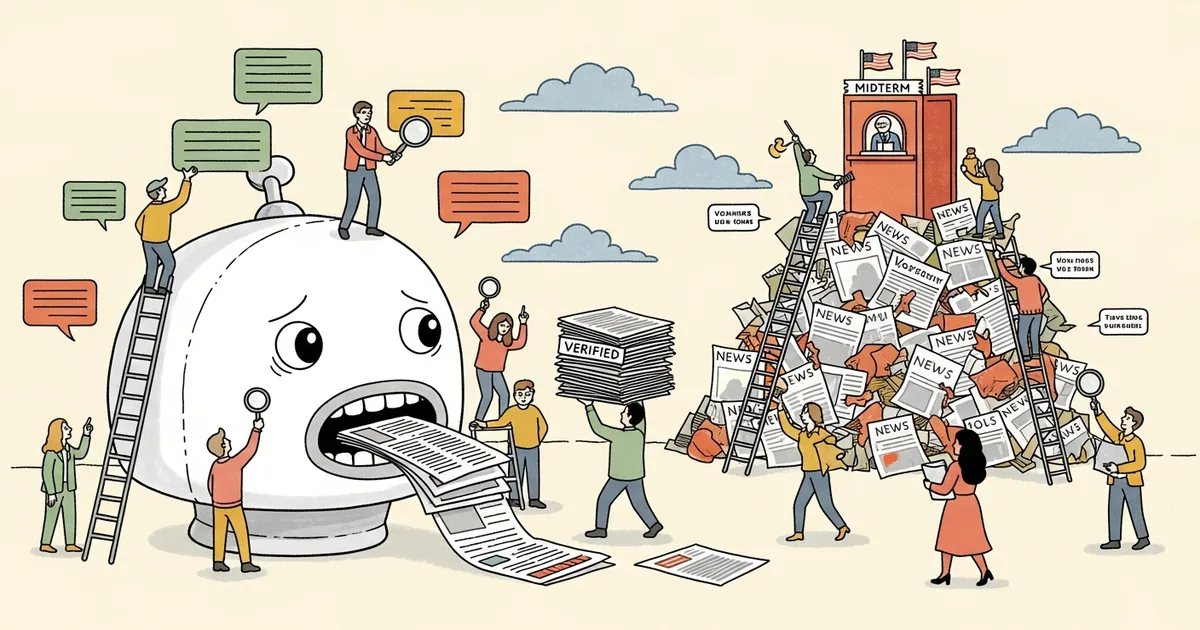
- AI chatbots continue to struggle with news accuracy and source attribution ahead of the 2026 U.S. midterm elections, Bloomberg reported on May 20.
- The findings concern major consumer-AI surfaces including ChatGPT, Gemini, Claude, Copilot, and Perplexity.
- The pattern lands alongside OpenAI’s same-day announcement on extending content provenance via C2PA + SynthID.
- Midterm elections are scheduled for November 3, 2026 — five months from the report date.
What Happened
AI chatbots continue to show difficulty with news accuracy and source attribution as the 2026 U.S. midterm elections approach, Bloomberg reported on Tuesday. The report — published behind Bloomberg’s subscription wall — focuses on the major consumer-AI surfaces (ChatGPT, Gemini, Claude, Microsoft Copilot, Perplexity) and their performance on news-and-political queries.
Why It Matters
Consumer AI chatbots have become a meaningful share of news consumption since 2024. Similarweb data reported by The Decoder on May 14 showed ChatGPT at 53.7% of AI-chatbot web traffic share, Gemini at 26.7%, and Claude at nearly 8%. When those surfaces inaccurately report or misattribute news, the effect propagates at the same scale.
The 2026 U.S. midterm elections are scheduled for November 3 — five months from the report date. AI-mediated misinformation has emerged as a primary policy concern at the FEC, the EU AI Office, and state-level election-integrity bodies. The Bloomberg report adds empirical evidence that the consumer-facing chatbots most exposed to election queries remain operationally unreliable.
Technical Details
Bloomberg’s specific methodology, test-set composition, error-rate measurements, and per-model breakdowns are presented in the paywalled article. The category of errors typically measured in chatbot-news-accuracy testing includes: factual hallucination (claiming events that did not occur), source misattribution (citing a publication or author incorrectly), temporal confusion (placing events in the wrong year), and refusal-without-reason (returning generic disclaimers rather than substantive information).
The findings land alongside OpenAI’s same-day announcement extending content provenance via C2PA conformance and cross-platform SynthID watermarking through a Google partnership. Provenance infrastructure addresses one side of the misinformation problem — verifying whether an image came from a given source — but does not directly improve text-generation accuracy.
Who’s Affected
Election-integrity advocates, state secretaries of state, the Federal Election Commission, and the EU AI Office all face heightened pressure to translate research findings into concrete platform requirements. Major AI providers — OpenAI, Anthropic, Google, Microsoft, xAI — face renewed scrutiny ahead of November. News publishers face the secondary effect of AI-mediated traffic loss and source-attribution erosion (the Parallel CEO’s observation last week that creators are missing out on the AI agentic economy applies directly to news publishers). Voters using AI chatbots for political-information queries are the affected population at scale.
What’s Next
Expect parallel research reports from NewsGuard, the Reuters Institute, and academic research groups at MIT, Stanford, and Columbia through the run-up to November. Major AI providers will likely accelerate news-specific guardrail and source-attribution work. Regulatory action — particularly at the EU AI Office and state-level — may move from policy-development to enforcement on a compressed timeline. Bloomberg’s full methodology and per-model breakdowns are available to Bloomberg.com subscribers.