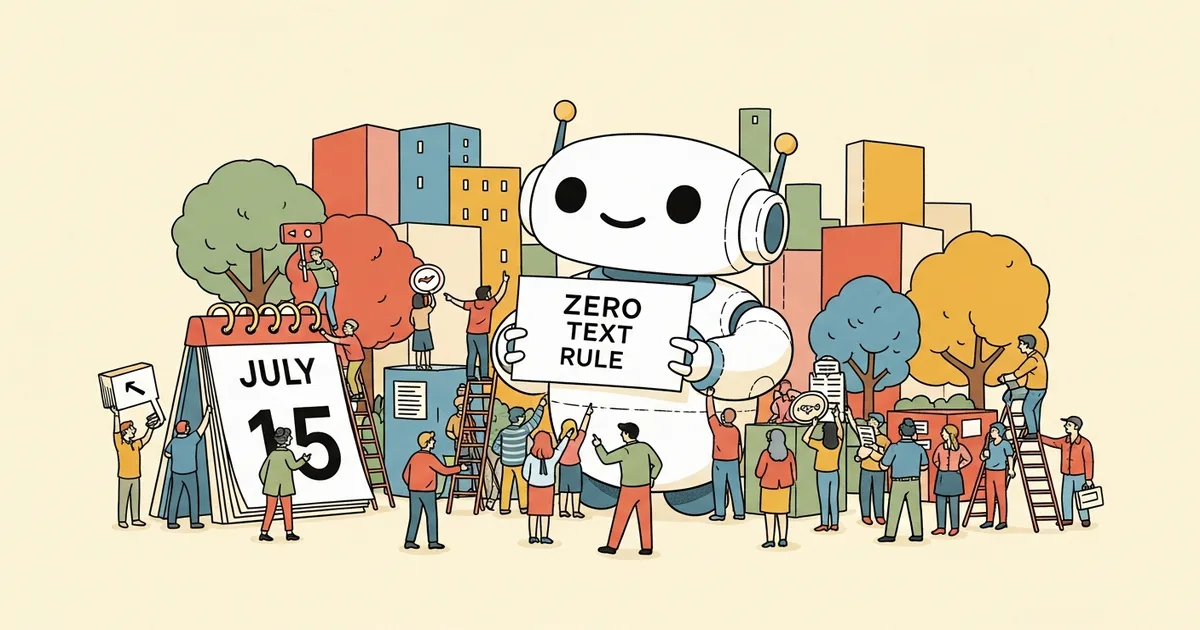
- China’s Interim Measures for the Administration of AI Anthropomorphic Interactive Services take effect July 15, 2026 — the first dedicated national framework for AI companion services.
- ByteDance’s Doubao and Alibaba’s Qwen switched off their humanlike agent features ahead of the deadline rather than retrofit anti-addiction systems.
- The rules target sustained emotional interaction only: customer service, workplace assistants, and education tools are excluded.
- Providers must run anti-addiction systems, bar virtual-companion services to minors, detect users in acute distress, and file security assessments once they cross 1 million registered users or 100,000 monthly actives.
What Happened
China’s rules for AI companion services take effect on July 15, and in the days before the deadline the country’s two most-used consumer AI apps quietly switched off the features at their heart, as reported by AI News on July 6, 2026. ByteDance’s Doubao told users its agent function would go offline July 15, citing “product function adjustments,” while Alibaba’s Qwen said its humanlike and user-created agents would stop working July 10 and its wider agent services five days later.
Why It Matters
Read quickly, it looks like China is turning off AI agents. It isn’t: the regulation draws a line between the agent that does your work and the agent that keeps you company, and only the second kind is targeted. Customer service bots, knowledge Q&A, workplace assistants, and education and research tools are explicitly excluded, provided they avoid sustained emotional engagement.
It is the first dedicated national framework of its kind — on paper a fuller set of user protections than the EU, the US FTC, or California’s SB 243 has yet put into force — and China’s own official interpretation cites the Character.AI lawsuits over psychological harm to teenagers, FTC investigations into companionship services, and European action against Replika as supporting context.
Technical Details
The regulation is the Interim Measures for the Administration of AI Anthropomorphic Interactive Services, co-issued April 10, 2026, by the Cyberspace Administration of China and four partner agencies. It covers services simulating human personality traits, thinking patterns, and communication styles for sustained emotional interaction. Providers must run anti-addiction systems with mandatory usage notifications and instant-exit mechanisms, detect unhealthy dependence in real time, bar virtual companion services to minors (with guardian consent required under 14 and dedicated “minor modes”), and intervene when users show signs of self-harm, suicidal behavior, or serious financial loss. Services crossing 1 million registered users or 100,000 monthly actives must file eight-area security assessments with provincial regulators, and app stores must delist non-compliant products. Doubao and Qwen fell foul not of a prohibition but of a design conflict — their agents were built to remember users and sustain relationships, and both companies chose shutdown over retrofit.
Who’s Affected
The cost has landed on users first: many mourned the shutdowns on Weibo, and data portability is absent — Doubao offers read-only access to configurations until October 15 before deletion, while Qwen users get no grace period. ByteDance is directing users to Maoxiang, a separate app where agents can be recreated; Alibaba has announced no equivalent. Tencent’s Yuanbao pulled a comparable feature in June, and Shanghai’s internet regulator said June 26 it had removed more than 14,000 non-compliant AI agents.
What’s Next
The measures fix no technical threshold for what counts as “emotional interaction” — the grey zone that drove platforms to pull entire features rather than risk misjudging the line. They also leave open how liability splits between platform operators and upstream model providers. MIIT expert-committee member Pan Helin put the official case to the South China Morning Post: “current agents are not yet mature.” The companies, for now, have taken the safest route available — switch the features off and work out what a compliant version looks like later.