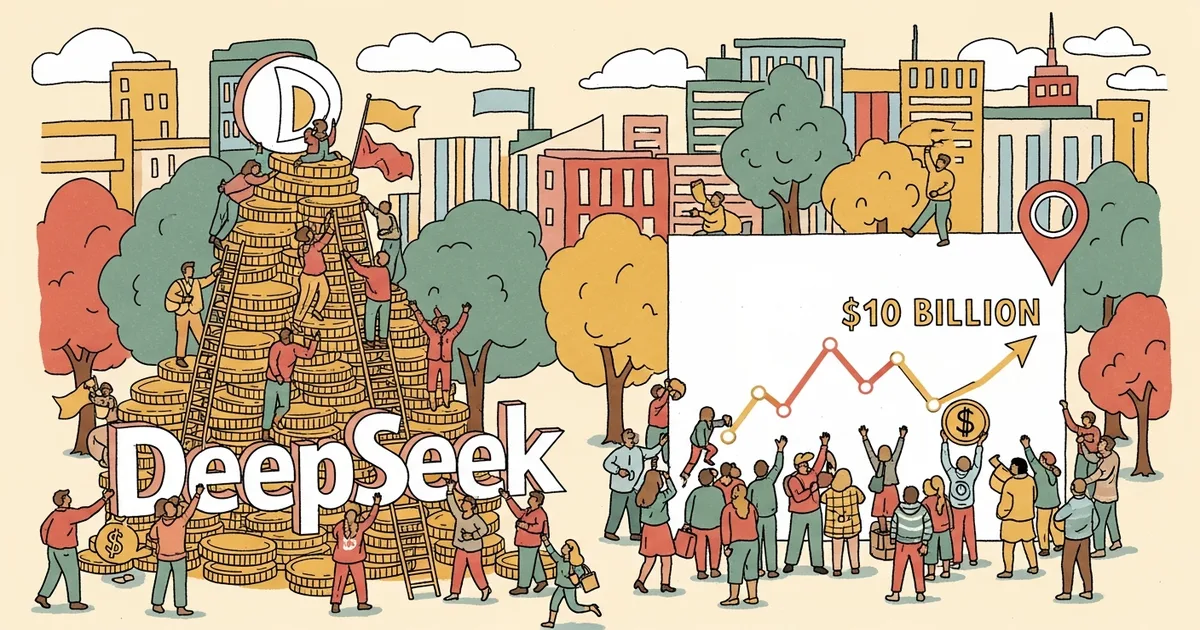
DeepSeek, the Chinese artificial intelligence lab that upended global AI markets in January 2025, is in talks to raise at least $300 million at a valuation exceeding $10 billion — its first external fundraise in three years of operation. The Information and Reuters confirmed the details on April 17, 2026. Until this week, DeepSeek had operated entirely on capital from High-Flyer Capital Management, the Hangzhou-based quantitative hedge fund that created it — turning down every major Chinese VC and tech conglomerate that approached in the interim.
The deepseek funding 10 billion figure demands context: this is a lab that trained its most consequential model for approximately $5.6 million. The distance between those two numbers is the actual story.
From Quant Fund to Global AI Lab: The High-Flyer Backstory
DeepSeek is not a conventional startup. It was founded by Liang Wenfeng, co-founder of High-Flyer Capital Management, which manages approximately 135 billion yuan (~$18.6 billion USD) in assets. High-Flyer is one of China’s most successful quantitative hedge funds — algorithmic derivatives strategies, not AI research labs.
Liang structured DeepSeek as a fully controlled in-house R&D capability rather than a standalone venture-backed entity. No board seats. No strategic investors. No liquidation preferences. No quarterly narratives to manage for outside LPs. The arrangement gave DeepSeek something virtually no frontier AI lab possesses: institutional patience without venture-driven timelines.
The structure produced outsized results. DeepSeek released V2 in May 2024, V3 in December 2024, and the R1 reasoning model in January 2025. Each release landed with disproportionate impact relative to the team’s size and stated expenditure.
Why DeepSeek Turned Down Every VC in China Until Now
DeepSeek was not short on suitors. China’s largest technology conglomerates and most prominent venture funds reportedly approached Liang Wenfeng with term sheets on multiple occasions. He declined them all.
The rationale is structurally coherent. Strategic capital from Alibaba, Tencent, or Baidu doesn’t arrive without implicit alignment pressure — ecosystem integration expectations, product direction influence, and constraints on model release timing. DeepSeek’s open-source releases gained global traction precisely because no strategic investor had a reason to suppress or delay them.
Venture terms also introduce governance complexity that a self-funded lab doesn’t require. DeepSeek has published foundational research, open-sourced key model weights, and maintained a rapid release cadence because its incentive structure rewarded research velocity, not revenue milestones.
The reversal now — three years in, after the most consequential AI model launch since GPT-4 — signals that frontier training costs are approaching a level that even an $18.6 billion quant fund cannot treat as discretionary R&D spend. The next model generation requires infrastructure commitment at a different order of magnitude.
The .6 Million Training Run That Erased Trillion
When DeepSeek published the training cost for R1 in January 2025 — approximately $5.6 million for the final training run — it triggered one of the fastest wealth destruction events in US market history. Nvidia‘s stock fell 17% in a single session, erasing approximately $593 billion in market capitalization. Broader AI-adjacent equities declined further; total losses across the sector exceeded $1 trillion.
The implication was direct: if a Chinese lab operating under chip export restrictions could produce a frontier-class reasoning model for less than the cost of a Series A, the capital-intensity moat US hyperscalers had been building was more porous than anyone had publicly acknowledged.
The $5.6 million figure covered the final training run, not total R&D expenditure including failed experiments, data curation, and infrastructure. But the efficiency gap it exposed was genuine. US labs spending hundreds of millions per training run had been treating capital density as a competitive moat. DeepSeek demonstrated it was a choice.
Now DeepSeek is raising $300 million — 53 times the reported cost of their most famous model. Whatever the next generation requires, R1-era efficiency no longer covers it.
The Chip Problem Nobody Is Pretending to Solve
DeepSeek has been training frontier models on NVIDIA hardware restricted from export to China under US Department of Commerce rules. H100s and A100s have been blocked since 2022. The H800 and A800 — chips NVIDIA designed specifically to skirt initial export thresholds — were added to the restriction list in October 2023.
How DeepSeek maintains access to training-grade compute is the question without a clean public answer. The most credible explanations involve pre-restriction stockpiling and procurement through indirect channels. Neither is formally confirmed.
This ambiguity is the primary reason US institutional investors are unlikely to participate in the current round. The Information’s April 17 report explicitly cited regulatory and national security concerns as the barrier. The $300 million round will be composed almost entirely of Chinese capital — which constrains exit paths for any investor seeking Western-market liquidity. As MegaOne AI has tracked in the context of the ongoing consolidation across the global AI sector, every major capital allocation decision in AI now carries direct national policy implications.
Stanford’s 2026 AI Index: The Gap Is 2.7 Percentage Points
Stanford University’s 2026 AI Index found the United States leads China in composite AI capability by just 2.7 percentage points — assessed across model benchmark performance, research output, infrastructure investment, and talent pipelines. Three years ago, that gap was measured in double digits.
In mathematics reasoning and code generation — two domains central to the next generation of agentic AI systems — Chinese labs have reached or exceeded US performance benchmarks. DeepSeek’s R1 was a material driver of that convergence.
| Metric | US Leaders | DeepSeek |
|---|---|---|
| Training cost (comparable run) | $100M+ (est.) | ~$5.6M (R1 final run) |
| External funding (pre-2026) | $10B+ (OpenAI, Anthropic) | $0 |
| Current valuation (2026) | OpenAI: $340B / Anthropic: $61.5B | $10B (proposed) |
| US–China composite AI gap | 2.7 points (Stanford 2026 AI Index) | |
The pattern across successive Stanford AI Index reports is directionally consistent: US technical leadership in frontier AI is narrowing faster than the export control frameworks designed to arrest it have modeled.
Is Billion a Steal or a Trap?
At $10 billion, DeepSeek sits at roughly 1/34th of OpenAI’s current valuation and about one-sixth of Anthropic’s $61.5 billion mark. OpenAI closed a $40 billion round at $340 billion earlier this year — making the DeepSeek figure look either deeply discounted or reflective of an unresolved monetization question. Anthropic — which recently made headlines following a high-profile operational security incident — has enterprise contracts with Google, Amazon, and Salesforce underpinning its multiple. DeepSeek has no comparable revenue infrastructure.
The bull case: DeepSeek is one of a handful of organizations on the planet capable of training frontier-class models. It is demonstrably capital-efficient, has built an open-source ecosystem that drives adoption without marketing spend, and has already demonstrated the ability to move global markets with a single research paper. At $10 billion, you are not buying revenue — you are buying a seat at a very short table.
The bear case involves three interconnected risks. First, regulatory exposure — a minority stake in a Chinese AI company with national security implications carries a complicated exit environment in Western capital markets. Second, chip supply uncertainty — if Commerce Department enforcement tightens further, DeepSeek’s training pipeline faces structural constraints that capital cannot fix. Third, the monetization gap — DeepSeek’s API and consumer app are early relative to its global profile and proposed valuation.
The honest read: $10 billion is neither obviously cheap nor obviously expensive. It depends entirely on what DeepSeek builds with the $300 million and whether the efficiency advantage that defined R1 can survive the scaling requirements of the next model generation.
What the First Fundraise Actually Signals
DeepSeek’s decision to accept outside capital for the first time doesn’t just describe DeepSeek — it describes the frontier AI cost curve.
The dominant narrative after R1 was that lean, efficient labs had made capital density irrelevant. DeepSeek’s own fundraise is the counterevidence. Even a lab that trained its most consequential model for $5.6 million eventually hits an infrastructure inflection point that no hedge fund balance sheet absorbs as discretionary spend.
The global compute buildout continues regardless. Nebius Group recently announced a $10 billion AI data center investment in Finland — part of the infrastructure land-grab that DeepSeek’s training efficiency was supposed to make obsolete. Efficiency and scale are sequential requirements, not competing philosophies. You optimize until you can’t, then you spend.
MegaOne AI tracks 139+ AI tools across 17 categories, and the pattern is consistent: research-first labs that achieve benchmark prominence eventually face an infrastructure commitment that reshapes their governance. DeepSeek has reached that inflection point three years faster than comparable US labs did.
The US-China AI race is no longer a story about one side controlling access to technology the other cannot replicate. Stanford’s 2.7-point gap makes that argument untenable. It is a story about compounding velocity — and DeepSeek’s first external fundraise, confirmed April 17, 2026, is the clearest public signal yet that the compounding is accelerating on both sides simultaneously.
Watch what the $300 million funds. Capital allocated toward GPU procurement signals that the efficiency model has structural ceilings. Capital directed toward multimodal systems, agentic infrastructure, or domestic chip development signals a strategic ambition substantially larger than any single model generation.