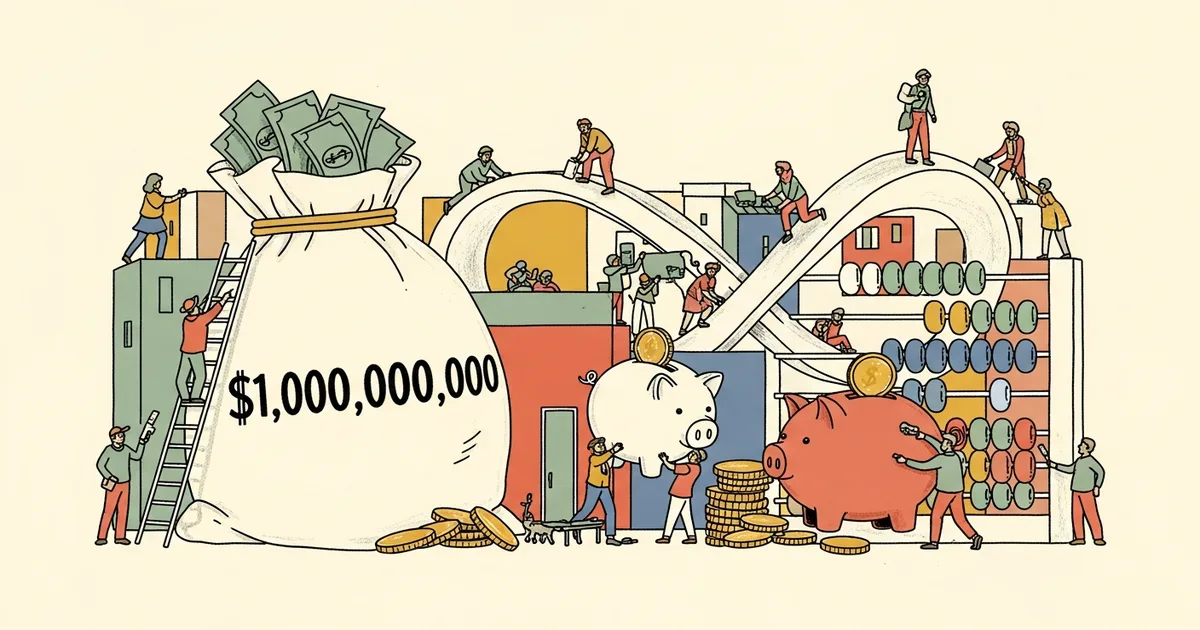
Meta Platforms, Inc. is offering performance bonuses of up to $1 billion per individual AI executive, according to reporting from April 2026. The packages target the company’s most senior frontier researchers and lab leaders, structured to hold key talent as OpenAI, Anthropic, and Google DeepMind run aggressive competing recruitment operations. This is what the meta ai executive bonuses arms race looks like when a $130 billion capital commitment requires a small number of irreplaceable people to operate it.
For scale: the maximum NBA contract in 2026 pays roughly $60 million per season. A $1 billion AI executive bonus outpaces sixteen years of that. The compensation table for building frontier AI has officially detached from every other talent market on earth.
What’s Actually Inside a Billion Package
These are not base salaries. Meta’s retention structures are multi-year performance bonuses tied to model capability milestones, product deployment targets, and commercial AI revenue thresholds. The architecture matters as much as the number: vesting schedules that require executives to remain or forfeit substantial portions of the payout create the retention mechanism. A $1 billion package with a four-year vest and milestone triggers is a very expensive lock — but it is a lock.
Meta’s 2026 total AI capital expenditure guidance sits at $115–135 billion — nearly double the $65–72 billion deployed in 2025. When a company is committing that level of capital to infrastructure, losing a key executive to a competitor isn’t a salary problem. It’s an organizational drag problem: delayed model releases, fractured research priorities, and compounding competitive advantage for whoever makes the hire. Against that calculus, $1 billion per executive is an insurance premium on a $130 billion investment.
Alexandr Wang and the .3 Billion Talent Acquisition Blueprint
Meta’s $14.3 billion investment in Scale AI, closed in April 2026, is the most instructive precedent in this story. Scale’s data annotation pipelines and labeled training infrastructure are valuable — comparable capabilities can be procured or built over 12–18 months at a fraction of the cost. The premium paid above that market rate was for Alexandr Wang, Scale’s 29-year-old founder-CEO, one of the most credentialed AI infrastructure operators in the United States defense and commercial AI ecosystem.
Wang brought a specific profile to Meta: deep relationships within U.S. defense AI procurement channels, direct credibility with the research community, and operational experience scaling data pipelines that train frontier models. Meta integrated him into Meta Superintelligence Labs, the internal unit now tasked with the company’s frontier model development. If $14.3 billion looks expensive for a data annotation company, it makes more sense as a talent acquisition structured around a single executive — with the company’s infrastructure included as collateral.
The playbook — if you can’t hire them, acquire the company around them — mirrors what leading AI labs have repeatedly done when top talent resists direct recruitment.
Meta Superintelligence Labs and the Muse Spark Signal
Meta Superintelligence Labs is the organizational structure Zuckerberg built to compete at the frontier. Its mandate is building foundation models that rival GPT-5 and Gemini Ultra — not fine-tuning Llama derivatives for internal product integrations.
Muse Spark, launched in April 2026, gave the lab a public-facing result. Early benchmarks positioned the model as competitive with Anthropic’s Claude and current OpenAI models on creative and multi-step reasoning tasks. Enterprise adoption curves typically lag benchmark releases by 6–12 months, but the signal Meta needed to transmit — that this lab ships models, not just headcount — landed with the research community.
The lab’s expanded roster since the Wang acquisition marks the clearest operational evidence that Meta is competing for frontier AI, not just product AI. MegaOne AI currently tracks 139+ AI tools across 17 categories; the number of credible frontier model builders remains in the single digits.
Why 0 Billion in Capex Demands Billion in Retention
Meta spent approximately $37 billion on AI infrastructure in 2023, $65–72 billion in 2025, and is now projecting $115–135 billion in 2026. That trajectory compresses the time horizon on competitive model development — and creates a direct organizational dependency on a very small number of people who know how to extract performance from that infrastructure.
A researcher who leaves Meta doesn’t just take their salary. They take institutional knowledge of how to train at scale on Meta’s specific hardware configurations, cluster topologies, and data pipelines. Rebuilding that takes months. For comparison, Nebius Group’s $10 billion AI data center in Finland represents the type of regional build that a single Meta capex quarter would fund three times over — which illustrates how fast the capital commitment calculus has shifted for frontier players.
The Four-Way Talent War
The competition for frontier AI talent concentrates across four players, each running a different compensation model:
- OpenAI: Equity-heavy packages backed by a $157 billion valuation, plus tender offers that have converted paper equity to cash for senior staff. The company’s aggressive commercial expansion adds revenue-backed stability to the equity narrative.
- Anthropic: $7.3+ billion raised from Google and Amazon, with equity packages at a company that has positioned safety research as its competitive differentiation — attracting a specific researcher profile willing to trade valuation upside for mission clarity.
- Google DeepMind: Unmatched compute access via TPU clusters, the deepest academic research bench in the field, and the stability of a $1.9 trillion parent. Base compensation runs below Meta and OpenAI; total comp and research freedom compete.
- Meta: Public-company cash certainty, global deployment scale across 3+ billion users, and now explicit nine-figure bonus packages for the top tier. The open-source Llama releases have built external researcher goodwill that feeds internal recruitment.
Meta’s cash-heavy approach is a deliberate counter to equity-heavy packages at OpenAI and Anthropic. If a company’s valuation is uncertain — OpenAI is still private, Anthropic has never posted a profit — cash guarantees carry real premium over paper equity. Meta generated $46.6 billion in net income in 2024 (Meta Platforms Q4 2024 earnings). It can write very large checks without existential balance sheet risk.
Athlete, CEO, Founder: Putting Billion in Context
| Role | Compensation | Structure |
|---|---|---|
| Top NBA player (2026) | ~$60M/year | Guaranteed contract |
| Top NFL quarterback | ~$55M/year | Contract with guarantees |
| Average S&P 500 CEO (2024) | $16.3M/year | Cash, equity, bonus mix |
| Elon Musk Tesla package (contested) | ~$5.6B/year | Performance-based stock |
| Meta top AI executive (2026) | Up to $1B (bonus) | Multi-year performance vesting |
According to AFL-CIO’s 2024 Executive Paywatch data, the average S&P 500 CEO earns $16.3 million annually. A $1 billion AI executive bonus exceeds the lifetime guaranteed earnings of most Fortune 500 CEOs across entire tenures. The only comparable single-person compensation figures are founder-CEO equity packages at companies with multi-trillion-dollar market capitalizations.
The scarcity premium is structural, not speculative. There are perhaps 200–400 people globally with the combination of theoretical depth, systems engineering capability, and organizational experience to lead frontier AI development at scale. There are roughly 2,000 Fortune 500 CEO positions. The supply/demand curve for frontier AI talent is categorically different from general executive markets, and compensation reflects that arithmetic exactly.
Can Any Package Actually Retain Top AI Talent?
Through the vesting cliff: yes. Permanently: no. A well-structured $1 billion package with a four-year vest will retain talent for four years. It will not retain talent if research environment quality, compute access, organizational autonomy, or team caliber fail to meet expectations — and the researchers who can command $1 billion packages know exactly what good looks like.
The AI talent market has produced enough documented departures to make this point concretely. Ilya Sutskever left OpenAI — one of the industry’s most generous employers — without a publicly announced destination, then founded Safe Superintelligence Inc. Top researchers have repeatedly accepted compensation cuts to work on specific problems with specific collaborators. Money is a threshold condition, not a sufficient one.
If Anthropic or OpenAI structured competing offers at $2 billion — not implausible given Anthropic’s $7.3 billion fundraising base and OpenAI’s accelerating revenue trajectory — the question becomes whether Meta’s research culture, compute access, and mission clarity justify the delta. A researcher maximizing impact rather than income will choose the environment with the best combination of compute, collaborators, and deployment scale. Meta’s actual structural retention advantage is its user base.
Mark Zuckerberg has publicly stated a target of one billion AI assistant users on Meta’s platforms. Whether or not that timeline holds, the inference infrastructure to support it exists. For a researcher who measures impact in real-world deployment rather than benchmark leaderboards, running models for three billion users is a stronger argument than any bonus check.
The $1 billion packages are a consequence of Meta’s capital commitment, not a cause. Zuckerberg decided frontier AI creates winner-take-most market dynamics and committed $130 billion to that thesis. The compensation follows from the infrastructure. The researchers who stay will do so because Meta’s lab offers the best environment to work on the most consequential problems at the largest scale — the bonus just makes the cost of leaving high enough to force a deliberate choice.