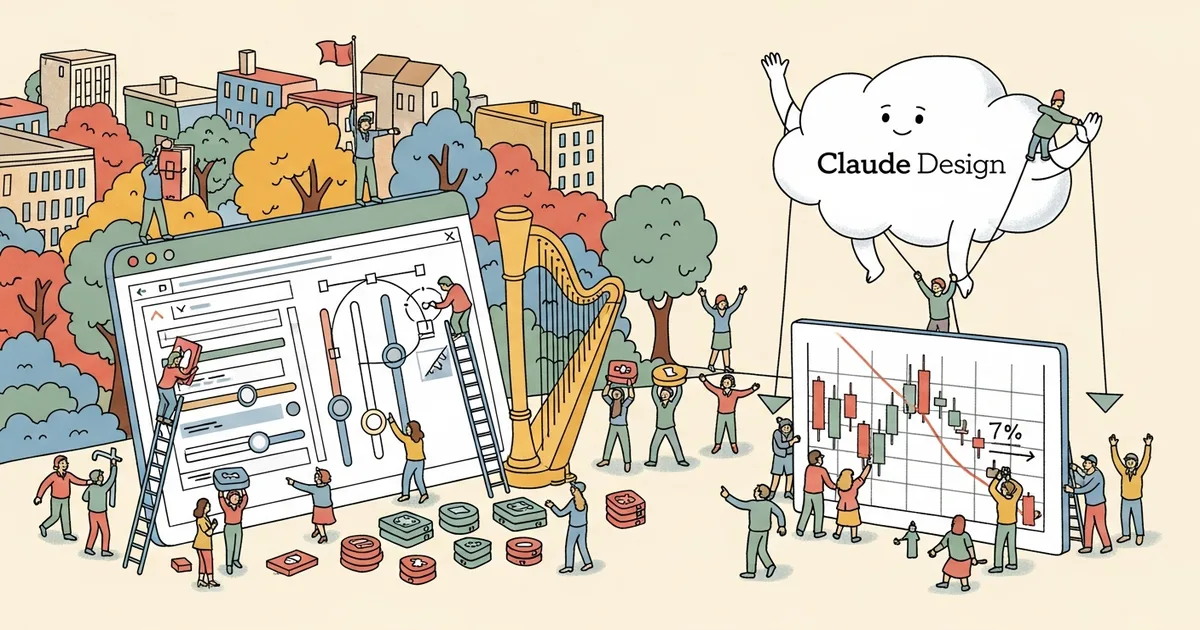
Anthropic launched Claude Design on April 17, 2026 — a generative design product built on Claude Opus 4.7 that converts text prompts into prototypes, pitch decks, slides, one-pagers, and marketing visuals. Figma’s stock dropped approximately 7% within hours of the announcement. The market read it correctly.
What Claude Design Actually Does
Claude Design is available to Anthropic’s Pro, Max, Team, and Enterprise subscribers — no separate pricing tier, no waitlist. Users describe what they want in plain language and receive production-ready design outputs. Refinement happens through conversation, inline comments, direct text edits, or AI-generated custom sliders that let non-designers manipulate visual parameters without touching code.
The output formats cover the full professional toolkit: Canva export, PDF, PPTX, HTML, or direct handoff to Claude Code for developers. That last option creates a closed loop between design and engineering that no competitor currently offers at the same subscription price point.
Anthropic CPO Mike Krieger — who co-founded Instagram and sold it to Facebook for $1 billion in 2012 — framed the product as “design literacy for everyone who has ever stared at a blank slide at 11pm.” The pitch is accessible. The underlying architecture is more ambitious.
The Design System That Learns Your Brand Automatically
The feature that separates Claude Design from every AI image generator or Canva clone is its onboarding intelligence. During setup, Claude reads your existing codebase and design files — Figma exports, CSS variables, component libraries, brand guides — and constructs your team’s design system automatically.
Every subsequent project inherits your brand colors, typography, spacing rules, and component library without manual configuration. A team that spent six months building a design system in Figma can port that institutional knowledge into Claude Design during a single onboarding session.
Brand consistency is the primary pain point for small-to-medium business design workflows — MegaOne AI tracks 139+ AI tools across 17 categories, and the absence of automatic brand context is the most common complaint across design-adjacent tools in our coverage. Claude Design’s auto-build feature targets that gap directly, and it’s the capability most likely to drive enterprise retention.
Why Claude Design Sent Figma Down 7%
Figma’s market capitalization declined approximately 7% on April 17, 2026, erasing billions in value on the day of Anthropic’s announcement. The drop reflects investor concern about a specific structural threat: the collapse of Figma’s handoff moat.
Figma’s defensibility has rested on three pillars — its multiplayer editing infrastructure, its component and design-system ecosystem, and its position as the handoff layer between design and engineering. Claude Design attacks all three simultaneously.
The handoff-to-Claude Code pipeline is the sharpest knife. Figma’s Dev Mode — which charges teams separately for developer access to design specs — generated recurring revenue precisely because the design-to-code transition was painful and proprietary. If Claude Design eliminates that friction natively within an existing Anthropic subscription, the economic justification for Dev Mode subscriptions weakens materially.
Figma’s previously blocked acquisition by Adobe — regulators killed the deal in 2023 at a $20 billion valuation — already surfaced the company’s strategic vulnerability. Today it faces a competitor with deeper AI infrastructure and a model already embedded in enterprise workflows at scale. Anthropic’s rapid internal development cadence has been visible for months — the design ambitions were not a surprise to anyone paying attention.
Mike Krieger’s Board Exit Was Not a Coincidence
Anthropic CPO Mike Krieger resigned from Figma’s board of directors during the same week Claude Design launched. Board resignations ahead of competitive product launches are standard conflict-of-interest protocol — Krieger almost certainly recused himself from Figma board discussions well before the public announcement. But the timing makes the competitive reality explicit in a way that no press release could.
Krieger’s background gives Claude Design a credibility signal that matters in enterprise sales. He built Instagram’s product experience from zero to over one billion users. When he frames this as “design literacy for everyone,” it carries a founder’s read, not a marketing department’s.
His departure also closes a governance conflict that had become structurally untenable. Sitting on the board of a company you are about to directly attack is a position that cannot hold. The exit formalizes what the market had already priced in — which is why the 7% drop came on announcement day rather than board-exit day.
Where Canva, Lovable, and the Competitive Field Stand
Canva CEO Melanie Perkins endorsed Claude Design as complementary rather than competitive — a response that reflects genuine product differentiation rather than diplomatic spin. Canva’s 185 million monthly active users come primarily for template-driven social media content, not enterprise design systems or technical engineering handoff workflows. Claude Design’s current feature set doesn’t touch that market in any meaningful way.
Lovable, the AI-powered front-end builder that converts prompts into deployable React applications, occupies different terrain. Its proposition is “from idea to app,” not “from brief to slide deck.” The Claude Code handoff from Claude Design could eventually erode Lovable’s positioning — particularly for users who want design and engineering outputs from the same conversational thread. That convergence pressure will intensify as Anthropic extends the pipeline.
The most direct competitive damage falls on Tome, Gamma, and Beautiful.ai — tools that built entire businesses around AI-assisted presentation design. Claude Design’s pitch deck output, distributed through Anthropic’s existing subscriber base across Pro, Max, Team, and Enterprise tiers, directly undercuts their market. These products have narrower moats and smaller distribution networks. The AI creative tool consolidation playing out in video is a useful parallel: mid-tier tools face the most acute pressure when a platform player enters with integrated distribution.
Claude Opus 4.7: The Vision Model Behind It
Claude Design runs on Claude Opus 4.7, the first Opus model with native vision generation capability alongside comprehension. Previous Claude versions could analyze images — they could not produce them. That capability gap had kept Anthropic out of visual creative tooling entirely. Opus 4.7 closes it.
Anchoring Claude Design to Opus 4.7 rather than a lighter, faster, cheaper model is a deliberate quality-first positioning decision. Competing AI design tools typically route generation through smaller models to minimize latency and inference costs. Anthropic is betting that output quality matters more than generation speed for professional design workflows — an argument that Figma’s entire product history supports. Figma never competed on speed; it competed on fidelity.
The vision generation backbone also opens Claude Design to future extensions: brand asset creation, in-document image editing, and eventually video content. The April 17 launch is a beachhead into a $50 billion+ design software market, not the full product.
The Claude Code Pipeline: Design to Deployment in One Thread
The Claude Code handoff is the feature that most clearly positions Claude Design as enterprise infrastructure rather than a standalone creative tool. A designer completes a prototype in Claude Design, triggers the handoff, and engineers receive structured component specs, asset references, and implementation notes — all within the same Anthropic interface, with no context lost in translation.
For teams already using Claude Code for engineering workflows, the value proposition is consolidation: one vendor, one subscription, one context window that holds both design intent and engineering implementation. The race to own the integrated workflow layer has defined enterprise AI competition through 2025 and into 2026. Anthropic just entered that race with a tool that connects directly to its existing coding product.
The alternative is what most teams operate today: Figma for design, a separate AI coding assistant, a project management layer, and multiple communication threads to keep everyone aligned. Claude Design’s pipeline doesn’t eliminate that complexity overnight. It removes one major seam — and that seam happens to be where Figma charges for access.
Anthropic has positioned Claude Design as an Anthropic Labs product, which historically signals rapid iteration over feature completeness. The design system auto-build, the Opus 4.7 vision backbone, and the Claude Code pipeline are the three structural bets that determine whether this product reshapes the market or becomes a capable-but-niche tool. The 7% Figma drop on launch day reflects investor judgment that at least one of those bets will land. Enterprise adoption over the next quarter will determine which ones.