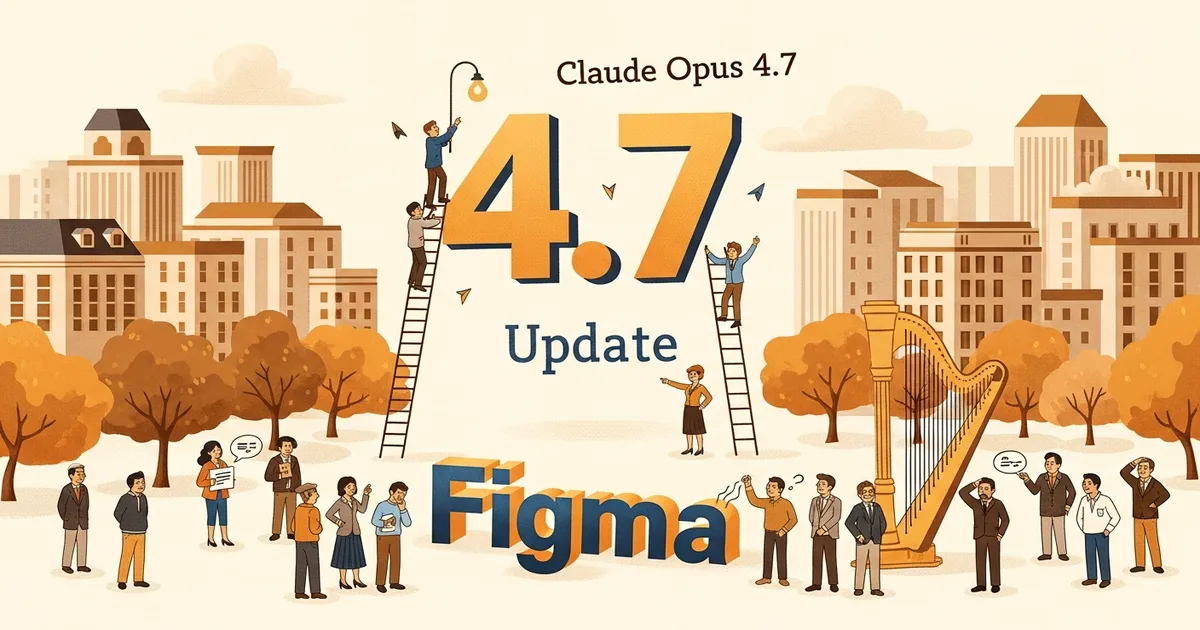
Anthropic released Claude Opus 4.7 on April 16, 2026 — confirmed via LLM Stats’ public model tracker, which logged the new proprietary model with a GPQA Diamond score of 0.90. The release, anticipated by reporting from The Information and Dataconomy during the week of April 14, marks an incremental upgrade over Claude Opus 4.6 but arrives bundled with a web-design feature that converts AI-generated code into editable Figma files — a move that immediately pressured Figma’s share price.
GPQA 0.90: The Benchmark That Sets the Baseline
The Graduate-Level Google-Proof Q&A (GPQA) Diamond benchmark tests expert-level reasoning across biology, chemistry, and physics — problems deliberately designed to defeat search engines. Opus 4.7’s confirmed score of 0.90 represents a measurable gain over Opus 4.6, which launched in February 2026 with strong coding performance and a 1-million-token context window.
GPQA Diamond is one of the few benchmarks that still differentiates frontier models. Human expert performance on GPQA Diamond sits around 0.69, meaning Opus 4.7 operates well above the upper bound of specialist human reasoning on the test’s targeted problem set.
MegaOne AI tracks 139+ AI models and tools across 17 categories. Opus 4.7’s score of 0.90 places it among the top performers on this metric as of mid-April 2026. The Information had previously reported that Anthropic was targeting a GPQA improvement as the centerpiece of this release cycle.
The Figma Code-to-Design Pipeline Explained
The more commercially significant announcement may be the design toolchain Anthropic released alongside Opus 4.7. The new web-design tool accepts natural-language prompts, generates HTML, CSS, or React code, and automatically converts that output into editable Figma components — layers, variables, auto-layout, and all.
This closes a hard gap in the standard AI-to-design workflow: generated code is useful to developers but opaque to designers who need to iterate in Figma. A designer can now prompt for a landing page, receive Figma-ready components, and modify them without touching a line of code.
Figma reported that its AI features — including its own code-to-design functionality — were a major driver of subscription growth through late 2025. Anthropic entering that territory directly, bundled with a frontier model subscription rather than sold as a separate product, changes the competitive calculus. The reaction in Figma’s share price reflects that concern more than any specific product shortcoming.
Word and PowerPoint: Anthropic Embeds Into the Office Suite
Alongside the web-design tool, Anthropic announced native embedding of Claude Opus 4.7 within Microsoft Word and PowerPoint. Users with qualifying Microsoft 365 subscriptions will be able to invoke Opus 4.7 directly from the Office ribbon — drafting, summarizing, reformatting, and analyzing documents without leaving the application.
This follows the broader pattern of AI companies deepening enterprise software partnerships as the consumer AI market matures. The integration positions Anthropic directly against OpenAI’s Copilot, embedded in Word and PowerPoint since 2023. Anthropic’s advantage on reasoning-heavy tasks — contract review, financial modeling, technical documentation — translates to accuracy gains where GPQA-class performance matters most.
No separate pricing has been announced. The integration is expected to roll out within existing Microsoft 365 Copilot tiers, pending tier-by-tier confirmation from Microsoft account teams.
Opus 4.7 vs. GPT-5.4 vs. Gemini 3.1 Pro
The three frontier models competing for enterprise deployment in Q2 2026 are Opus 4.7, GPT-5.4, and Gemini 3.1 Pro. Based on publicly tracked benchmark data as of April 17, 2026:
| Model | GPQA Diamond | Context Window | Notable Edge |
|---|---|---|---|
| Claude Opus 4.7 | 0.90 | 1M tokens | Reasoning depth, Figma toolchain, Office embedding |
| GPT-5.4 | Tracking | Undisclosed | Tool use, API ecosystem breadth |
| Gemini 3.1 Pro | Tracking | 2M tokens | Multimodal throughput, Google Workspace |
The 1-million-token context window introduced with Opus 4.6 remains a differentiator for long-document workloads. Gemini 3.1 Pro’s 2-million-token ceiling exceeds it on raw capacity, but Anthropic has consistently outperformed Google on instruction-following accuracy within long contexts — a distinction enterprise customers running legal and compliance workloads have validated in production.
GPT-5.4 continues to lead on tool-use breadth and API ecosystem depth. For developers building agentic AI applications, OpenAI’s integration surface remains wider. Opus 4.7 narrows the reasoning quality gap without yet matching GPT-5.4’s function-calling ecosystem.
What Opus 4.7 Is Not: The Claude Mythos Distinction
Opus 4.7 is not Claude Mythos. That distinction matters and has been consistently blurred in social media commentary since the April 16 release.
Claude Mythos — developed under Project Glasswing, Anthropic’s internal frontier research program — is a separate model that Anthropic has withheld from public release on security grounds. Mythos represents Anthropic’s current capability ceiling: a model the company has determined poses sufficient dual-use risk that standard API access is not appropriate. Anthropic disclosed the existence of Project Glasswing earlier in 2026 without releasing the model itself.
Opus 4.7 sits firmly in Anthropic’s commercial lineup — fully available via API and designed for enterprise deployment. The source code disclosure earlier this year offered an inadvertent look at the internal architecture separation Anthropic maintains between its commercial and frontier research tracks.
Confusing Opus 4.7 for Mythos understates both how capable Mythos reportedly is and how deliberately Anthropic is managing its release pipeline.
Anthropic’s Two-Week Release Cadence: The Fastest Pace in the Industry
Since January 2026, Anthropic has maintained a roughly two-week release cadence — the fastest sustained pace among frontier AI labs. Opus 4.6 launched in February. The intervening months included at least three Sonnet and Haiku tier updates, each targeting specific gaps in coding, multimodal performance, or context handling.
No other lab is matching this pace. OpenAI’s GPT-5 series has followed a monthly-plus cadence. Google’s Gemini releases have been spaced roughly six weeks apart. The two-week cycle reflects Anthropic’s shift to continuous improvement over the discrete major-version releases that defined 2023 and 2024.
The business logic is direct: faster iteration forces competitors to respond faster than their organizations are built to, creates more frequent reasons for enterprise customers to evaluate subscriptions, and generates a steady stream of benchmark coverage. MegaOne AI’s reporting on the AI acceleration debate has tracked how release cadence has become a competitive signal independent of the performance numbers themselves.
What the Claude Opus 4.7 Release Means for Your Stack
Opus 4.7 is worth testing if your workloads are reasoning-intensive: legal analysis, code review, financial modeling, or long-document synthesis. The GPQA improvement is confirmed and the 1M-token context window is production-stable following February’s rollout.
The Figma integration is the higher-conviction opportunity for product teams. If your workflow currently involves manual handoffs between AI-generated code and Figma, Anthropic has built the bridge. Test it before deciding whether to continue investing in Figma’s native AI tier.
For enterprise IT: if your organization is already on Microsoft 365 Copilot, Opus 4.7 access via Office may arrive without a separate procurement process. Confirm with your Microsoft account team before signing standalone Anthropic contracts. Anthropic’s next release is likely two weeks away.