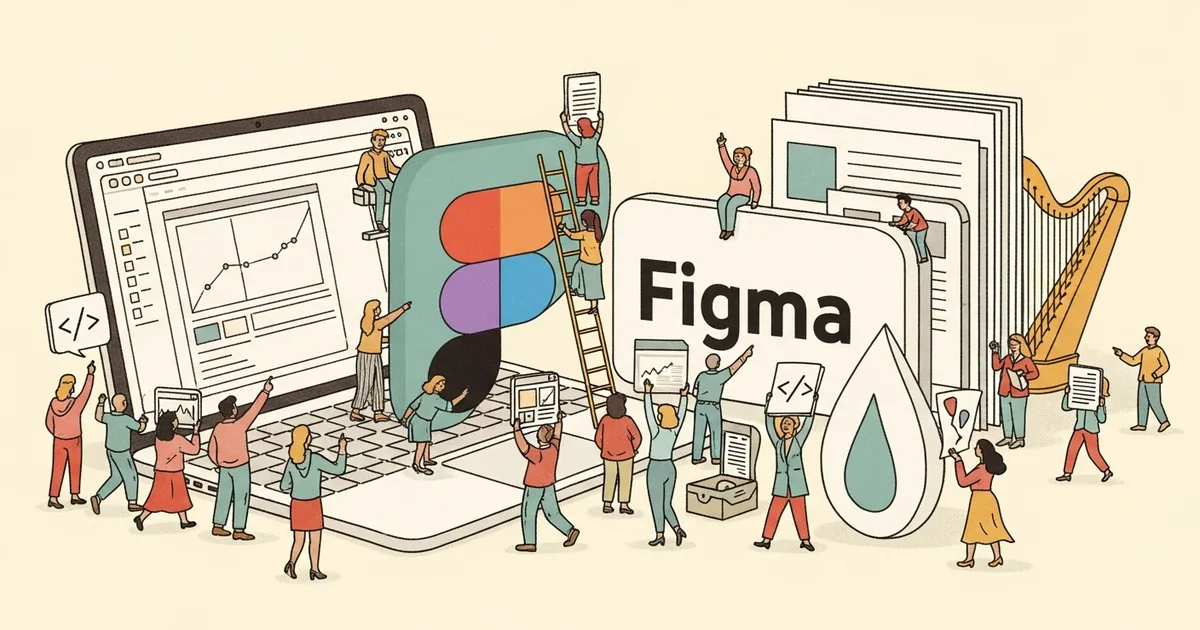
Anthropic confirmed the Claude Opus 4.7 release for the week of April 14, 2026, paired with a Figma integration that converts Claude-generated front-end code into editable design files — a direct pipeline from AI output to production-ready design assets. The launch drops in the most competitive week of AI product releases on record, competing for developer attention alongside GPT-5.4-Cyber, NVIDIA Ising, and Meta’s LlamaCon.
The Figma partnership is the structural story. Anthropic isn’t just updating reasoning benchmarks — it’s inserting Claude into the design workflow at the precise point where AI output typically ends up forgotten in a clipboard.
What the Claude Opus 4.7 Release Ships With
The April 14 launch packages three distinct capabilities under the Opus 4.7 label. The model-level upgrade carries standard Opus-class improvements in coding, reasoning, and instruction-following. The Figma code-to-design bridge translates Claude’s front-end code generation into structured Figma components, preserving layout hierarchies, spacing, and typography. And Microsoft Office embedding places Claude natively inside Word and PowerPoint as a first-class writing and content assistant — not a plugin, not a sidebar, but a native layer.
The Office integration is a distribution play as much as a capability play. Microsoft 365 has over 400 million commercial seats globally, according to Microsoft’s published reporting. Embedding Claude in that installed base doesn’t require users to change tools — it brings the model to where they already work.
The Figma Integration: Closing the Code-to-Design Gap
The persistent friction in AI-assisted development has been the handoff problem: Claude or another model generates clean React or CSS, and a designer then manually reconstructs that layout in Figma to create a source of truth for the design system. The Claude-Figma bridge eliminates that round-trip entirely.
When Claude generates front-end code through the new tool, the Figma integration automatically renders that output as editable Figma components — not screenshots, not static exports, but actual component objects with adjustable properties. A product team can take Claude’s generated UI, modify it in Figma, and push changes back to development without losing fidelity at any stage of the workflow.
The stakes of owning this layer were already established by market dynamics: Adobe’s attempted $20 billion Figma acquisition, abandoned in 2023 after EU regulatory intervention, confirmed that design tooling is a category worth fighting over at the highest levels of enterprise software consolidation. Anthropic is entering a space the market already priced at that level.
Design-to-code handoff consistently ranks as one of the most expensive friction points in product development. Research from Nielsen Norman Group on design-development workflows identifies specification misalignment as a leading driver of rework cycles. Anthropic is betting that owning this integration layer creates stickiness that benchmark leaderboards alone cannot generate.
The Figma deal also signals a shift in Anthropic’s go-to-market strategy. As MegaOne AI reported when Anthropic’s source code was briefly exposed, the company’s architecture has been primarily API-centric. The Figma partnership suggests Anthropic is now building directly into category-defining tools rather than waiting for developers to integrate Claude themselves.
Claude Enters Microsoft Office
The Word and PowerPoint integration extends Claude into Microsoft’s productivity stack at a moment when Google is pushing Gemini deeper into Workspace. Both moves reflect a race to capture the “working in documents” use case — the default behavior of hundreds of millions of knowledge workers who have never opened a standalone AI chat interface.
For Word, Claude generates first drafts, restructures arguments, summarizes research, and rewrites for tone without the user switching applications. For PowerPoint, Claude generates slide narratives from outlines and suggests visual structure based on content type — collapsing a workflow that previously required moving between at least three separate tools.
Microsoft’s decision to embed Claude alongside its existing Copilot products confirms the multi-model enterprise strategy that major platforms have been quietly building toward. As MegaOne AI tracked through the OpenClaw and broader acquisition wave, enterprise platforms are hedging across frontier models rather than committing to a single vendor — and paying for all of them simultaneously.
Anthropic’s Two-Week Shipping Machine
Since January 2026, Anthropic has shipped major, named releases on approximately a two-week cycle — a pace sustained across more than 14 weeks and unusual even by the current standards of an AI industry that materially accelerated its release cadence through 2025.
Each release in this window has bundled model improvements with at least one integration or partnership announcement, rather than shipping model-only updates. The pattern is deliberate: expand Claude’s surface area across category-defining tools rather than compete purely on benchmark scores, where the margin between frontier models continues to compress toward statistical noise.
MegaOne AI tracks 139+ AI tools across 17 categories, and Anthropic’s Q1 2026 cadence stands out as the most sustained high-frequency shipping schedule among the frontier labs in the dataset. The Figma and Office announcements with Opus 4.7 follow the same template every prior release established: model upgrade plus platform-level distribution expansion, packaged and shipped together.
The Week AI Competed With Itself
The week of April 14, 2026, requires a dedicated calendar to track. OpenAI shipped GPT-5.4-Cyber, a security-focused release, and completed the Hiro acqui-hire, bringing on specialized expertise in AI safety tooling. NVIDIA launched Ising, its next-generation inference chip targeting large-scale deployment workloads. Meta is hosting LlamaCon, its first developer conference built around the Llama open-source ecosystem.
Against that backdrop, the Claude Opus 4.7 release would ordinarily dominate the week’s coverage. In this particular window, it’s one of five flagship announcements competing for the same developer and enterprise audience. The concentration is partly coincidental, partly strategic — each company wants its narrative set before the others define the week.
The workforce displacement debate that movements like Humans First have been advancing finds a measurable, concrete expression in a week like this: the tooling environment changes faster than teams’ capacity to evaluate it. A design organization assessing the Claude Figma integration is simultaneously deciding what to do with GPT-5.4-Cyber, what NVIDIA Ising means for inference cost, and whatever Meta announces at LlamaCon. The information burden alone is a product strategy decision.
What Changes for Design and Development Teams Now
The Claude Opus 4.7 launch creates a practical new workflow that didn’t exist seven days ago:
- AI code → Figma component: No manual reconstruction of AI-generated UI in design tools; the integration renders it directly
- Design iteration → code sync: Designers modify Figma components while maintaining fidelity with the development branch
- Office-native drafting: Technical writers, product managers, and analysts use Claude in Word and PowerPoint without a context switch or tab change
Teams already on Claude via API should evaluate the Figma integration first — it addresses a documented bottleneck rather than requiring behavioral change to unlock value. The Office integration is the higher-leverage entry point for knowledge workers who haven’t adopted standalone AI tools, which remains the majority of enterprise employees across most industries.
The Opus 4.7 release doesn’t make AI-assisted design inevitable. It removes the friction that was the main practical obstacle to it. That’s a different kind of milestone than a benchmark score, and historically it’s the kind that compounds.