Three former U.S. national security officials — General Joseph Dunford, former Chairman of the Joint Chiefs of Staff; Frances Townsend, former White House Homeland Security and Counterterrorism Adviser; and Michael Morell, former CIA Deputy Director and Acting Director — co-published a warning on April 20, 2026, that China’s AI military advantage is advancing through an aggressive five-part strategy, and that the margin separating the two nations is now “razor thin.” Their combined assessment: the structural conditions that sustained American military dominance for half a century no longer hold.
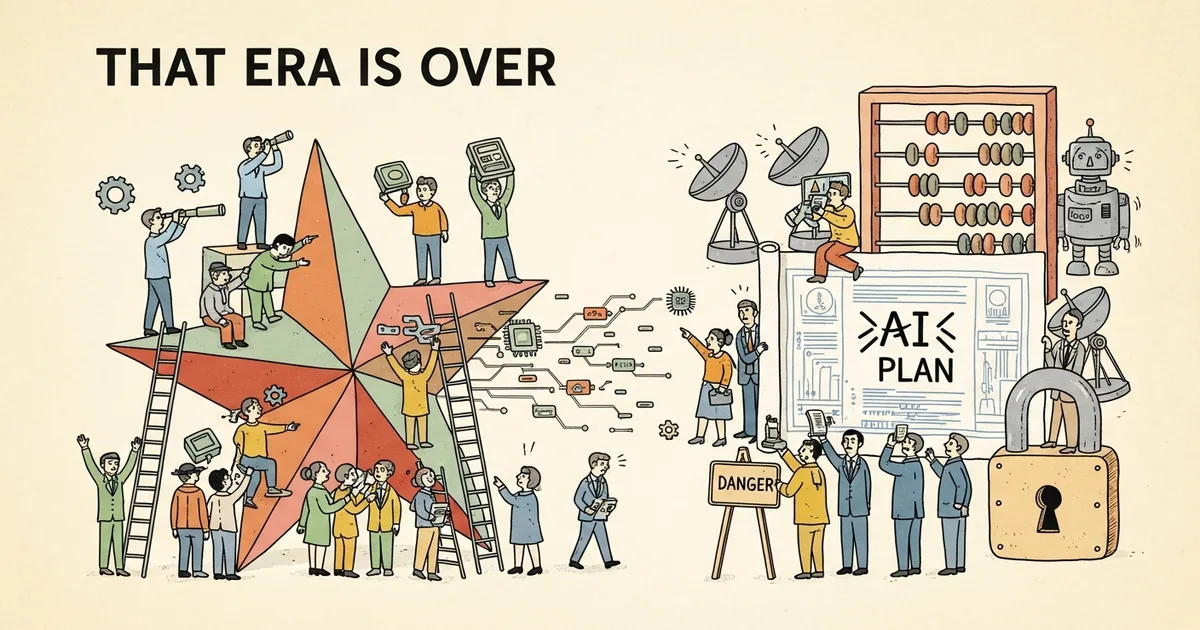
“For decades, America’s military edge was unquestioned,” the three officials wrote. “That era is over.”
The Stanford 2026 AI Index places the U.S.-China gap at just 2.7 percentage points on Chatbot Arena rankings — the closest convergence on any major AI capability benchmark in the modern era of large language models.
The Credentials Behind the Warning
These are not think-tank theorists. Dunford served as the 19th Chairman of the Joint Chiefs from 2015 to 2019, the highest-ranking officer in the U.S. military. Townsend directed homeland security and counterterrorism coordination across sixteen intelligence agencies from 2004 to 2008. Morell spent 33 years at the CIA, twice serving as Acting Director and co-authoring the agency’s most sensitive finished intelligence products.
When officials at this operational level publish a joint warning, it typically reflects access to classified assessments that cannot be stated in public. Their five-part framework maps onto open-source evidence that has been accumulating for years — which is precisely what makes the warning structurally credible, not merely alarming.
China’s Five-Part AI Strategy
The officials characterize China’s approach as coordinated, state-directed, and multi-vector — not a single program but a portfolio of simultaneous advances designed to achieve full-spectrum AI dominance by 2030. The five pillars they describe align with documented Chinese policy:
- Centralized government investment. China’s 2017 New Generation AI Development Plan committed to becoming the world’s primary AI innovation center by 2030. Government and state-directed private spending now exceeds $15 billion annually, according to Georgetown University’s Center for Security and Emerging Technology — with no equivalent federal coordination mechanism in the United States.
- Military-civil fusion. China’s MCF doctrine legally requires private AI firms to share technology and research with the People’s Liberation Army. There is no American analog. U.S. defense AI programs compete with private-sector breakthroughs rather than commandeering them.
- Talent pipeline at scale. China produces approximately 1.4 million STEM graduates annually — roughly four times the U.S. figure, according to the National Science Foundation’s 2025 Science and Engineering Indicators. Beijing’s talent recruitment programs continue drawing back diaspora researchers despite U.S. restrictions on some participants.
- Data infrastructure at population scale. China’s surveillance state — biometric databases, predictive policing systems, real-time social monitoring — generates AI training data at a volume no democratic government can match. The PLA’s access to this data for autonomous systems development represents a structural, not merely tactical, advantage.
- Technology acquisition through restricted channels. The DeepSeek case, detailed below, demonstrates China’s ability to extract frontier-class capability from legally restricted hardware — a direct counter to U.S. export controls that American policymakers have not effectively answered.
The Stanford Data: 2.7 Points Is Not a Comfortable Margin
The Stanford 2026 AI Index benchmarks national AI performance across research output, model capability, infrastructure deployment, and economic application. On Chatbot Arena rankings — the most widely cited head-to-head model evaluation platform — the U.S.-China gap stands at 2.7 percentage points.
The trend is more alarming than the current figure. In 2022, the gap exceeded 12 percentage points. By 2024, it had compressed to roughly 6. The rate of compression, not the absolute gap, is what the three officials flag. At the current trajectory, parity on frontier model capability arrives before the end of the decade.
Stanford’s index shows China leading in categories that benchmark rankings do not capture. China holds 61% of global AI patents versus 21% for the United States. Chinese institutions produced 38% of all peer-reviewed AI research papers in 2025, compared to 21% from U.S. institutions. On industrial robot installations — a direct indicator of AI-enabled manufacturing capacity — China accounted for 70% of global deployments in 2025, according to the International Federation of Robotics.
Patent leadership translates to licensing leverage over future standards. Publication leadership shapes the global research agenda. Robot deployment leadership means the PLA trains on AI-optimized logistics and manufacturing systems that U.S. forces are still building toward.
DeepSeek: Restricted Chips, Unrestricted Results
The clearest evidence that U.S. export controls are underperforming is DeepSeek. The Chinese AI lab trained frontier-level models on NVIDIA H100 chips legally restricted for export to China under Commerce Department rules. The hardware arrived through gray-market distributors operating across Southeast Asia, according to Reuters and Bloomberg reporting in early 2025.
DeepSeek is now raising $300 million at a $10 billion valuation — making it one of the most valuable AI companies operating outside the United States. Its R1 reasoning model performed comparably to OpenAI’s o1 on multiple benchmarks at a fraction of the reported training cost, a result that triggered a $600 billion single-day decline in NVIDIA’s market capitalization in January 2025.
The restricted-chip evidence cuts in two directions simultaneously. First, U.S. export controls have not prevented China from accessing frontier-class hardware at operational scale. Second, Chinese researchers have demonstrated the ability to approach frontier results on constrained compute budgets, which means chip restrictions alone cannot function as a containment strategy. As the global AI infrastructure race accelerates — with companies like Nebius committing $10 billion to AI data centers in geopolitically sensitive locations — China is simultaneously building domestic chip production capacity to reduce future exposure to U.S. export rules entirely.
China’s AI Military Advantage: Where the Lead Is Already Operational
Washington’s AI competition debate concentrates on model benchmarks — which country’s chatbot scores higher on reasoning tests. That framing systematically misses the domains where China’s lead is not closing but already established at operational scale.
- Autonomous weapons systems. The PLA has deployed AI-enabled drone swarms and loitering munitions in operational combat units. The U.S. Department of Defense’s Replicator autonomous systems initiative, announced in 2023, is still scaling toward its first deployment targets.
- Industrial automation at military scale. China’s 70% share of global industrial robot installations directly translates into AI-optimized defense manufacturing throughput — a capability that arena benchmark scores do not measure.
- Population-scale AI operations experience. China’s domestic AI deployment — facial recognition across an estimated 700 million cameras, algorithmic social scoring, real-time population monitoring — gives the PLA accumulated operational experience running large-scale AI systems that no Western military has accumulated in live production environments.
The gap in consumer-facing AI models is narrowing. The gap in military-industrial AI application is already closed in several operational categories, according to the three officials’ assessment.
What Dunford, Townsend, and Morell Recommend
The three officials do not limit their analysis to diagnosis. Their recommended response has five corresponding elements that mirror China’s strategy in structure if not in method:
- Federal AI coordination authority with real budget power. A National AI Strategy Council that controls actual appropriations, not another advisory board that produces reports. The current landscape of siloed DoD, NSF, NIST, and intelligence community AI programs lacks the unified direction that China’s centralized model provides by design.
- STEM immigration reform to retain trained talent. Approximately 40% of U.S. AI PhDs are foreign nationals. Current visa policy effectively exports that talent to Canada, Europe, and, in some cases, back to China after graduation from American universities.
- Accelerated defense AI procurement timelines. The existing 18-to-24-month acquisition cycle for AI-enabled defense systems is incompatible with the pace of AI development. China moves from research to operational deployment faster, partly through military-civil fusion and partly through reduced regulatory friction at the development stage.
- Export controls enforced through allied coordination. Restrictions enforced unilaterally fail when allied jurisdictions do not participate. The DeepSeek chip acquisition illustrates this directly — the restricted hardware transited jurisdictions that did not share U.S. export control obligations.
- Sustained federal AI R&D investment at $10 billion annually. Market incentives will not fund the basic research and national security AI applications that China’s state-directed model provides by design. The officials argue this floor is the minimum required to maintain research leadership in dual-use domains.
The Geopolitical Stakes
The Dunford-Townsend-Morell warning is not an outlier alarm. It follows a consistent pattern of senior officials across administrations reaching the same conclusion: AI capability and national security have become inseparable, and the United States is competing in a race it has not yet organized to win at the pace required.
The technology reshaping AI industry consolidation across Silicon Valley is the same technology the PLA is integrating into command-and-control systems, intelligence analysis pipelines, and autonomous weapons platforms. MegaOne AI tracks 139+ AI tools across 17 categories; the pattern visible across that coverage mirrors what the three officials describe — Chinese AI applications are moving from research to operational deployment faster than benchmark gap data suggests. The domestic pressure AI is generating within American society is real, but the geopolitical pressure is building faster and with fewer countervailing forces.
The 2.7-point Arena gap will not remain at 2.7 points. The question facing U.S. policymakers is whether the American response will be organized before it closes — and the three officials who spent their careers answering that kind of question are not optimistic about the current trajectory.