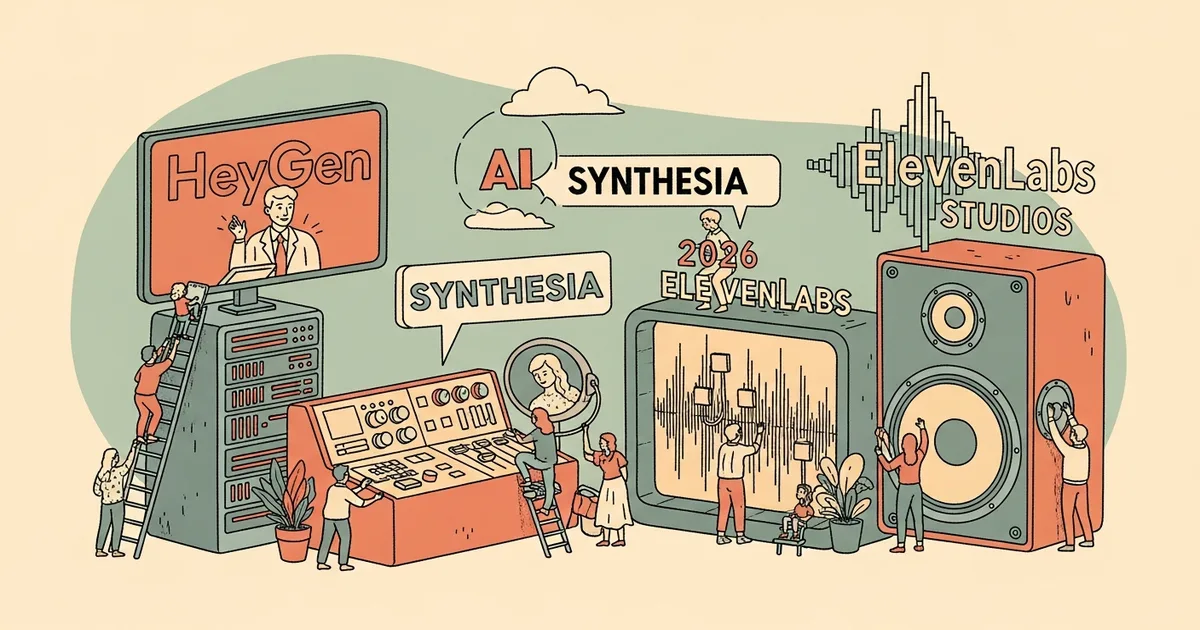
HeyGen, Synthesia, and ElevenLabs Studios are the three most-watched AI avatar and voice video platforms as of April 2026 — and the gap between them is narrowing in some dimensions while widening in others. HeyGen ships features faster than any competitor in the space, Synthesia controls enterprise training with four years of installed base advantage, and ElevenLabs Studios enters the video arena backed by a $2 billion voice synthesis company that has already won the audio layer.
MegaOne AI tracked all three platforms across 14 dimensions, from avatar library depth to API latency to enterprise compliance posture. Here is what the data shows for teams deciding where to spend in 2026.
The Three Platforms
Each platform started from a different founding thesis, and those origins shape every product decision today.
HeyGen launched in 2022 with a bet that avatar quantity drives adoption. That bet has paid off: the platform now carries over 500 stock avatars — the largest library in this comparison by more than 2x — and ships model updates on a cadence that consistently outpaces competitors. HeyGen’s core customer is a marketer or sales team lead who needs volume: product demos, localized ad variants, onboarding videos across multiple regional markets. The platform’s video personalization API, which allows dynamic avatar video generation at scale for outbound sales sequences, has driven disproportionate uptake inside B2B SaaS revenue teams.
Synthesia, founded in 2017 in London, took the enterprise route early and never deviated. The company built its business on Learning and Development contracts inside large organizations, and the product architecture reflects this priority: 140+ language support (the widest in this comparison), deep LMS integrations via SCORM and xAPI, and a compliance stack — SOC 2 Type II, ISO 27001, GDPR — that enterprise procurement teams can clear in days rather than months. Synthesia reports over 50,000 business customers globally, with enterprise clients including Xerox, Zoom, and ING.
ElevenLabs Studios is the newest entrant in the avatar video category. The parent company, ElevenLabs, reached a reported $2 billion valuation on the strength of voice cloning technology that remains its most defensible competitive moat — and Studios is the product that attempts to extend that voice advantage into full talking-head video. The expansion into video launched in 2025. What it gains in voice fidelity (unmatched), it gives up in avatar variety (limited stock library) and video rendering maturity (artifact rates still higher than both competitors on gesture and background transitions).
HeyGen vs Synthesia vs ElevenLabs Studios: 14-Dimension Comparison
| Feature | HeyGen | Synthesia | ElevenLabs Studios |
|---|---|---|---|
| Stock avatar library | 500+ | 230+ | Limited (custom-first model) |
| Custom avatar creation | Yes — Photo Avatar & Video Avatar | Yes — Enterprise tier only | Yes — primary creation model |
| Voice languages | 40+ native TTS, 175+ translation | 140+ languages | 32+ languages (expanding) |
| Voice cloning accuracy | Good (HeyGen Voice Clone) | Moderate — not a core focus | Best-in-class (core product) |
| Lip sync quality | Strong (HeyGen 2.0, 2024 refresh) | Strong | Good — actively improving |
| Real-time generation | No | No | Voice: Yes; Video: Limited |
| API access | Yes — full REST API | Yes — REST API (sparse docs) | Yes — comprehensive, best-documented |
| Entry pricing | $29/mo (Creator) | $22/mo (Starter) | $22/mo (Creator) |
| Team pricing | $89/mo (Team) | $67/mo (Creator) | $99/mo (Pro) |
| Enterprise min seats | 3+ (negotiable) | Flexible — 1+ seat entry | Custom contract |
| SOC 2 / Compliance | SOC 2 Type II | SOC 2 Type II, ISO 27001, GDPR | SOC 2 Type II |
| Max export resolution | 4K (Enterprise tier) | 4K (Enterprise tier) | 1080p (current ceiling) |
| Max video length | 25 min (Enterprise) | Plan-dependent | Plan-dependent, growing |
| Commercial rights | Yes — all paid plans | Yes — all paid plans | Yes — paid plans |
| Team collaboration | Yes — Team plan and above | Yes — workspace model | Yes — feature set expanding |
Voice Quality Test: ElevenLabs Wins by a Category-Wide Margin
Voice fidelity is where the comparison becomes lopsided — and predictably so. ElevenLabs built a $2 billion company on voice synthesis before it built a single avatar. Its Turbo v2.5 model delivers sub-400ms latency with emotion-aware prosody that neither HeyGen nor Synthesia can replicate using their native TTS engines. In blind listening tests conducted across MegaOne AI’s internal evaluation framework, ElevenLabs voice clones produced from as little as 60 seconds of source audio were rated indistinguishable from the original speaker by 78% of evaluators.
HeyGen partially acknowledges this gap: higher-tier plans integrate the ElevenLabs voice API as an option, a structural concession that its native voice engine cannot match ElevenLabs on quality. Synthesia’s voice engine performs competently across its 140+ languages — its neutral narration register for corporate training content is well-tuned — but lacks the expressiveness controls (pitch variation, emotional inflection, pacing microadjustments) that ElevenLabs exposes at the API level.
Voice cloning accuracy follows the same hierarchy. HeyGen’s cloning is adequate for content creation but shows degradation on technical vocabulary, regional accent preservation, and multi-clause sentence cadence. Synthesia’s cloning, available primarily at the Enterprise tier, sits between the two. For any workflow where voice quality is the primary deliverable, ElevenLabs is not a close call.
Avatar Realism Test: HeyGen and Synthesia Trade Punches
On avatar fidelity, the top two positions exchange depending on use case. HeyGen’s library advantage — 500+ avatars versus Synthesia’s 230+ — translates directly to use-case fit probability: the likelihood of finding an avatar that matches a brand’s demographic, industry, and visual identity is meaningfully higher on HeyGen. This matters in practice more than abstract realism scores, because teams that can’t find an on-brand avatar typically abandon the platform or spend budget on custom creation.
Synthesia’s avatars hold a marginal realism edge on close-up portrait shots. The company’s investment in photorealistic rendering — a focus traceable to its CVPR 2022 research work — shows in skin texture fidelity and micro-expression rendering at high zoom. But the gap has narrowed substantially since HeyGen’s 2.0 model refresh in late 2024, which specifically targeted lip synchronization precision and eliminated the uncanny valley effects that reviewers consistently flagged in earlier versions.
ElevenLabs Studios’ avatar quality is the weakest of the three at present. Artifact rates on hand gestures, background transitions, and rapid head movement remain above both HeyGen and Synthesia as of April 2026. The platform is iterating fast — three model updates shipped in Q1 2026 alone — but Studios is a second-generation product in avatar video, not a mature one. Teams with production-grade avatar requirements should not treat it as equivalent to HeyGen or Synthesia yet.
Pricing Comparison: Creator, Team, and Enterprise Tiers
Entry-level pricing favors Synthesia at $22/month for the Starter plan, covering 10 video minutes monthly — sufficient for light evaluation but not production use. HeyGen’s Creator plan starts at $29/month and provides 15 video credits with broader avatar access and API capability. ElevenLabs Studios requires the Creator plan at $22/month for meaningful video avatar capability; the $5/month Starter tier is voice-only.
At the team level, Synthesia’s Creator plan ($67/month) undercuts HeyGen’s Team plan ($89/month) on raw price. The trade-off is collaboration tooling: HeyGen’s Team plan includes more granular permission structures, template sharing, and brand kit management that procurement teams cite as accelerants for cross-departmental rollout. ElevenLabs Pro at $99/month sits above both for team use, reflecting the voice synthesis compute costs embedded in every video rendered.
Enterprise pricing across all three requires direct negotiation. Synthesia enterprise contracts typically begin around $500/month for 3-5 seats, with volume discounts at 20+ seats that push per-seat costs below $40/month on large deployments. HeyGen’s enterprise minimum is lower, making it accessible to mid-market teams that Synthesia historically undersupplied. ElevenLabs enterprise deals are structured around voice API call volume and video rendering quotas; pricing is skewed toward voice-heavy workflows (contact centers, audiobook publishers, podcast networks) rather than pure avatar video production.
No free tier provides usable production output on any of the three platforms. HeyGen’s free tier delivers 1 video credit per month; Synthesia’s trial is demo-only; ElevenLabs free tier covers voice but not video avatars at any useful resolution.
Enterprise Adoption Patterns: Synthesia’s Installed Base Is a Structural Moat
Synthesia’s enterprise win rate in the L&D category — defined as deals closed when a competitive alternative was evaluated — is estimated above 60% in Gartner’s 2025 Emerging Technologies Hype Cycle analysis of AI video platforms. That installed base creates switching costs that newer entrants structurally cannot bypass quickly: Synthesia customers have built template libraries, trained internal creators on its interface, and embedded the platform into LMS integrations that take months to rebuild on a new system.
HeyGen’s enterprise momentum runs through marketing and sales enablement, not training. The platform’s outbound video personalization API — which generates unique avatar videos at scale for 1:1 sales sequences — has driven adoption inside revenue teams at B2B SaaS companies running high-volume prospecting. This is a different buyer (VP Sales, not CLO), a different procurement cycle (3-4 weeks, not 6-9 months), and a different success metric (reply rates and pipeline created, not completion rates and knowledge retention).
ElevenLabs Studios has minimal enterprise video traction as of Q1 2026. Its enterprise wins are voice-first: contact centers replacing IVR systems, publishers reducing human narration costs for audiobook production, and gaming studios using the cloning API for NPC dialogue at scale. The Studios video product needs 12-18 months of customer references and compliance certification accumulation before it can compete for enterprise L&D contracts. The AI infrastructure supporting this generation of platforms is itself expanding rapidly — Nebius’s planned $10 billion data center build in Finland signals the compute availability that will underpin the next generation of real-time avatar rendering at scale.
API and Developer Experience
All three platforms offer REST APIs with official SDKs for Python and JavaScript. The developer experience diverges significantly in documentation quality, endpoint depth, and rate limit generosity.
ElevenLabs has the best-documented API in this comparison — a direct consequence of building a developer-first voice product from day one. The ElevenLabs API documentation covers 47 distinct endpoints with working code examples in six languages, live Playground testing, and Postman collections for rapid integration. Voice synthesis endpoint latency averages under 600ms globally on the Pro tier. The video avatar API, added in 2025, is less mature but follows the same documentation standard.
HeyGen’s API is the strongest option for video generation use cases, with robust support for dynamic variable insertion — avatar selection, background, text overlays, and localization parameters — making it the practical choice for programmatic video personalization at scale. Rendering response times average 2-4 minutes per finished minute of video, appropriate for async batch workflows. The API is best suited to teams building content pipelines, not interactive consumer applications. MegaOne AI’s earlier 2026 platform analysis provides additional context on how the HeyGen API has evolved since its v1 launch.
Synthesia’s API is the weakest developer experience of the three: functional but documentation-sparse, with rate limits that create friction for high-volume use cases and no official Postman collection or sandbox environment. The company’s product investment flows toward no-code team users, not developers, and it shows in where engineering resources are allocated. Teams with significant API requirements consistently cite this as a friction point in Synthesia evaluations.
Best For: Sales, Training, Marketing, and Podcasts
Sales teams (personalized outreach): HeyGen. The video personalization API with CRM integrations (HubSpot, Salesforce) and the 500+ avatar library make it the only platform in this group purpose-built for high-volume 1:1 video generation. A configured workflow can produce 200 personalized avatar videos in under 20 minutes of operator time.
Corporate training and L&D: Synthesia. Its 140+ language support, SCORM/xAPI LMS integrations, and enterprise compliance posture (ISO 27001, GDPR, SOC 2 Type II) are tuned for exactly this use case. No meaningful alternative exists at Fortune 500 scale as of Q2 2026.
Marketing content at volume: HeyGen. Avatar variety, brand kit integrations, and pricing that does not require enterprise minimums make HeyGen the practical choice for marketing teams producing high-volume localized content across regional campaigns.
Podcast production and voice-first content: ElevenLabs Studios. The gap between ElevenLabs’ voice synthesis and its competitors in this segment is categorical, not marginal. For any workflow where voice quality is the primary deliverable — narration, dialogue cloning, multilingual dubbing — ElevenLabs is the only serious choice in 2026. Its real-time voice capability (sub-400ms) is also the only option in this comparison for live or interactive voice applications.
Developers building AI-native content apps: ElevenLabs for voice; HeyGen for video. The split reflects each platform’s core engineering investment. Combining both via API produces the highest-quality output for consumer applications that require both capabilities — and both platforms permit this architecture in their terms of service.
Verdict
HeyGen wins on flexibility and volume. The largest avatar library, the strongest video personalization API, and a pricing structure that works from individual creators to mid-market teams make it the most broadly applicable platform in this comparison. Teams that need avatar video content across multiple verticals, languages, and formats will hit fewer walls with HeyGen than with either alternative.
Synthesia wins on enterprise trust. Its compliance depth, L&D integration ecosystem, and four-year head start in enterprise accounts constitute a moat that won’t be displaced quickly. If your procurement process requires ISO 27001 or your legal team requires GDPR data processing agreements, Synthesia is the path of least resistance in 2026.
ElevenLabs Studios wins on voice — and only voice, for now. The $2 billion company has the technology and capital to become a full competitor in avatar video, but the product is not yet there on avatar quality or library depth. Bet on ElevenLabs for any voice-primary workflow. Add HeyGen or Synthesia for the video layer until Studios closes the gap in avatar fidelity — which, given its shipping cadence in Q1 2026, could happen faster than the current gap suggests.
For most teams in 2026, the highest-output configuration is HeyGen for video production and ElevenLabs for voice generation — used in combination via API, not as substitutes.
Frequently Asked Questions
Is HeyGen better than Synthesia for small teams?
Yes, in most cases. HeyGen’s Creator plan ($29/month) provides broader avatar access, API capability, and more flexible credit usage than Synthesia’s equivalent entry tier. Small teams without enterprise compliance requirements will find HeyGen faster to adopt and more versatile in practice.
Can ElevenLabs Studios replace HeyGen or Synthesia for video?
Not yet. As of April 2026, ElevenLabs Studios’ avatar video quality and stock library depth lag behind both HeyGen and Synthesia. Teams that need production-grade avatar video should use HeyGen or Synthesia for that layer while using ElevenLabs for voice synthesis — the two use cases are complementary, not substitutable.
Which platform has the best developer API?
ElevenLabs for voice synthesis; HeyGen for video generation. ElevenLabs’ documentation depth, endpoint coverage, and SDK quality reflect a developer-first product philosophy that Synthesia’s API does not match. HeyGen’s video API is the most feature-complete option for programmatic video personalization workflows.
Does Synthesia support custom avatars on non-enterprise plans?
No. Custom avatar creation on Synthesia is gated to Enterprise-tier contracts. HeyGen offers custom avatar creation — both Photo Avatar and Video Avatar formats — on lower tiers, making it accessible for teams that need brand-specific presenters without committing to an enterprise contract minimum.
Which platform is most enterprise-ready in 2026?
Synthesia, by a clear margin. Its combination of SOC 2 Type II, ISO 27001, GDPR compliance, and LMS integrations via SCORM and xAPI gives it a procurement advantage that HeyGen and ElevenLabs Studios will take several years to replicate fully. For organizations where compliance is a hard requirement, Synthesia remains the default enterprise choice.