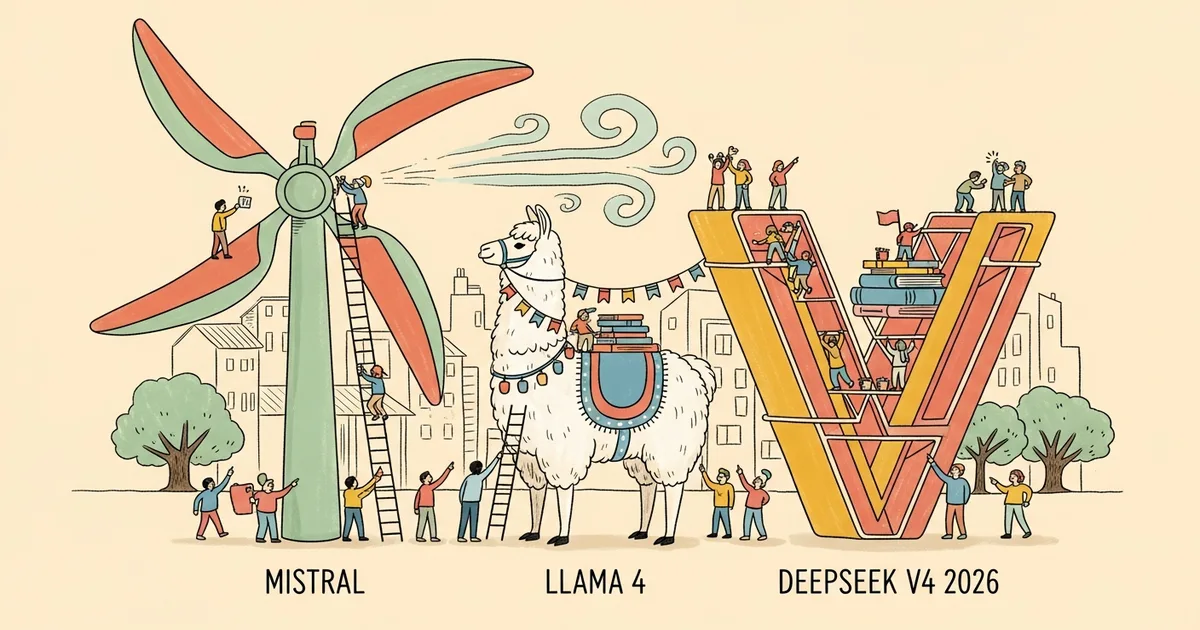
Three open-weight foundation models — Mistral Large 3 (Mistral AI, France), Meta Llama 4 Behemoth (Meta Platforms, United States), and DeepSeek V4 (DeepSeek, China) — define the open-source AI frontier as of April 21, 2026. The Stanford HAI 2025 AI Index reports the gap between the strongest open-weight and best proprietary models has narrowed to 2.7 percentage points on aggregate benchmarks, down from 19 points in 2023. Open source has, measurably, arrived.
That convergence carries geopolitical weight. Each model embeds the regulatory DNA, infrastructure philosophy, and strategic alignment of its country of origin. Choosing between them is no longer purely a technical decision — it is a supply-chain decision with compliance implications now occupying board-level AI risk committees. MegaOne AI tracks 139+ AI tools across 17 categories. This comparison covers the foundational layer beneath them all.
Full Model Specification Matrix
| Specification | Mistral Large 3 | Meta Llama 4 Behemoth | DeepSeek V4 |
|---|---|---|---|
| Origin Country | France (EU) | United States | China |
| Parameter Range | 123B (dense) | ~2T total / 288B active (MoE) | ~800B total / 42B active (MoE) |
| Architecture | Dense Transformer | Mixture-of-Experts (MoE) | MoE + Multi-head Latent Attention (MLA) |
| Training Compute | ~6×10²³ FLOPs | ~10²⁵ FLOPs | ~3×10²³ FLOPs |
| Training Cost (est.) | ~$15–20M | $100M+ | ~$5.6–12M |
| License | Mistral Research / Commercial License | Llama Community License v4 | DeepSeek Model License |
| Commercial Restrictions | API >10M tokens/mo requires MCL; self-hosting free | Prohibited for orgs >700M MAU | Outputs cannot be used to train competing LLMs |
| SWE-bench Verified | 37.1% | 44.3% | 46.8% |
| MMLU | 84.3% | 88.1% | 87.8% |
| GPQA Diamond | 53.2% | 59.4% | 61.2% |
| HumanEval | 78.4% | 84.7% | 86.3% |
| Context Window | 128K tokens | 256K–1M tokens | 128K tokens |
| Multilingual Support | 28 languages (EU-focused) | 12 languages | English + Chinese (strong); 8 others limited |
| OpenRouter Available | Yes | Yes | Yes |
| Together AI Available | Yes | Yes | Pending (Apr 2026) |
| Fine-tuning Support | Yes (HuggingFace PEFT + official recipes) | Yes (llama-recipes, PEFT, full fine-tune) | Yes (community; official recipes Q2 2026) |
Geopolitical Stakes: Why Origin Country Now Outweighs Benchmarks for Many Enterprises
Three former CIA directors — Leon Panetta, John Brennan, and David Petraeus — issued a joint 5-point warning in early 2026 urging the U.S. government to treat Chinese open-weight model releases as potential intelligence vectors. Their concerns centered on model backdoors, unverifiable data provenance, and the use of state-adjacent compute infrastructure. The warning did not name DeepSeek explicitly, but the timing — three weeks after DeepSeek’s $300 million Series B — left little ambiguity about the intended target.
DeepSeek V4 is reported to have been trained on Huawei Ascend 910C clusters. Huawei sits on the U.S. Entity List. American enterprises self-hosting DeepSeek V4 weights face an unresolved legal grey area: doing so does not currently constitute a sanctions violation, but several Fortune 500 legal teams have informally advised against production deployment until Treasury publishes clearer guidance on Huawei Ascend-trained model weights.
Mistral occupies a more comfortable regulatory position. Headquartered in Paris and operating under EU AI Act general-purpose AI (GPAI) provisions, Mistral Large 3 was structured specifically to comply with Article 53 transparency obligations. The Humans First movement, which gained traction in EU policy circles throughout 2025, has cited Mistral as proof that sovereign AI capability is achievable without dependency on Chinese or American cloud infrastructure — a talking point that plays well in Brussels procurement conversations.
Meta’s position is the most paradoxical of the three. Zuckerberg made open-source AI a personal brand through 2023–2025. But as explored in coverage of Meta’s intensifying competitive pressures, the Llama 4 Behemoth release structure signals a quiet retreat from unconditional openness: the flagship model ships under a license prohibiting commercial use by organizations exceeding 700 million monthly active users. That threshold excludes exactly zero of Meta’s platform-scale competitors while technically preserving the “open” label. The 2.7-point benchmark gap against closed models is a structural win for openness; the licensing architecture is a concession in the other direction.
Training Cost Deltas: The Million Gap That Restructured Industry Assumptions
DeepSeek’s $5.6 million training run for V3 — confirmed in their published technical report — restructured the industry’s understanding of compute-efficiency frontiers. V4’s training cost, not yet officially disclosed, is estimated at $8–12 million based on Huawei Ascend cluster pricing and scale increases implied by architecture disclosures. Compare that to Meta’s Llama 4 Behemoth training budget of $100 million+ and Mistral Large 3’s estimated $15–20 million compute spend, and the gap is not a rounding error — it is a structural cost advantage that compounds at inference scale.
DeepSeek achieves this through three documented techniques: Multi-head Latent Attention (MLA), which reduces KV cache memory requirements by up to 93%; FP8 mixed-precision training, which cuts compute costs versus BF16 by approximately 20–25% at scale; and an aggressive MoE routing strategy that activates only 42 billion of 800 billion total parameters per forward pass. The combined effect is a model that achieves frontier-class benchmark performance while running at inference costs that challenge $50/million token pricing models in the cloud API market.
Meta’s cost advantage lies elsewhere entirely — it already owns the compute. Meta AI‘s infrastructure investment exceeds $35 billion annually, meaning Llama 4’s $100 million training cost is a rounding error against depreciated capex. The broader infrastructure race — illustrated by developments like the $10 billion Nebius AI data center build in Finland — demonstrates that the real competition is not between training budgets but between organizations treating compute as capital assets versus those purchasing it on the spot market.
Mistral sits in an uncomfortable middle position: spending more per training run than DeepSeek, owning far less infrastructure than Meta, and needing commercial API revenue from its MCL tier to fund subsequent iterations. Its path to financial sustainability depends on enterprise API adoption in a market where DeepSeek undercuts on price and Meta subsidizes open access from advertising revenue.
Benchmarks Face-Off: Numbers With Asterisks Attached
DeepSeek V4 leads on GPQA Diamond at 61.2%, a 1.8-point margin over Llama 4 Behemoth’s 59.4% — the reasoning benchmark most predictive of PhD-level scientific task performance, according to Scale AI’s internal validation study. HumanEval code generation similarly favors DeepSeek V4 at 86.3% versus Llama 4 Behemoth’s 84.7%. On SWE-bench Verified, which tests real-world software engineering issue resolution, DeepSeek V4 scores 46.8% against Llama 4 Behemoth’s 44.3% — a 2.5-point gap that translates to meaningfully better autonomous code repair performance on production-scale repositories.
Llama 4 Behemoth’s decisive advantage is context length. Its 256,000-token Behemoth window and 1-million-token Scout configuration enable document-scale reasoning that neither Mistral Large 3 (128K) nor DeepSeek V4 (128K) currently matches. For use cases requiring full-codebase analysis, multi-document synthesis, or book-length summarization, Llama 4’s context architecture is not a marginal edge — it is a qualitative capability difference with no workaround at equivalent hardware cost.
Mistral Large 3 scores 84.3% on MMLU and 78.4% on HumanEval — competitive on general reasoning but trailing both competitors on specialized coding and scientific benchmarks. Its advantage emerges on multilingual European-language evaluations, where it outperforms both DeepSeek V4 and Llama 4 Behemoth by 4–9 points on French, German, Italian, and Spanish benchmarks. For European enterprise deployments with multilingual customer-facing workloads, that gap is the deciding factor.
One caveat applies uniformly across all three: the figures above are self-reported or evaluated on v1.0 base weights as of April 2026. Instruction-tuned and fine-tuned variants regularly outperform base models by 4–8 percentage points on task-specific evaluations. Model selection should incorporate vertical fine-tuning potential alongside base numbers — a point that favors Llama 4’s ecosystem depth, which includes thousands of community fine-tunes spanning medical coding, legal contract analysis, and financial modeling.
Commercial Licensing: Real Differences Behind the Open-Source Label
Mistral Large 3 uses a dual-license structure: the Mistral Research License (MRL) for research and non-commercial use with attribution, and the Mistral Commercial License (MCL) for production API deployments above 10 million tokens per month. Critically, self-hosted deployments are permitted free under the MRL with no revenue-threshold restrictions and no MAU caps. For a European mid-market enterprise, this is functionally the most permissive commercial structure of the three.
Meta Llama 4 uses the Llama Community License v4, which prohibits commercial use by any organization with more than 700 million monthly active users. Fine-tuned derivatives must retain license terms. No commercial sublicensing is permitted. In practice, the MAU threshold excludes Google, Microsoft, and ByteDance while permitting 99.9% of enterprise deployments. Below the threshold, the license is Apache 2.0-compatible — meaning most enterprise teams can treat it as open for practical purposes.
DeepSeek V4 uses the DeepSeek Model License, permitting free non-commercial research use and requiring a commercial agreement for production deployments. The critical restriction: model outputs cannot be used to improve other large language models. Several European counsel have flagged this clause as potentially unenforceable under EU contract law. U.S. enterprise legal teams have treated it as a hard constraint requiring explicit carve-outs in any AI development pipeline that processes DeepSeek V4 outputs — including RAG pipelines that might feed outputs into fine-tuning datasets.
The practical winner on licensing clarity: Mistral, by a meaningful margin. Mistral’s dual-license structure maps cleanly onto standard enterprise procurement frameworks in a way that neither Llama 4’s MAU-threshold complexity nor DeepSeek V4’s output-restriction ambiguity does. For legal teams under time pressure, that clarity has real procurement value.
Self-Hosting Infrastructure: What Running These Models Actually Costs
Mistral Large 3 at 123B dense parameters requires a minimum of 4× H100 80GB GPUs for FP8 inference — approximately $120,000 per month in on-demand cloud compute, or $280,000 amortized for owned hardware over three years. INT4-quantized versions run on 2× H100s with a 3–5% benchmark regression. Mistral publishes official quantization recipes with active HuggingFace support, making it the most operationally accessible of the three for teams without dedicated ML infrastructure engineers.
Llama 4 Behemoth at 288B active parameters (2T total) requires a minimum of 16× H100 80GB for full-precision FP8 inference — approximately $400,000 per month in cloud compute equivalent. The Scout variant (17B active parameters) runs on 1–2× A100s but scores 6–11 points lower than Behemoth on GPQA and HumanEval. Meta provides official inference integration via llama.cpp and vLLM with documented deployment recipes.
DeepSeek V4 at approximately 800B total / 42B active hits a practical cost-performance sweet spot: 8× H100 80GB for full-precision FP8 inference, approximately $200,000 per month in cloud equivalent. The MLA architecture’s 93% KV cache reduction makes it the most memory-efficient of the three at equivalent active-parameter count. The operational risk to note: vLLM’s DeepSeek V4 MLA support required a community patch as of March 2026, with official support scheduled for vLLM 0.7 in Q2 2026.
For organizations comparing self-hosting economics directly, DeepSeek V4 offers the best benchmark-per-dollar ratio at equivalent H100 hardware configurations. Mistral offers the best operational maturity and tooling. Llama 4 Behemoth’s full-precision inference cost is prohibitive for all but hyperscale deployments, though Scout makes the ecosystem accessible at mid-market infrastructure budgets — at the cost of the performance figures that justify the Behemoth label.
What Each Model Is Best At
Mistral Large 3 excels at multilingual European-language tasks; EU-regulated enterprise deployments in healthcare, finance, and legal contexts; RAG pipelines requiring citation-accurate retrieval; and Python, TypeScript, and Java code generation. Its dense architecture delivers more predictable latency than either MoE competitor — a meaningful operational advantage for latency-sensitive APIs. Best deployment fit: European enterprises and regulated industries where compliance certainty outweighs raw benchmark maximization.
Meta Llama 4 Behemoth excels at long-document analysis (1M token context in Scout), multimodal tasks via native vision input, agentic workflows requiring broad general knowledge, and fine-tuning on proprietary domain data. Its ecosystem advantage — the largest community of fine-tuned derivatives of any open model — means purpose-built variants already exist for medical coding, contract analysis, customer service, and dozens of other verticals. Best deployment fit: enterprises with large proprietary datasets, long-context processing requirements, or multimodal production workloads.
DeepSeek V4 excels at scientific reasoning, mathematical problem-solving, code generation in Python and competitive programming contexts, and cost-efficient high-volume inference. Its GPQA and HumanEval leadership reflects a training corpus with unusually deep scientific and technical density. Best deployment fit: research organizations, developer-tools companies, technical documentation platforms, and cost-sensitive high-volume deployments where U.S. or EU enterprise compliance constraints do not apply.
Verdict
European enterprise: Mistral Large 3. Regulatory fit is unambiguous, licensing is the cleanest of the three, and multilingual EU-language performance leads the field. The 8-point benchmark gap against DeepSeek V4 on GPQA is a real tradeoff — but one that compliance officers, not ML engineers, will make in most regulated industries. The Article 53 alignment alone removes a procurement blocker that neither competitor can match.
U.S. enterprise needing long-context or multimodal capability: Meta Llama 4 Behemoth. The ecosystem depth, Meta’s infrastructure reliability, and the 256K–1M context architecture are decisive for document-heavy workflows. The $100 million training budget is evidence of compute-quality investment, not excess. The MAU licensing restriction is irrelevant for all but a handful of consumer platforms that already know who they are.
Research institutions, developer-tools companies, and cost-sensitive technical workloads without strict compliance requirements: DeepSeek V4. Benchmark leadership on reasoning tasks is real and measured. Inference efficiency is documented and reproducible. The $5.6–12 million training cost signals a persistent output-per-dollar advantage that will compound across future iterations. Legal teams must review the output-restriction clause before deployment in U.S. AI development pipelines — particularly any pipeline where model outputs could become training data for internal models.
The Stanford HAI 2.7-point gap between open and closed models is a floor, not a ceiling. All three models will receive major updates by Q3 2026. What does not change is the geopolitical reality: the model you deploy carries the regulatory and supply-chain identity of the nation that built it. That identity has consequences no benchmark will measure. For a comparable analysis methodology applied to AI application-layer tools, see MegaOne AI’s 2026 AI video tool comparison.
Frequently Asked Questions
Is DeepSeek V4 safe for U.S. enterprise deployment?
Legal guidance is unresolved as of April 2026. DeepSeek V4 weights are not currently covered by U.S. sanctions, but several Fortune 500 legal teams have advised against production deployment until Treasury Department guidance clarifies the status of Huawei Ascend-trained model weights. Non-U.S. organizations outside the Five Eyes intelligence alliance face a materially different risk calculus and should evaluate independently.
Can Llama 4 Behemoth be fine-tuned for commercial use?
Yes, under the Llama Community License v4 for organizations below 700 million MAU — which covers essentially all enterprise deployments. Fine-tuned derivatives inherit the license restrictions. Meta provides official PEFT and full fine-tuning recipes via the llama-recipes repository, with LoRA support for organizations without full-weight fine-tuning infrastructure.
What is the context window for each model?
Mistral Large 3: 128,000 tokens. DeepSeek V4: 128,000 tokens. Llama 4 Behemoth: 256,000 tokens; Llama 4 Scout: 1,000,000 tokens. For full-book or full-codebase context requirements, Llama 4 Scout is the only viable option among the three — though at meaningfully lower benchmark scores than Behemoth.
Which model has the lowest inference cost per token?
DeepSeek V4, due to its MoE architecture activating only 42B of 800B parameters per token and its MLA mechanism reducing KV cache memory by 93%. On equivalent H100 80GB hardware, DeepSeek V4 delivers approximately 2.4× higher throughput than Mistral Large 3 (dense) and 1.6× higher than Llama 4 Behemoth at equivalent active-parameter configurations. At high token volumes — above 50 million tokens per day — that efficiency differential becomes the dominant cost factor.
Are all three models available on OpenRouter and Together AI?
Mistral Large 3 and Llama 4 variants are available on both OpenRouter and Together AI as of April 2026. DeepSeek V4 is available on OpenRouter; Together AI availability is pending due to ongoing legal review of the Huawei Ascend training provenance. DeepSeek’s own API at api.deepseek.com offers V4 access at competitive per-token pricing for teams comfortable with direct vendor routing.
How does the mistral vs llama 4 vs deepseek v4 comparison change for regulated industries?
Regulated industries (healthcare, finance, legal) in the EU should default to Mistral Large 3 for its Article 53 GPAI compliance and clean dual-license structure. U.S. regulated deployments should use Llama 4 Behemoth, which carries no unresolved export-control ambiguity and benefits from Meta’s U.S.-based infrastructure. DeepSeek V4 is best avoided in regulated contexts until the legal landscape around Huawei Ascend-trained weights is resolved by Treasury guidance.