- Hugging Face published a glossary defining ‘harness,’ ‘scaffold,’ ‘agent,’ and related AI-agent terms that lack consistent meaning across frameworks.
- The glossary addresses confusion about these terms at ICLR 2026 and across the broader research community.
- The 11-term glossary covers: model, scaffolding, harness, agent, context engineering, policy, tool use, skills, sub-agents, training, and learn more.
- Most of these terms come up when building, deploying, or just using tools like Claude Code, Codex, or Hermes Agent.
What Happened
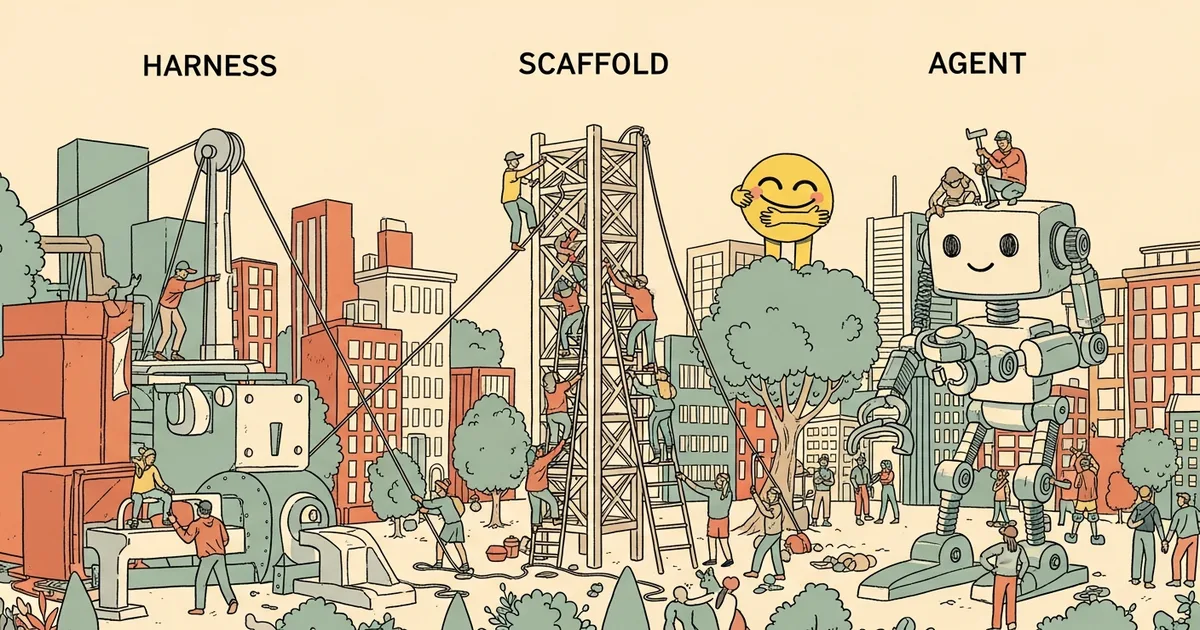
Hugging Face published a glossary defining the AI-agent terms that keep coming up at conferences and in product documentation without consistent meaning. The glossary is framed as an attempt to ground terms that are mixed up, reused in different ways, or assumed to be obvious when they are not.
Why It Matters
The vocabulary for AI agents has fragmented through 2024-2026 as more teams build on top of frontier models. A team writing about a “harness” at OpenAI may mean something operationally different from what a team at Anthropic, Hugging Face, or Google means. The result is research papers, product documentation, and discussion threads that talk past each other.
One of the Hugging Face authors (@ariG23498) posted publicly after ICLR 2026: “What do you mean by the terms ‘harness’ and ‘scaffold’ in the context of agents? I have heard a lot of explanations while I was at ICLR, but I could not understand why they did not converge to a single explanation.” That observation drove the glossary.
Technical Details
The glossary defines 11 terms organised into deployment-side and training-side categories. Deployment-side: model, scaffolding, harness, agent, context engineering, policy, tool use, skills, sub-agents. Training-side: training. Plus a learn-more section.
Per the glossary, the model is the LLM itself — it takes text in and produces text out (Claude, Qwen, GPT, Kimi, DeepSeek). On its own it has no memory between calls and no loop; the model can express the intent to call a tool but needs a harness to actually execute it. Scaffolding wraps the model to give it those capabilities. The harness is what actually executes tool calls. An agent is the combination of model plus scaffolding plus harness running in a loop. Context engineering is what fills the model’s context window. Policy is the model’s decision-making behavior. Tool use is the model’s ability to call external functions. Skills are reusable capabilities. Sub-agents are nested agents.
Who’s Affected
AI researchers gain a reference point for technical-paper terminology. Engineering teams building agent products gain a shared vocabulary for cross-team and cross-organization discussions. Developers using tools like Claude Code, OpenAI’s Codex, and the various Hermes and Cursor products gain clearer documentation context. AI educators and bootcamps gain teaching material for the technical vocabulary. The broader open-source AI community gains a community-owned reference rather than vendor-specific definitions.
What’s Next
Hugging Face explicitly states the glossary is not meant to enforce one correct vocabulary but to provide a practical mental model. Different frameworks will continue to use the same words differently. Expect iterations as the field matures — additional terms, deeper definitions, and possibly community contributions through Hugging Face’s standard open-content workflow. Other AI organizations may produce their own glossaries; whether they converge with the Hugging Face version or further fragment remains to be tracked.