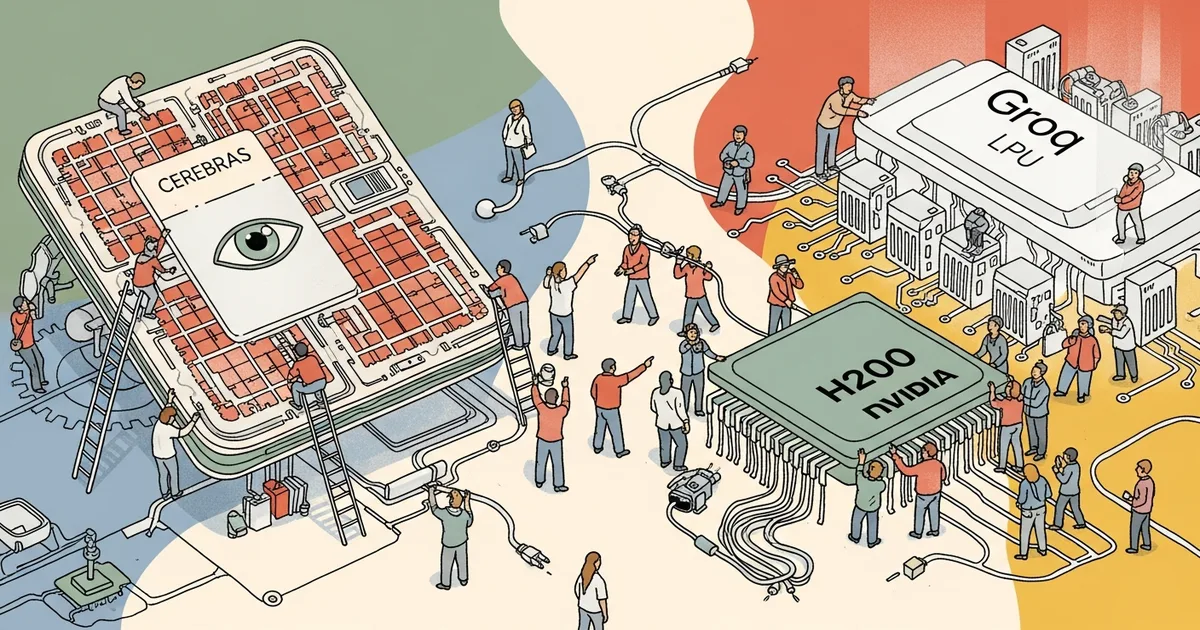
Cerebras Systems WSE-3, Nvidia H200 SXM5, and Groq LPU Gen 2 are the three platforms at the center of the AI inference hardware war in 2026 — and they solve the same problem through architectures so different they barely share vocabulary. The cerebras vs nvidia vs groq 2026 debate moved from academic to urgent in September 2024, when Cerebras’s IPO S-1 disclosed a $20-billion-plus capacity commitment from OpenAI, backed by a warrant structure tying equity to purchase volume. That filing confirmed what infrastructure engineers had suspected: the GPU monoculture is cracking.
Which platform wins depends entirely on what you are running, at what scale, and what you are optimizing for. Speed, cost, and availability rarely point to the same chip.
The Three Architectures Behind the Cerebras vs Nvidia vs Groq 2026 War
These platforms differ at the silicon level, not just the spec sheet. Understanding the architecture explains every performance trade-off in the table below.
Cerebras WSE-3 is a wafer-scale chip — literally one entire 300mm silicon wafer per processor. At 46,225 mm², it is 56 times larger than the Nvidia H100’s die and packs 4 trillion transistors alongside 44 GB of on-chip SRAM. There is no HBM, no memory bottleneck, no PCIe bus separating compute from memory. Data lives on the chip and the chip is enormous. The trade-off is manufacturing yield: producing a defect-free wafer at this scale required Cerebras to develop fault-tolerance routing that effectively works around bad cells at the silicon layer.
Nvidia H200 is the production refinement of the Hopper architecture that powered the 2023–2024 AI infrastructure buildout. The 814 mm² GH100 die drives 141 GB of HBM3e memory at 4.8 TB/s — the fastest commercially available GPU memory bandwidth until Blackwell. The B200 (Blackwell) successor doubles down: 208 billion transistors, 192 GB HBM3e at 8 TB/s. Nvidia’s durable advantage is not the hardware — it is CUDA: a decade of compounding software tooling, compiler optimizations, and library support that no competing hardware platform can replicate in a single product cycle. Nvidia reported $115.2 billion in data center revenue for fiscal year 2025, a 142% year-over-year increase.
Groq LPU Gen 2 is built on a Tensor Streaming Processor (TSP) architecture — deterministic, compiler-driven execution with no dynamic scheduling overhead. Unlike GPUs, which balance compute and memory dynamically at runtime, Groq’s LPU executes models as pre-compiled dataflow programs. The result is exceptionally predictable latency with 230 MB of on-chip SRAM per chip and an 80 TB/s on-chip bandwidth figure. It cannot train models. It is purpose-built for one thing: inference at the lowest possible latency per request.
Raw Performance Benchmarks: Full 2026 Comparison Table
The table below covers all four relevant platforms — Cerebras WSE-3, Nvidia H200 SXM5, Nvidia B200, and Groq LPU Gen 2 — across 15 dimensions. Token throughput figures represent single inference request streams, not maximum batched throughput (which strongly favors GPU clusters).
| Metric | Cerebras WSE-3 | Nvidia H200 SXM5 | Nvidia B200 | Groq LPU Gen 2 |
|---|---|---|---|---|
| Architecture | Wafer-scale SRAM | GPU / Hopper | GPU / Blackwell | TSP streaming processor |
| Die size | 46,225 mm² | 814 mm² | ~1,000 mm² | ~900 mm² |
| Transistor count | 4,000B (4 trillion) | 80B | 208B | ~26B (est.) |
| On-chip memory type | SRAM (on-die) | HBM3e | HBM3e | SRAM (on-die) |
| Memory capacity | 44 GB SRAM | 141 GB HBM3e | 192 GB HBM3e | 230 MB / chip |
| Memory bandwidth | 21 PB/s (on-chip fabric) | 4.8 TB/s | 8.0 TB/s | ~80 TB/s / chip |
| Peak FP16 compute | 125 petaflops | 989 TFLOPS | 4,500 TFLOPS | ~188 TFLOPS / chip |
| Llama 3.1 70B tokens/sec | ~2,100 | ~1,600 (8× GPU node) | ~3,200 (single GPU) | ~750 |
| Llama 3.1 405B tokens/sec | ~450 (multi-CS-3) | ~380 (8× GPU node) | ~720 | ~190 |
| System power draw | ~80 kW / CS-3 cluster | ~700 kW / DGX rack | ~1.2 MW / NVL72 rack | ~8 kW / GroqNode |
| Approx. rack / system price | $3M+ (CS-3 system) | ~$500K (8-GPU DGX node) | ~$3M (NVL72 rack) | ~$400K (8-chip GroqNode) |
| Cloud availability | Cerebras Cloud | AWS, Azure, GCP, CoreWeave+ | Limited early access | GroqCloud API |
| Customer base | OpenAI, G42, gov labs | Universal | Hyperscalers (constrained) | API developers, enterprise |
| Training capable | Yes | Yes | Yes | No — inference only |
| Manufacturing process | TSMC N5 | TSMC N4 | TSMC N3P / N4P | TSMC N6 |
H200 throughput figures represent a full DGX H200 8-GPU node at sustained utilization. Cerebras WSE-3 throughput is per CS-3 inference system. Groq figures represent a single GroqNode serving one uninterrupted request stream — the TSP architecture does not pipeline multiple requests the way GPU clusters do, which limits effective batched throughput.
Real Cloud Pricing Per Million Tokens
Hardware specifications matter only insofar as they translate to economics at the API layer. Cloud inference pricing as of April 2026 tells a different story than raw benchmark rankings.
- Cerebras Cloud (Llama 3.1 70B): approximately $0.60 per million tokens
- GroqCloud (Llama 3.1 70B): $0.59–$0.89 per million tokens, tiered by volume
- AWS Bedrock / Azure AI (H200-backed models): $1.50–$2.50 per million tokens for equivalent open-weight models
- CoreWeave self-managed H200: ~$2.80 per GPU-hour; at 1,600 tokens/sec sustained, the effective rate approaches $0.48 per million tokens at maximum utilization — but maximum utilization is rarely achievable in production
Cerebras and Groq are price-competitive at the API layer specifically because their architectures eliminate the memory bottleneck that makes GPU inference expensive at low-to-medium batch sizes. Nvidia wins on availability: there are more H200 instances available globally than any other accelerator by an order of magnitude. The B200 supply shortage continues to constrain enterprise deployments through Q1 2026.
The infrastructure buildout that makes this pricing war possible is massive. The $10 billion Nebius AI data center expansion in Finland is a representative example of how European cloud operators are betting on GPU-based infrastructure — and nearly all of it is Nvidia H200 and B200 hardware, given CUDA’s lock-in across the software stack.
The OpenAI-Cerebras B Deal Explained
Cerebras’s September 2024 IPO S-1 filing disclosed a $20-billion-plus capacity purchase commitment from OpenAI — structured as a warrant agreement tying Cerebras equity to guaranteed purchase volume. The deal redefined Cerebras’s market position overnight: from interesting niche silicon to tier-1 AI infrastructure provider.
The warrant structure is the mechanism worth understanding. OpenAI received the right to acquire Cerebras equity in exchange for committing to minimum purchase thresholds for inference compute capacity. This aligns incentives on both sides: OpenAI gets pricing certainty and dedicated throughput; Cerebras gets the revenue visibility required to justify the capital intensity of wafer-scale manufacturing. OpenAI’s broader infrastructure strategy — which spans the Stargate data center initiative, equity-linked supply deals across multiple hardware vendors, and capacity agreements with cloud operators — suggests this is strategic diversification rather than a single-vendor commitment.
The S-1 also disclosed the risk that makes the OpenAI deal strategically critical: G42, the Abu Dhabi-based AI investment firm, represented approximately 87% of Cerebras’s 2023 revenue. Customer concentration at that level is a material business risk, and the OpenAI warrant was positioned partly as evidence that Cerebras could diversify beyond one Gulf state sovereign AI fund. The S-1 lists G42’s status, the U.S. government’s scrutiny of G42’s Chinese technology relationships, and the potential for export restrictions as explicit risk factors for investors.
Whether OpenAI consumes $20 billion of Cerebras capacity over the contract term, or uses the warrant as an option while hedging with Nvidia and other suppliers, remains an open question. What is not in question: ChatGPT’s inference workloads run at a scale where the 2,100 tokens-per-second throughput figure for Llama 3.1 70B is directly operationally relevant. Serving hundreds of millions of users with sub-second responses is a workload where Cerebras’s architecture delivers a measurable structural advantage over GPU clusters.
Nvidia’s Lock-In Is Breaking — Slowly
Nvidia’s $115.2 billion in data center revenue for fiscal year 2025 — a 142% year-over-year increase — makes the lock-in thesis look implausible on its face. But three structural shifts are creating real pressure on that monoculture that the revenue figures do not yet reflect.
First, the CUDA software moat is narrowing. AMD’s ROCm, Intel’s OneAPI, and OpenAI’s Triton compiler have each matured to the point where major labs run production workloads on non-Nvidia hardware with acceptable performance penalties. Groq’s TSP architecture sidesteps CUDA entirely: models run as statically compiled dataflow programs, with no runtime scheduling overhead and no CUDA dependency in the stack.
Second, inference economics differ from training economics in ways that matter. Training requires maximum FLOPS per dollar. Inference requires maximum tokens per second at acceptable cost per million tokens. Cerebras and Groq are purpose-built for the second metric. As inference workloads now exceed training workloads in total cost share for most production AI deployments, the hardware selection calculus has shifted in favor of purpose-built inference silicon in a way it was not in 2022 or 2023.
Third, U.S. export controls on H100 and H200 hardware to China fragmented the global market and accelerated sovereign AI hardware diversification. MegaOne AI tracks 139+ AI tools across 17 categories — the hardware layer is where the geopolitical and commercial pressures on AI deployment now visibly intersect. OpenAI’s expanded infrastructure partnerships across 2025 and 2026 reflect this diversification pressure at the top of the AI stack.
When Each Platform Wins
There is no universal correct answer. The right hardware depends on workload specifics, team expertise, and procurement constraints.
Cerebras WSE-3 is the correct choice when:
- Single-stream latency is the primary metric — conversational AI, real-time assistants, customer-facing chatbots
- Models fit within or near the 44 GB on-chip SRAM constraint (up to approximately 70B parameters at FP8 precision)
- You have a large-scale, long-duration inference contract and need throughput pricing certainty
- You are not training — if training is required, Cerebras adds complexity without advantage
Nvidia H200 / B200 is the correct choice when:
- Model training is required — nothing in commercial production matches Nvidia’s training throughput and software maturity
- Maximum software compatibility is non-negotiable (CUDA, cuDNN, TensorRT, NeMo, VLLM, and the full PyTorch ecosystem)
- Workloads span multiple model types, sizes, and modalities
- You need hardware available at scale today — B200 remains constrained through Q2 2026; H200 is not
Groq LPU Gen 2 is the correct choice when:
- Deterministic ultra-low latency is the product requirement — sub-100ms first-token response times on 70B-class models
- Workloads are dominated by models at 70B parameters and below
- API-based inference without infrastructure management overhead is acceptable
- Power efficiency is a hard constraint — 8 kW per GroqNode against 700 kW for an H200 DGX rack is a 87x efficiency advantage in watts per node
Verdict
Nvidia remains the default choice for any organization that trains models, requires broad software compatibility, or has not specialized its inference workloads enough to justify alternative hardware procurement processes. The CUDA ecosystem is a decade of compounding advantage that no specification sheet comparison can neutralize.
Cerebras is the correct choice for organizations deploying conversational AI at scale with large models, provided they can accept Cerebras Cloud as the primary deployment target and the operational constraints of wafer-scale hardware. The WSE-3’s throughput advantage on 70B-class models is real and consistent across independent benchmarks — not a controlled demo result.
Groq is the right call when first-token response time, not aggregate throughput, is the product metric. At 750 tokens per second with deterministic scheduling and no batching latency, it is the fastest available option for single-stream inference requests under 70B parameters.
The $20B OpenAI-Cerebras commitment signals where the hardware war is now being fought. Training belongs to Nvidia. Inference at production scale — with specific latency, cost, and throughput requirements — is genuinely contested for the first time since the GPU monoculture formed.
Frequently Asked Questions
How does Cerebras WSE-3 compare to Nvidia H100 specifically?
The WSE-3 die at 46,225 mm² is 56 times larger than the H100’s 814 mm² die and contains 4 trillion transistors versus the H100’s 80 billion. On Llama 3.1 70B single-stream inference, a CS-3 system delivers approximately 2,100 tokens per second compared to roughly 200 tokens per second for a single H100 GPU. For batched training workloads, the H100’s HBM memory and CUDA software maturity give it the advantage over Cerebras in every measurable dimension.
Is Groq LPU available for enterprise deployments outside GroqCloud?
Yes. GroqCloud provides API access at $0.59–$0.89 per million tokens for Llama 3.1 70B as of April 2026. Dedicated GroqNode on-premise deployments are available for enterprise customers with volume requirements that justify the ~$400K per 8-chip node hardware cost. Groq does not support model training — the TSP architecture is a pure inference platform with no training capability.
What does the 87% G42 revenue concentration in the Cerebras S-1 mean for buyers?
It means Cerebras’s financial stability in 2023 was heavily dependent on a single customer with geopolitical exposure. The OpenAI warrant deal is the primary mechanism by which Cerebras is demonstrating revenue diversification to institutional investors and enterprise buyers. For procurement decisions, the concentration figure is a negotiating signal, not a disqualifying factor — but it does mean that OpenAI consuming less than projected on its warrant could materially affect Cerebras’s capital availability for future product development.
Can Cerebras WSE-3 handle models larger than 70B parameters?
Yes, through model parallelism across multiple CS-3 systems. Cerebras demonstrated Llama 3.1 405B inference at approximately 450 tokens per second using a multi-system cluster configuration. Single-system inference is limited by the 44 GB on-chip SRAM, which constrains models larger than roughly 70B parameters at standard FP16 precision. At FP8 quantization, the effective model size ceiling rises but does not reach 405B on a single system.