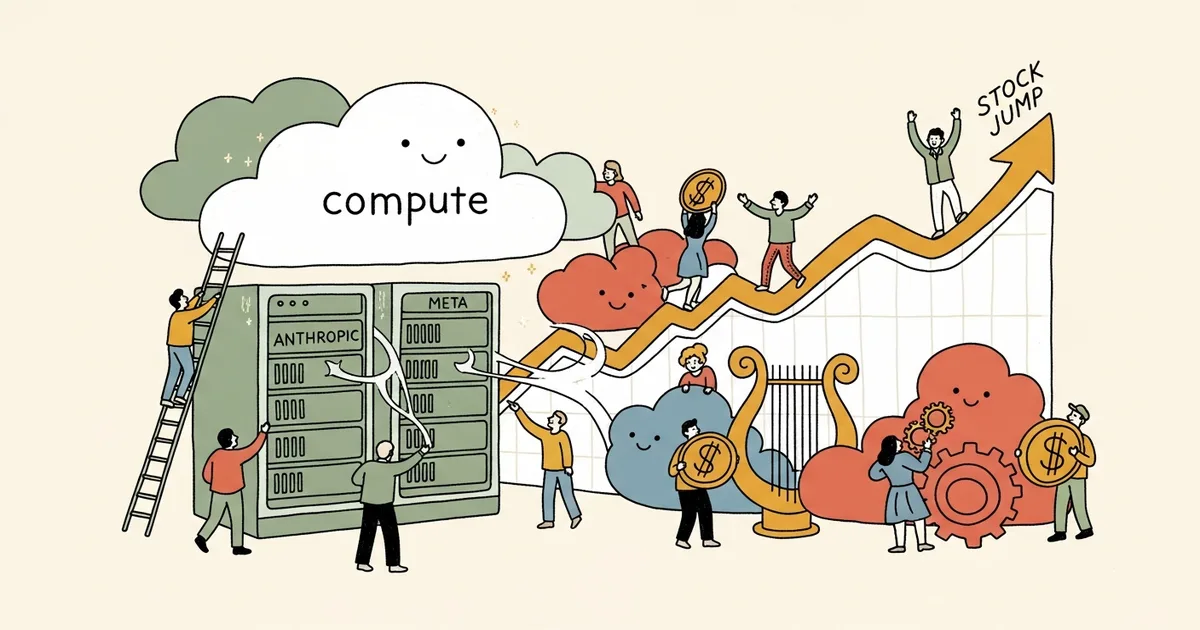
CoreWeave (CRWV), the GPU cloud infrastructure company that completed its IPO in March 2026, saw its stock climb 12.52% on April 14, 2026 after announcing separate compute agreements with Anthropic and Meta within 18 hours of each other. The two signings, taken together, cement CoreWeave’s position as the infrastructure backbone for frontier AI development — a position now backed by approximately $35 billion in committed spend from Meta alone.
With Anthropic aboard, CoreWeave now powers nine of the world’s top ten AI model providers. That is not a marketing claim. It is a structural moat, assembled one signed contract at a time.
The 18-Hour Double: How the Timeline Played Out
The sequence matters. Meta’s expanded commitment — an additional $21 billion through 2032 — landed first, extending a partnership that already ran deep into the billions. Before markets could fully price that in, Anthropic followed with its own CoreWeave compute agreement: the first public confirmation that Anthropic’s rapidly scaling infrastructure operation had selected CoreWeave as a primary cloud vendor.
Eighteen hours separating two of the largest AI compute commitments announced in a single week is not coincidence. It reflects a procurement reality that infrastructure teams at frontier labs have already internalized: at scale, CoreWeave’s GPU density and interconnect architecture deliver better per-token economics than hyperscaler alternatives for the training and inference workloads that justify dedicated clusters.
The timing also signals something about competitive positioning. Announcing in rapid succession — whether coordinated or not — creates a market narrative that single announcements cannot: CoreWeave is not a vendor for one frontier lab, it is the vendor for the frontier.
Meta’s Billion Stack
The $21 billion addition brings Meta’s cumulative CoreWeave commitment to approximately $35 billion through 2032. For context, that figure exceeds the annual capital expenditure of most Fortune 500 companies and comfortably surpasses the GDP of several small nations.
Meta’s AI infrastructure spending has accelerated sharply since Llama 3, with the company aggressively consolidating AI capabilities across its 3.3 billion daily active users. The through-2032 horizon is the detail that matters most to analysts: it signals that Meta’s internal planning does not expect custom silicon to fully displace rented GPU clusters within the next six years — a timeframe that covers at least two full AI investment cycles.
Locking in capacity at 2026 rates, before next-generation GPU supply tightens further around Blackwell and its successors, is textbook capital allocation. CoreWeave gets revenue certainty; Meta gets guaranteed cluster access at predictable cost.
Nine of Ten: What That Statistic Actually Means
CoreWeave now counts nine of the world’s top ten AI model providers as customers. The company has not disclosed the identity of the holdout, but the claim — if accurate — approaches a natural monopoly on frontier AI compute procurement. MegaOne AI tracks 139+ AI tools across 17 categories, and the pattern across that dataset is consistent: the labs producing the most capable models are concentrating infrastructure spend on an increasingly short list of providers, with CoreWeave at the top.
Anthropic’s inclusion is particularly consequential. The company’s revenue run rate is projected to more than quadruple in 2026, according to multiple sources tracking Anthropic’s commercial progress, and compute requirements scale proportionally with that trajectory. An Anthropic signing carries real infrastructure weight — this is not a pilot program or a line item in a diversified vendor strategy.
The consolidation dynamic creates compounding advantages. Each new frontier lab customer generates reference credibility that reduces the cost of landing the next. It also creates switching costs: a lab that has built its training pipeline, fine-tuning workflow, and inference stack on CoreWeave’s Kubernetes-native architecture does not migrate those dependencies on a whim. OpenAI’s own enterprise expansion follows the same structural logic — massive revenue growth creates massive compute requirements that outpace any single owned infrastructure program.
Why Margins Should Expand From Here
CoreWeave’s current gross margins sit below those of mature cloud providers — a predictable reflection of the capital intensity required to build GPU clusters ahead of customer demand. That dynamic inverts as utilization climbs and the fixed-cost base of installed hardware is amortized across longer contract terms.
Multi-year deals with Anthropic and Meta accomplish two things simultaneously. They push utilization toward 100% for dedicated GPU clusters, improving unit economics. They also lock in revenue streams long enough to reduce refinancing risk on the debt CoreWeave used to acquire H100 inventory at scale before competitors could. The result is a flywheel: high utilization improves per-GPU economics, improved economics justify further hardware acquisition, larger hardware pools attract larger customers, and larger customers demand the dedicated cluster architecture that CoreWeave has already built.
CoreWeave’s IPO prospectus disclosed that its top three customers accounted for the substantial majority of revenue — a concentration risk that short-sellers flagged aggressively in the months following the IPO. The Anthropic signing partially addresses that critique while adding a customer whose spending trajectory is ascending sharply.
The Sympathy Trades: Who Else Moved on April 14
CoreWeave’s 12.52% gain triggered predictable sympathy moves across AI infrastructure equities on the same session:
- Nebius Group — the GPU cloud operator spun out of Yandex that is building a $10 billion AI data center in Finland — rose as investors read CoreWeave’s deals as validation of the dedicated GPU cloud thesis in European markets.
- IREN, the Bitcoin mining company that has pivoted aggressively toward AI cloud services, climbed on the same underlying logic: compute demand is structural, and second-tier GPU cloud providers benefit when the market’s most important buyer demonstrably cannot get enough from any single first-tier source.
- Applied Digital and Cipher Digital both moved in sympathy, reflecting persistent investor appetite for exposure to the GPU-as-a-service value chain at any point in the stack.
The sympathy pattern is instructive. Markets are pricing AI infrastructure as a sector thesis, not a collection of individual company bets. That dynamic could reverse quickly if spend concentrates further at the top tier — but for now, a rising CoreWeave lifts the broader GPU cloud fleet.
The Custom Silicon Risk: Real, But Overpriced in the Market
The standard bear case on CoreWeave centers on vertical integration: if Anthropic scales its internal chips team to production volumes, if Meta’s Marvell-designed MTIA accelerators expand beyond inference into general training, or if any of the nine CoreWeave customers decides that owned silicon delivers better economics than rented clusters, demand for CoreWeave’s GPU fleet contracts.
This risk is real. It is also overpriced in most scenarios currently being modeled.
Custom silicon programs require five to seven years from tape-out to production deployment at the scale needed to replace meaningful CoreWeave capacity. Anthropic’s chips effort is years from that threshold. Meta’s MTIA chips are engineered for inference at Meta’s specific workload distribution, not general-purpose frontier training. And even companies with the most mature custom silicon programs — Google with TPUs, Amazon with Trainium — continue purchasing Nvidia GPUs for workloads where H100 and B200 clusters remain the optimal tool.
The more credible medium-term risk is bilateral: Nvidia releases next-generation hardware that renders current H100 clusters economically obsolete before CoreWeave’s contracts expire, while hyperscalers simultaneously match CoreWeave’s specialized GPU interconnect features. Even in that scenario, CoreWeave’s multi-year locked contracts and its head start in customer architecture integration provide significant runway — measured in years, not quarters.
The Constraint Is Not Willingness to Spend
The Anthropic and Meta deals, read together, resolve a question that AI infrastructure analysts have debated for 18 months: whether frontier labs would continue leasing compute at scale or accelerate toward owned infrastructure programs. The $35 billion Meta commitment through 2032 and Anthropic’s fresh CoreWeave signing answer that with specificity. Rented, specialized GPU cloud wins the hybrid model for the foreseeable future.
The constraint driving this is not capital. The frontier labs have access to capital. The constraint is the physical timeline of building, wiring, cooling, and operating GPU clusters at the pace that frontier AI model development demands. CoreWeave built that infrastructure early, at risk, financed with borrowed money, before the customer contracts existed to justify it. April 14 was the market acknowledging the returns on that bet — and pricing in the reasonable expectation that the remaining holdout among the top ten will not hold out indefinitely.