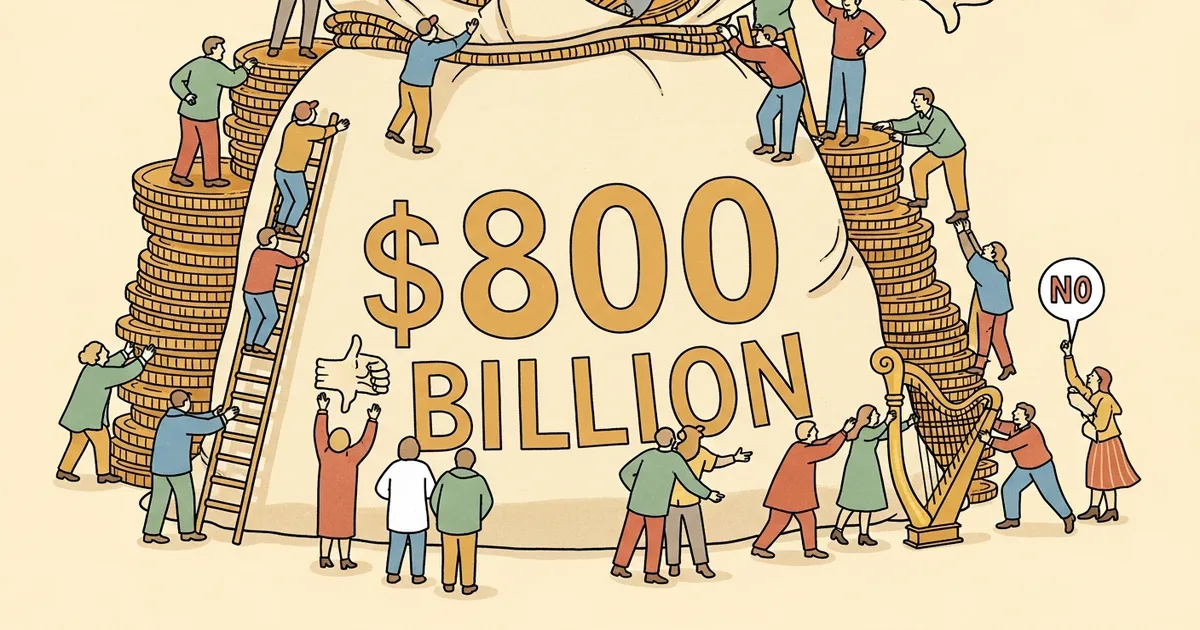
Anthropic (the AI safety company behind Claude) was offered a preemptive funding round valuing it at $800 billion or more this week — and turned it down. Bloomberg reported the approach on April 17, 2026, citing sources familiar with the discussions. The rejection lands as either one of the most confident moves in startup history or a calculated bet that public markets will value the company above what the most aggressive private investors on the planet are willing to offer.
The company’s annual revenue run rate sits at roughly $30 billion, with a net figure closer to $22 billion after infrastructure costs — numbers that surfaced in a leaked internal OpenAI memo circulated earlier this month. At $800 billion, that implies a revenue multiple above 26x before a single public share trades.
The Anthropic 0 Billion Offer, Contextualized
OpenAI’s most recent private funding round valued it at $852 billion, making it the highest-valued private company in recorded history. An $800 billion Anthropic would pull within 6% of that mark — and the gap between the two companies has narrowed faster than almost any analyst forecast. Six months ago, Anthropic’s private valuation was approximately $61 billion. The trajectory implies a 13x re-rating in under two quarters.
For scale: a combined Goldman Sachs, Morgan Stanley, and JPMorgan Chase is worth less. Meta sits around $1.4 trillion. At $800B, Anthropic would be larger than every bank, every pharmaceutical company, and every traditional media conglomerate on earth. AI acquisition and valuation premiums have been escalating sector-wide, but this figure represents a new ceiling for a company that did not exist before 2021.
The $800B figure was not a formal round — sources describe preemptive approaches, where investors were essentially asking Anthropic to name a price before a process was even opened. Anthropic declined to open that process.
Why Anthropic Said No
The most straightforward explanation is the IPO calendar. Anthropic is in active preparation for a public offering, with October 2026 as the reported target window. A private round at $800B arrives with governance strings attached — liquidation preferences, board seats, information rights, anti-dilution provisions. A public offering avoids most of those constraints while potentially delivering a higher headline number.
The Dresser memo exchange — a series of competing internal documents that circulated between Anthropic and OpenAI leadership in March and April 2026 — reportedly includes Anthropic’s own scenario modeling of a $1.2 trillion public valuation floor. If that figure reflects genuine internal projections, accepting $800B private becomes straightforward to decline. You don’t take a discount when you believe the market will price you higher without conditions attached.
There is also a structural preference for the type of capital Anthropic accepts. The company has consistently prioritized strategic partners who bring compute access and distribution — Google’s investment came with TPU cluster access; Amazon’s partnership anchored Claude across AWS Bedrock. A preemptive VC round, however large, brings none of that infrastructure leverage. Anthropic already has more financial runway than it needs.
The Run Rate War and the OpenAI Memo
The leaked internal OpenAI document — confirmed by multiple outlets and widely circulated in early April — placed Anthropic’s net annual revenue at $22 billion after compute costs, versus a gross run rate of approximately $30 billion. OpenAI’s own reported run rate sits above $60 billion annualized, but its infrastructure spend is dramatically higher, making the net comparison considerably closer than headline figures suggest.
The memo’s circulation served OpenAI’s competitive narrative — positioning Anthropic as smaller and more margin-compressed than its enterprise reputation implies. Anthropic’s decision to simultaneously decline an $800B funding offer and ship two major product releases in the same week reads, in part, as a counter-signal. OpenAI’s commercial partnerships have been accelerating, and both companies understand that the IPO window is partly a confidence competition.
Net revenue of $22 billion at a 36x multiple — conservative for a company growing at this rate — produces an $800B valuation. Anthropic’s argument for more relies on continued revenue acceleration and a premium for its enterprise concentration in high-value verticals: coding, healthcare documentation, financial analysis.
What Anthropic Shipped This Week
While declining nine-figure approaches, Anthropic launched Claude Design — a visual generation and UI prototyping suite — alongside Opus 4.7, the latest iteration of its flagship reasoning model. Opus 4.7 includes updated context handling and materially improved performance on multi-step agentic coding tasks, per Anthropic’s release notes.
Simultaneously, the company is testing Mythos under the internal codename Project Glasswing — a multimodal project that sources describe as combining narrative generation with real-time world modeling. No public announcement has been made. The name surfaced in a code review disclosed earlier this month. Anthropic has had prior inadvertent source disclosures that surfaced early-stage projects, and Glasswing follows that pattern.
Two major product releases in a single week, combined with a funding rejection, is either genuine operational momentum or deliberate pre-IPO signaling. The two are not mutually exclusive.
The Infrastructure Position That Justifies the Confidence
Valuation confidence at this scale requires compute certainty. Anthropic recently committed $50 billion to Fluidstack for dedicated data center capacity through 2029 — one of the largest single AI infrastructure contracts on record. The deal locks in training and inference capacity at fixed cost structures, insulating margins against the GPU shortage cycles that have periodically compressed competitor profitability.
Nine of the top ten AI labs globally run on CoreWeave infrastructure, and Anthropic holds preferred capacity agreements giving it priority allocation during peak demand. The global data center buildout race continues to accelerate, but Anthropic has effectively pre-purchased its position in it at 2024 pricing.
This infrastructure certainty is what separates Anthropic’s valuation argument from speculative AI hype. Investors pricing AI companies at 2026 multiples are primarily underwriting compute access and margin trajectory. Anthropic has both locked in at scale. That is a quantifiable moat, not a narrative one.
The IPO Math Behind the Rejection
A public offering in October 2026 — if it proceeds as planned — would follow a year in which Anthropic grew revenue by an estimated 4x, launched three major model generations, and established enterprise dominance in the sectors commanding the highest AI spending. MegaOne AI tracks 139+ AI tools across 17 categories, and Anthropic’s Claude platform holds the leading position in enterprise API adoption by contract value.
The valuation question reduces to which multiple public markets apply. Consumer tech comps at this growth rate command 40-60x revenue. Conservative SaaS comps sit at 20-30x. At $30B gross run rate and a 40x multiple, the implied valuation is $1.2 trillion. At 27x, it is $810 billion — which is precisely why $800B private looks like a floor, not a ceiling.
The downside scenario is real. IPO windows close. If public markets reprice AI multiples between now and October — from a model failure, a regulatory event, or broader macro conditions — Anthropic’s refusal of $800B will look considerably less prescient. The companies that locked in private capital during 2025 at lower multiples accepted worse terms but eliminated that timing risk entirely.
What This Signals for the AI Valuation Ceiling
When the second-largest AI company on earth turns down $800 billion in private funding, something structural has shifted. The dynamic has inverted: capital is chasing AI, not the reverse. Three years ago, the top labs competed for compute access and investor attention. Today, they have more investor interest than they can accommodate and enough enterprise revenue to fund operations independently.
Anthropic reportedly holds 18+ months of runway at current burn rates, making the $800B approach a luxury problem. The company’s position — declining the offer, shipping two products, and pursuing an IPO on its own timeline — reflects a leverage that did not exist at this scale in AI twelve months ago.
The October IPO will determine whether that confidence was priced correctly. If Anthropic lists above $1 trillion, it will have been the most valuable startup decision of the decade. If the window closes or markets reprice, the $800B they declined will be the number everyone remembers.