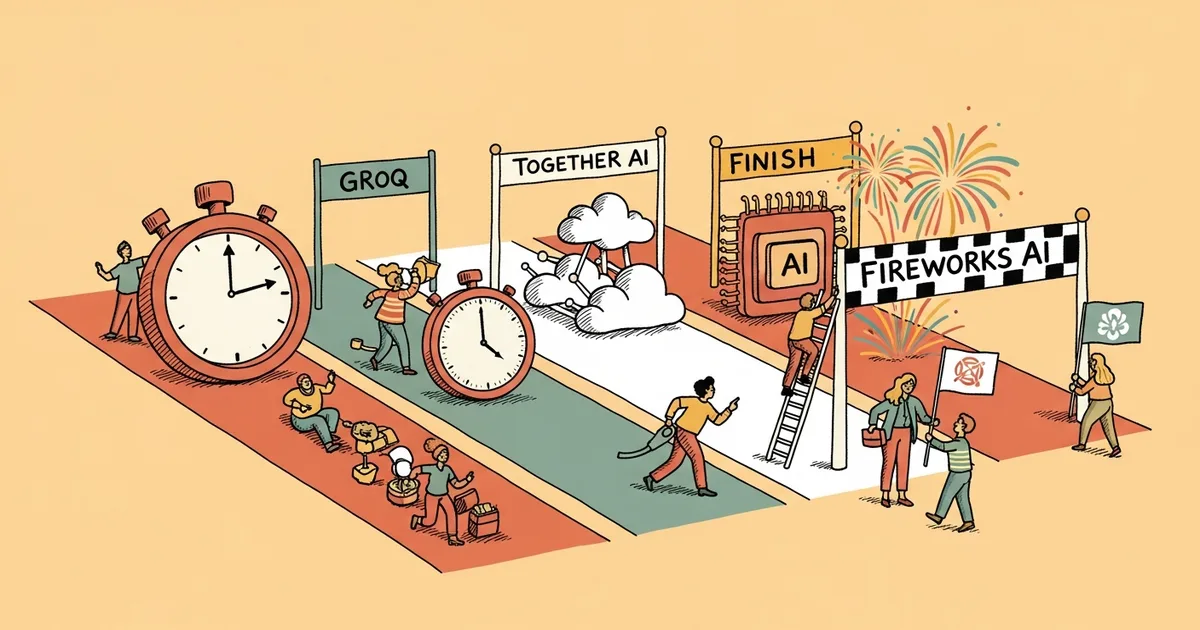
Groq, Together AI, and Fireworks AI are the three dominant independent inference API providers competing for developer workloads in April 2026. Each built its platform on a different architectural thesis: Groq on custom LPU silicon, Together AI on model breadth and fine-tuning, and Fireworks AI on enterprise-grade GPU optimization. The right choice for a given team is not obvious — this groq vs together ai vs fireworks 2026 comparison breaks down where each platform wins and loses across speed, pricing, model selection, fine-tuning, and enterprise readiness.
MegaOne AI tracks 139+ AI tools across 17 categories. Inference APIs have become one of the most contested categories in the stack, with pricing compressing 40–60% across all three platforms over the past 12 months as GPU costs fall and open-weight model weights commoditize.
Full Platform Comparison: Groq vs Together AI vs Fireworks AI (2026)
| Feature | Groq | Together AI | Fireworks AI |
|---|---|---|---|
| Primary Hardware | LPU (proprietary) | GPU cluster | GPU + FireAttention |
| Llama 3.1 70B — Speed | ~800 tok/s | ~110 tok/s | ~90 tok/s |
| Llama 3.1 405B — Speed | ~260 tok/s (limited access) | ~35 tok/s | ~30 tok/s |
| Llama 3.1 70B — Input Price | $0.59/M tokens | $0.90/M tokens | $0.90/M tokens |
| Llama 3.1 70B — Output Price | $0.79/M tokens | $0.90/M tokens | $0.90/M tokens |
| Llama 3.1 405B — Input Price | Limited / enterprise only | $3.50/M tokens | $3.00/M tokens |
| Llama 3.1 405B — Output Price | Limited / enterprise only | $3.50/M tokens | $3.00/M tokens |
| Model Library | 50+ models | 200+ models | 150+ models |
| Fine-Tuning | Not supported | Full fine-tune + LoRA | LoRA + full fine-tune |
| Batch Inference | Not supported | Yes — 50% discount | Yes — 50% discount |
| Uptime SLA | 99.9% (shared infra) | 99.9% | 99.95% |
| Dedicated Deployments | Not available | Yes | Yes |
| Region Availability | US-West only | US, EU | US, EU |
| Free-Tier Rate Limit | 30 req/min | 60 req/min | 30 req/min |
| SOC 2 Type II | No | Yes | Yes |
The Inference Speed Race in 2026
Groq’s Language Processing Unit (LPU) — purpose-built for the sequential, token-by-token demands of autoregressive inference — delivers approximately 800 tokens per second on Llama 3.1 70B, based on Artificial Analysis benchmarks current as of April 2026. That is roughly 7x faster than Together AI’s GPU cluster infrastructure on the same model, and nearly 9x faster than Fireworks AI. For latency-sensitive applications, this gap directly determines user experience: a 1-second budget at 800 tok/s generates the full response; the same budget at 110 tok/s generates the first paragraph.
Cerebras is the only provider approaching Groq’s throughput on large models. Its Wafer Scale Engine 3 (WSW-3) chip — a single silicon die spanning an entire wafer — processes inference at speeds that rival LPU performance on frontier-scale models. Cerebras secured over $20 billion in infrastructure commitments, with a high-profile OpenAI partnership signaling where frontier inference hardware is heading. The same period saw OpenAI expand commercially across multiple vectors — including a $1 billion content arrangement with Disney — reflecting that the company views both hardware bets and content moats as durable competitive assets. Unlike Groq, Cerebras has no self-serve API equivalent; access requires enterprise agreements.
Together AI and Fireworks AI both run GPU-based infrastructure with proprietary optimization layers. Fireworks AI’s FireAttention — a custom CUDA kernel designed for multi-query attention efficiency — achieves approximately 90 tok/s on Llama 3.1 70B. Together AI reaches ~110 tok/s on the same model. The delta between these two sits within measurement noise for most production workloads; neither closes the gap with Groq’s purpose-built hardware advantage on current model architectures.
Model Library: Breadth vs. Depth
Together AI’s 200+ model catalog is the widest available on any single inference API. It spans the full Llama 3.1 family (8B, 70B, 405B), Mistral 7B and 8x7B, DBRX, Qwen 2.5, Code Llama, Stable Diffusion XL, and hundreds of community fine-tuned variants. For teams still in model evaluation — benchmarking Llama 3.1 70B against Mistral Large before committing infrastructure — Together AI eliminates the need to manage multiple provider accounts and normalize pricing across APIs.
Fireworks AI offers 150+ models with particular depth in code and function-calling tasks. Its FireFunction-v2 model benchmarks within 3% of GPT-4 on structured output tasks, according to Fireworks’ published internal evaluations — a claim consistent with developer reporting in production environments. Fireworks also ships first-party models (f1 and f1-mini) optimized specifically for its FireAttention runtime.
Groq supports approximately 50 models — an architectural constraint, not a product decision. Not every model architecture translates efficiently to LPU execution. The catalog covers the most widely used open-weight models: Llama 3.1 8B, 70B, and limited 405B access; Mixtral 8x7B and 8x22B; Gemma 2; and Whisper for transcription. Teams that need model diversity will hit this ceiling fast.
Pricing Per Million Tokens in 2026
Groq is the cheapest option for supported models. Llama 3.1 70B via GroqCloud costs $0.59 per million input tokens and $0.79 per million output tokens as of April 2026. Together AI and Fireworks AI both charge $0.90 per million tokens (input and output) for the same model — a 34–52% premium over Groq depending on your input/output ratio. At 10 billion tokens per month, that gap is roughly $3,000–$5,000 in avoided cost on Together AI’s standard tier.
For Llama 3.1 405B — the model that actually moves quality benchmarks on complex reasoning and instruction-following — pricing diverges more sharply. Together AI charges $3.50 per million tokens (input and output). Fireworks AI charges $3.00 per million tokens, representing a 14% discount. Groq’s 405B access is limited and not published at standard rates; developers should confirm current availability directly with Groq’s enterprise team before building against it.
Batch inference changes the cost calculation for non-latency-sensitive workloads. Both Together AI and Fireworks AI offer asynchronous batch processing at a 50% discount, reducing Llama 3.1 70B costs to approximately $0.45 per million tokens — competitive with Groq’s standard-tier pricing for data enrichment, document processing, or nightly evaluation pipelines. Groq does not support batch inference. Its architecture optimizes for minimum time-to-first-token; high throughput per dollar is not the design target.
Fine-Tuning and Model Customization
Together AI has the most mature fine-tuning platform of the three. It supports full fine-tuning and LoRA (Low-Rank Adaptation) for most models in its 200+ library, with training costs starting at $0.80 per GPU-hour. Enterprise customers get dedicated fine-tuning infrastructure and private model endpoints that keep custom weights off shared infrastructure. This makes Together AI the default for teams building domain-specific models: legal classifiers, proprietary-codebase coding assistants, or customer-support bots trained on historical ticket data.
Fireworks AI supports LoRA fine-tuning on a comparable pricing model. Its dedicated deployment option means fine-tuned models run on reserved GPU capacity with consistent latency — a requirement for any team that has already shipped a fine-tuned model into production and cannot accept the P99 variability of shared endpoints.
Groq does not support fine-tuning. LPU hardware is optimized for inference on fixed, compiled model weights; customization is architecturally incompatible with the execution model. Developers who need customization must fine-tune on another platform, then verify whether the resulting weights can be served on Groq infrastructure. Currently, Groq serves only published model checkpoints, which means fine-tuning eliminates Groq as a runtime option. That trade-off — Groq’s 7x latency advantage against zero fine-tuning flexibility — is the central decision point for teams moving from prototype to production.
Enterprise Readiness
Fireworks AI is the strongest enterprise-grade offering of the three. It provides a 99.95% uptime SLA, dedicated GPU deployments (allocated compute not shared with other API users), SOC 2 Type II certification, and enterprise support contracts with defined response SLAs. Infrastructure available in both US and EU regions addresses GDPR data residency requirements that Groq’s US-only architecture structurally cannot meet.
Together AI offers a comparable enterprise tier — 99.9% uptime, dedicated endpoints, EU data residency on enterprise plans — formalized in late 2025 following the platform’s valuation reaching $1.25 billion. The global infrastructure buildout underpinning these expansions is substantial: projects like Nebius’ $10 billion AI data center in Finland illustrate how rapidly regional inference capacity is becoming a compliance and latency variable, not just a technical footnote for enterprise procurement teams.
Groq’s enterprise offering is the weakest of the three. GroqCloud operates on shared infrastructure with no dedicated deployment option as of April 2026. Rate limits on standard tiers — 30 requests per minute — are restrictive enough to block serious production deployments without custom enterprise agreements negotiated directly. Teams with compliance requirements, data residency constraints, or dedicated compute needs should not default to Groq for enterprise deployments, regardless of its speed advantage in benchmarks.
Best For: Matching the Platform to the Use Case
Choose Groq if: latency is the primary product constraint and your model requirements fit its ~50-model catalog. Real-time applications — voice AI pipelines, live coding assistants, interactive customer-facing chatbots — extract the most value from 800 tok/s throughput. Groq is also the right choice for developer demos where inference speed is itself the product feature being showcased.
Choose Together AI if: you need model diversity or fine-tuning in a single platform. Research teams evaluating multiple open-weight models before committing infrastructure, and production teams requiring domain-specific customization, will find Together AI’s platform the most complete single-stop option. Its breadth also makes it the default for multimodal workloads — image generation, transcription, and text completion across one API account. As we noted in our ElevenLabs vs HeyGen vs Synthesia comparison, platform depth — not just headline speed — increasingly determines which tools survive in competitive developer categories.
Choose Fireworks AI if: enterprise SLA requirements, EU data residency, or dedicated GPU deployments are non-negotiable. Teams with compliance requirements (HIPAA, GDPR, SOC 2) or production systems that cannot absorb shared-infrastructure latency variability should default to Fireworks AI. Its FireFunction-v2 model also makes it the strongest choice for function-calling-heavy and structured output tasks.
Verdict
Groq wins on speed and price for supported models — no qualification needed. Together AI wins on model breadth and fine-tuning. Fireworks AI wins on enterprise readiness, compliance, and SLA guarantees.
The inference API market is compressing. Custom CUDA kernels and GPU memory optimization are closing the throughput gap that Groq’s LPU opened; Together AI and Fireworks AI narrow the difference quarter by quarter. Cerebras’ WSE-3 represents the theoretical ceiling of what purpose-built inference silicon can achieve, and the enterprise commitments surrounding that chip suggest the raw speed race has a plateau approaching. When it levels out, the durable differentiators will be fine-tuning infrastructure, enterprise tooling, and pricing — exactly where Together AI and Fireworks AI are compounding their advantages.
The practical default for most teams starting a project in April 2026: begin with Together AI for model evaluation across its full 200+ catalog, migrate latency-critical production paths to Groq once model selection is locked, and bring in Fireworks AI when enterprise SLAs or EU data residency become procurement requirements. Benchmark against your specific model and workload — Artificial Analysis publishes weekly latency data that reflects real-world conditions more accurately than any static comparison table, including this one.
FAQ
Is Groq faster than Together AI in 2026?
Yes. Groq’s LPU hardware generates approximately 800 tokens per second on Llama 3.1 70B — roughly 7x faster than Together AI’s GPU infrastructure on the same model, based on Artificial Analysis benchmarks as of April 2026. For Llama 3.1 405B, Groq offers limited access at approximately 260 tok/s versus Together AI’s 35 tok/s.
Does Together AI support fine-tuning in 2026?
Yes. Together AI supports full fine-tuning and LoRA for most models in its 200+ library. Training costs start at $0.80 per GPU-hour. Enterprise customers get dedicated fine-tuning infrastructure and private model endpoints.
Which inference API has the best enterprise SLA?
Fireworks AI offers the strongest enterprise SLA at 99.95% uptime with dedicated GPU deployments, SOC 2 Type II compliance, and EU data residency — the preferred choice for compliance-sensitive production deployments at scale.
Can I use Groq for Llama 3.1 405B?
Groq offers limited access to Llama 3.1 405B, but it is not its primary supported configuration. Together AI ($3.50/M tokens) and Fireworks AI ($3.00/M tokens) both offer consistent, publicly priced 405B access with better availability guarantees.
What is the cheapest inference API for Llama 3.1 70B in 2026?
Groq at $0.59 per million input tokens and $0.79 per million output tokens is the cheapest standard-tier option. Together AI and Fireworks AI both charge $0.90 per million tokens, though their batch inference pricing — 50% discount on async workloads — brings non-latency-sensitive jobs to approximately $0.45 per million tokens, competitive with Groq’s standard rate for bulk processing.
What is Cerebras WSE-3 and how does it compare to Groq?
The Cerebras Wafer Scale Engine 3 (WSE-3) is a purpose-built inference chip — a single silicon die spanning an entire semiconductor wafer — capable of matching or exceeding Groq’s LPU throughput on large models. Cerebras secured over $20 billion in infrastructure commitments, including a partnership with OpenAI, positioning it as the ceiling of custom inference silicon performance. Unlike Groq, Cerebras has no self-serve API as of April 2026; access is through enterprise agreements only.