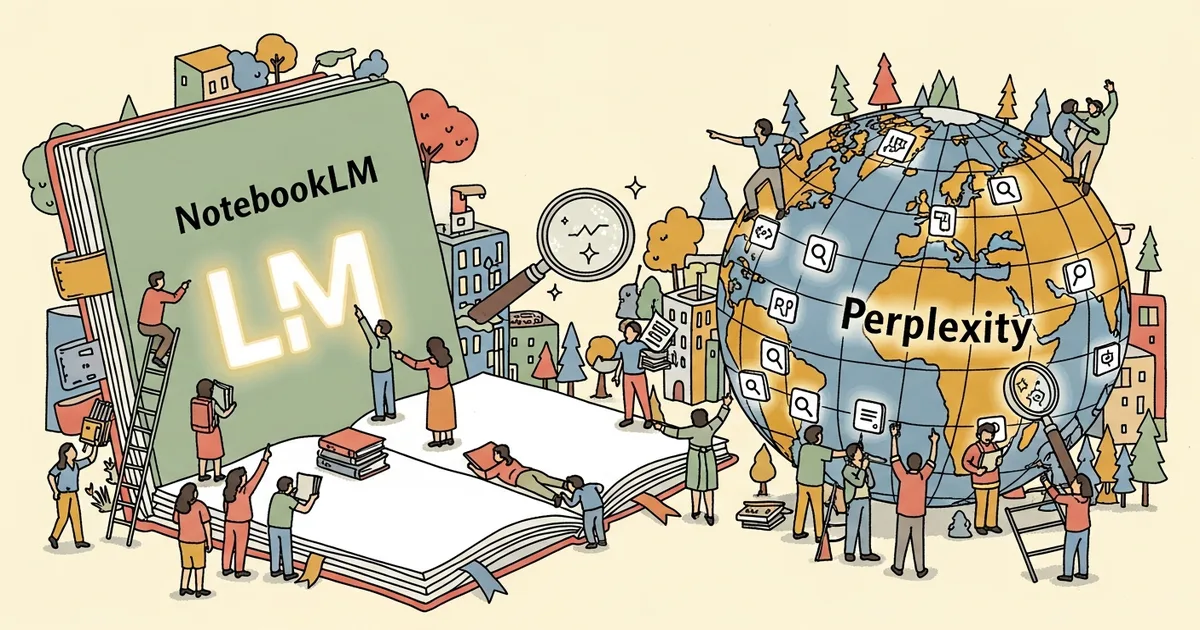
Google NotebookLM and Perplexity Deep Research are the two dominant AI research tools in 2026, and they are built around opposite assumptions about where truth lives. As of April 2026, NotebookLM grounds every response exclusively in documents you upload — PDFs, YouTube transcripts, audio files, Google Docs — and refuses to speculate beyond them. Perplexity Deep Research deploys autonomous web agents for up to 30 minutes to synthesize live intelligence from across the internet. The architecture choice determines everything: citation reliability, update latency, use-case fit, and what happens when the AI gets something wrong.
Perplexity reported 15 million daily active users in early 2026, driven partly by the standalone Deep Research mode launched in late 2024. NotebookLM has not disclosed DAU figures, but Google reported over 50 million Audio Overviews generated through 2025 — a meaningful proxy for sustained engagement in a tool built around repeated use.
How Each Tool Works
NotebookLM operates as a closed-context reasoning system. You create a notebook, upload up to 50 sources on the free tier, and the AI builds its knowledge exclusively from that corpus. It will not hallucinate content from outside your sources — by design. When you ask a question the sources cannot answer, NotebookLM says so. This constraint is the product’s core value proposition.
Supported source types include PDFs, Google Docs, Google Slides, plain text files, URLs, YouTube videos (via transcript extraction), and audio files. Each source supports up to 500,000 words. Beyond standard Q&A, NotebookLM generates study guides, briefing documents, FAQ lists, and timelines — and, uniquely, Audio Overviews: 10–20 minute AI-generated podcasts where two synthetic hosts discuss your uploaded source material in naturalistic conversation.
Perplexity Deep Research works differently. Triggering a Deep Research query launches an autonomous agent that runs dozens of iterative web searches, reads and evaluates sources, identifies contradictions, and synthesizes findings into a structured report. The process runs between 5 and 30 minutes. The result is typically a 5–15 page document with 20–80 inline citations drawn from live news, academic preprints on ArXiv, Reddit, official announcements, and proprietary data partnerships.
Perplexity’s model has access to real-time web data — something NotebookLM explicitly lacks. This makes Deep Research the tool of choice when the question is “what’s happening now” rather than “what do these documents say.”
Feature Comparison: NotebookLM vs Perplexity Deep Research
| Feature | NotebookLM | Perplexity Deep Research |
|---|---|---|
| Source types | PDF, Google Docs/Slides, text, URL, YouTube, audio upload | Live web, news, ArXiv preprints, Reddit, proprietary data partnerships |
| Source limit (free) | 50 sources per notebook; up to 500K words each | Unlimited (web-crawled); Deep Research not available on free tier |
| Source limit (paid) | 500 sources per notebook (NotebookLM Plus) | Unlimited web access (Pro and Enterprise) |
| Citation quality | Grounded: links to exact source passage; near-zero hallucination rate | Inline citations; 20–30% error rate in independent testing |
| Audio overview | Yes — AI podcast format, downloadable MP3 | No equivalent feature |
| Real-time data | No — static uploads only | Yes — live web indexing |
| Free tier access | Full feature set with usage limits | Standard search only; Deep Research requires Pro plan |
| Paid pricing | $19.99/mo (Google One AI Premium); enterprise via Workspace | $20/mo Pro; $200/yr annual; Enterprise: custom pricing |
| Enterprise features | Via Google Workspace (SSO, compliance, admin controls) | Enterprise Pro: SSO, data isolation, zero-retention policy |
| Team collaboration | Shared notebooks (view/edit access); no version control | Spaces (team knowledge sharing), admin controls |
| Mobile apps | iOS and Android | iOS and Android |
| Export formats | Copy/paste; MP3 download (audio); Google Docs integration | Copy/paste; shareable report links; PDF export (Pro) |
| Search integration | None — no web search capability | Full web + academic search; Bing data partnership |
| Hallucination risk | Near-zero (grounded to uploaded sources only) | Low-to-moderate; verification required for high-stakes use |
Use-Case Fit: Students, Analysts, and Legal Teams
Student Research
NotebookLM has become the default AI research tool for graduate students working with a defined body of literature. Upload 20 papers on a research topic, then ask the AI to identify contradictions across studies, map citation networks, or produce a structured literature synthesis. Every claim links to a specific passage in a specific paper — a non-negotiable requirement for academic work that Perplexity’s web-synthesis model cannot reliably provide.
The Audio Overview feature has an underappreciated academic use case: students upload lecture notes and course readings, and the AI generates a podcast-style discussion that many find easier to absorb than re-reading dense PDFs. NotebookLM’s free tier handles this entire workflow without payment.
Perplexity Deep Research is more useful at the start of a research project, when the question is “what exists on this topic?” rather than “what do these specific papers say?” A 30-minute Deep Research query on an unfamiliar research area returns a structured synthesis of recent publications that helps define which primary sources are worth acquiring. For citation-verified final academic work, it is a starting point, not a finishing tool.
Market Analysts
Perplexity Deep Research holds a clear advantage for market and competitive intelligence. A venture analyst tracking AI infrastructure investment can run a query and receive a structured report synthesizing news coverage, company announcements, earnings call excerpts, and analyst commentary from the past week — in under 30 minutes. Nebius’s $10 billion AI data center announcement in Finland is precisely the kind of fast-moving development Perplexity indexes within hours of a news break, surfacing automatically in any report covering European AI infrastructure.
NotebookLM serves the synthesis phase. Once an analyst has gathered primary documents — annual reports, SEC filings, earnings transcripts, internal research memos — the tool excels at cross-document comparison. “What does each company in this group say about capital expenditure in Q4 2025?” across 12 uploaded 10-Ks is a task NotebookLM handles with precision that no live-web tool can match.
Legal and Compliance Teams
Legal teams have adopted NotebookLM for contract review and regulatory document analysis. The closed-context architecture is essential: when an AI cites a precedent in legal work, it must cite the document in possession — not a web scrape that may be outdated, jurisdiction-mismatched, or non-authoritative. NotebookLM’s enterprise deployment through Google Workspace provides the compliance infrastructure regulated industries require.
Perplexity Deep Research is useful for legal landscape orientation — “What are the current EU AI Act compliance deadlines for foundation model providers?” — but it is not a substitute for Westlaw or LexisNexis for citation-verified case law. Use it to understand the terrain; use primary legal databases to work in it.
Source Transparency and the Hallucination Problem
NotebookLM’s grounded architecture produces citation transparency that web-crawling AI tools structurally cannot match. Every answer links to the source passage, and the system explicitly flags when a question falls outside the uploaded corpus. Hallucination within the grounded context is near-zero by design — the model cannot invent content that doesn’t exist in its sources.
Perplexity’s citation quality is strong relative to general-purpose AI chatbots but imperfect in absolute terms. Independent testing published in 2024 found that 20–30% of AI-generated citations in web-synthesis tools either misrepresented the source or cited content that didn’t support the specific claim made. Perplexity Deep Research, by running longer synthesis passes and pulling more sources, reduces this rate — but doesn’t eliminate the underlying structural problem of synthesizing across sources that may conflict, be outdated, or be misrepresented in how they’re indexed.
The stakes here are concrete. Physician and tech entrepreneur Pratik Desai highlighted in 2023 how AI-assisted analysis helped surface a correct cancer diagnosis after three years of misdiagnosis — but his point was not simply that AI was useful. It was that the tool’s value depended entirely on the quality and specificity of the information it processed. An AI that synthesizes confidently but incorrectly doesn’t just waste time: in medical, legal, or financial contexts, it can actively mislead. NotebookLM’s closed-corpus design addresses this directly for document-based research. Perplexity’s open-web model pushes verification responsibility back to the user — a reasonable trade-off for exploratory research, a dangerous one for high-stakes decisions.
As with comparisons across AI tool categories, the pattern holds: closed-context tools optimize for precision; open-web tools optimize for coverage. Neither is universally superior. Both trade-offs are real, and neither dissolves with model improvement alone.
Audio Overviews: NotebookLM’s Differentiating Feature
Perplexity has no equivalent to NotebookLM’s Audio Overview, and this single feature drives a significant share of the tool’s organic adoption. The system generates a 10–20 minute AI podcast where two synthetic hosts discuss, debate, and explain your uploaded source material in naturalistic conversation — including follow-up questions, disagreements, and caveats that make the format feel like a prepared briefing rather than a text-to-speech readout.
Google reported that Audio Overviews had been generated across every subject domain imaginable: legal briefs, academic dissertations, corporate earnings calls, medical literature reviews, and personal health records. Users can download the output as an MP3. That portability matters in a way that a 15-page text report does not: a stakeholder who won’t read a briefing document often will listen to a 12-minute podcast version of it during a commute.
The free tier includes Audio Overviews with monthly usage limits per notebook. NotebookLM Plus removes those caps. No competing research tool has launched a comparable feature at scale, and the combination of grounded accuracy with listenable audio output creates a workflow — trusted source synthesis you can hear — that Perplexity’s text-report model simply does not address. For anyone building research pipelines that serve non-technical stakeholders, this distinction is operational, not cosmetic.
Pricing: What You Actually Get at Each Tier
NotebookLM is free with a Google account. The free tier provides up to 100 notebooks, 50 sources per notebook, and access to all core features including Audio Overview with monthly usage limits. NotebookLM Plus, bundled with Google One AI Premium at $19.99 per month, raises source limits to 500 per notebook, increases Audio Overview quotas fivefold, and adds priority model access and enhanced collaboration features. Enterprise pricing is available through Google Workspace contracts and inherits Google’s compliance certifications.
Perplexity’s free tier covers standard AI-assisted search but does not include Deep Research. Perplexity Pro at $20 per month — or $200 per year ($16.67/month) on the annual plan — unlocks Deep Research, access to multiple underlying models including GPT-4o, Claude 3.7, and Gemini 1.5 Pro, plus monthly API credits. Enterprise Pro adds SSO, team management, a zero-data-retention policy, and admin controls. The zero-retention guarantee — queries do not train Perplexity’s models — is the feature that matters most to legal, financial, and healthcare organizations with data privacy requirements.
At the $20/month price point, NotebookLM Plus and Perplexity Pro are direct competitors. The choice reduces cleanly: NotebookLM Plus for document-corpus-heavy work requiring auditable citations; Perplexity Pro for live intelligence, exploratory research, and fast-moving topic synthesis. MegaOne AI tracks 139+ AI tools across 17 categories, and the $20/month research tool slot has become one of the most contested price points in the productivity stack — with both tools earning it on different merits.
Verdict: Two Tools, Two Different Research Jobs
NotebookLM and Perplexity Deep Research are not substitutes. They address different phases of the research process, and the most effective knowledge workers in 2026 use both in sequence.
Choose NotebookLM when your source set is defined, citation accuracy is non-negotiable, you work with sensitive or proprietary documents, or you need Audio Overview for stakeholder briefings. Students, legal teams, compliance officers, and researchers with existing document libraries belong here.
Choose Perplexity Deep Research when the question involves current events or rapidly evolving topics, you’re doing exploratory research on unfamiliar terrain, or you need a rapid landscape synthesis before diving into primary sources. Analysts, strategists, and journalists covering fast-moving stories belong here.
The professional research workflow emerging across the tools MegaOne AI tracks runs in sequence: Perplexity Deep Research to map the landscape and surface key sources, then NotebookLM to interrogate those sources with grounded precision. Each tool is stronger in that order than either is alone. For organizations building AI-assisted research infrastructure — particularly in regulated industries — that combination, not a single tool, is the destination. The broader question of how AI agents handle source authority and verification is one the AI research community is actively working through, and both tools reflect different bets on how that question resolves.
Frequently Asked Questions
Can NotebookLM search the web?
No. NotebookLM is entirely source-grounded and performs no web searches. It draws only from documents you upload or link directly. This is a deliberate architectural choice that eliminates the hallucination risk inherent in open-web synthesis — and is the reason the tool’s citation accuracy is near-zero for grounded content.
How long does Perplexity Deep Research take?
Between 5 and 30 minutes depending on topic complexity. Most standard reports complete in 10–15 minutes. The interface displays real-time progress — sources visited, subtopics covered — as the research agent runs.
Does NotebookLM support audio file uploads?
Yes. NotebookLM accepts MP3, WAV, and similar audio formats, which it transcribes and analyzes like any other source document. This makes it useful for researchers working from recorded interviews, oral histories, conference recordings, or podcasts.
Is Perplexity Deep Research accurate enough for professional use?
For first-draft synthesis and exploratory research: yes. For citation-verified professional outputs — published reports, legal documents, academic submissions — treat it as a research starting point that requires verification, not a final citation layer. Independent testing places the citation error rate at 20–30% for web-synthesis AI tools; Deep Research’s longer synthesis process reduces but does not eliminate this.
Can I export NotebookLM content to other formats?
NotebookLM outputs can be copied into any document. Audio Overviews download as MP3 files. Google Docs integration enables seamless transfer to editable documents, which then support standard PDF export. There is no one-click PDF export directly from the NotebookLM interface.
Which tool is better for medical research?
Neither replaces clinical-grade databases for treatment-level decisions. For synthesizing a defined body of medical literature you’ve already gathered, NotebookLM’s grounded architecture is safer and more auditable. For understanding the current state of a medical field, Perplexity Deep Research with careful verification is a reasonable starting point — but the Pratik Desai case remains instructive: the gap between AI-plausible and clinically verified can be life-altering, and in medical contexts, source verification is not optional regardless of which tool you use.