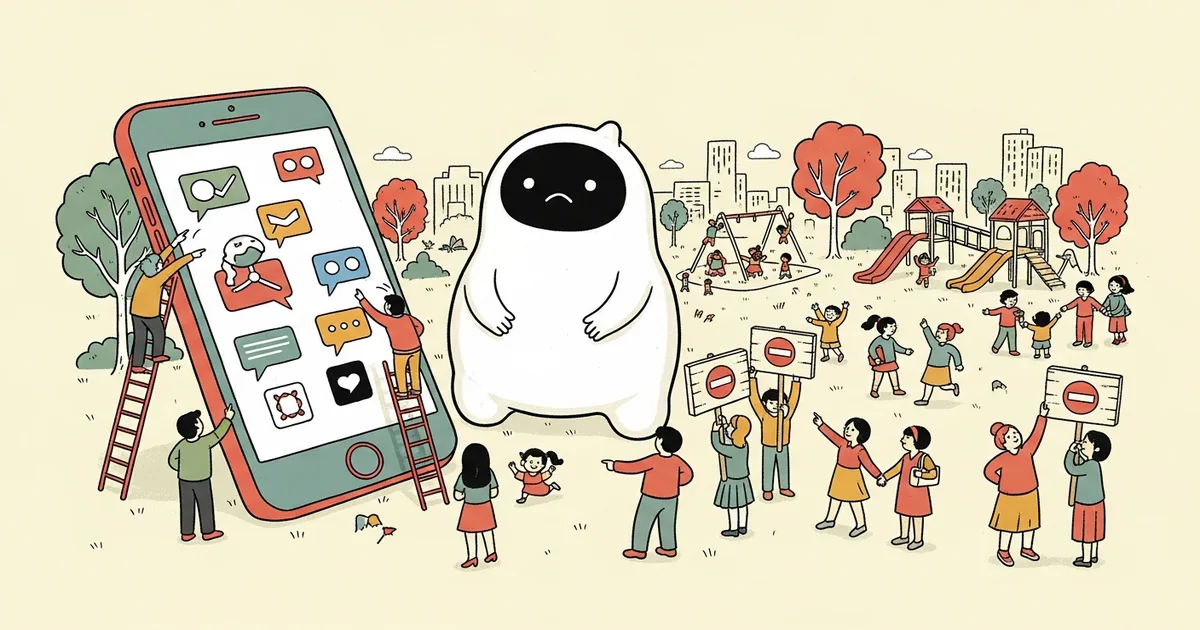
- Manitoba Premier Wab Kinew announced on April 26, 2026 that the province plans to prohibit young people from accessing social media platforms and AI chatbots, according to Bloomberg.
- The proposal extends beyond comparable legislation in Australia and several U.S. states by explicitly naming AI chatbots as a restricted category alongside social media.
- No draft bill, age threshold, enforcement mechanism, or legislative timeline had been published as of April 27, 2026.
- Any provincial statute would face jurisdictional questions, as internet services in Canada fall under federal telecommunications authority.
What Happened
Manitoba Premier Wab Kinew said his province plans to prohibit young people from accessing social media platforms and artificial intelligence chatbots, Bloomberg reported on April 26, 2026. The declaration makes Manitoba one of the first Canadian provinces to publicly commit to restricting AI chatbot access for minors — a product category that governments elsewhere have not previously included alongside social media in youth protection statutes.
No draft legislation, specific age cutoff, or enforcement timeline had been released as of April 27, 2026. The announcement was described by Bloomberg as a statement from the province’s leader rather than the introduction of a formal bill.
Why It Matters
The announcement arrives roughly 17 months after Australia enacted the Online Safety Amendment (Social Media Minimum Age) Act in November 2024, which required platforms to take “reasonable steps” to prevent users under 16 from creating accounts, with penalties of up to AU$50 million for systemic non-compliance. Several U.S. states, including Florida — which signed the Social Media Use by Minors Act in March 2024 — and Utah, which enacted age-verification requirements in 2023, have pursued similar measures focused exclusively on social media.
Manitoba’s proposal is broader in stated scope. General-purpose AI assistants including OpenAI’s ChatGPT and Google’s Gemini reached hundreds of millions of users globally after their respective 2022 and 2023 launches, but no comparable jurisdiction had moved to restrict minor access to this product class prior to Manitoba’s announcement. Whether the province can enforce such restrictions unilaterally under Canadian constitutional law is an open question.
Technical Details
Internet services in Canada are governed primarily by federal telecommunications authority under the Telecommunications Act, which means a Manitoba-only statute would likely operate through provincial consumer protection or child welfare statutes and could face constitutional challenges around jurisdictional overreach. Effective enforcement — particularly placing compliance obligations on platforms operating outside the province — would likely require federal coordination or a companion federal framework.
Defining “AI chatbot” for legislative purposes introduces a distinct classification problem. The category includes general-purpose assistants, voice-activated AI features embedded in consumer devices, AI tutoring tools deployed by schools, and specialized domain-specific agents — products with different interaction models, data handling practices, and exposure profiles. A statute would need to specify whether it covers standalone applications, embedded AI features within third-party apps, or both.
Age verification implementations typically rely on one of three approaches: government-issued ID checks, financial data matching, or third-party verification services. Australia’s 2024 law did not mandate a specific technical method, requiring instead that platforms demonstrate “reasonable steps” — a standard that drew both praise for its flexibility and criticism for creating uneven enforcement outcomes across platforms of different sizes.
Who’s Affected
Minors residing in Manitoba would face the most direct impact, along with social media operators and AI service providers whose platforms they access. Meta, ByteDance (TikTok), Snap, OpenAI, Google, and Anthropic would be among the companies facing compliance scrutiny under any law imposing platform-level obligations. The province had approximately 1.45 million residents as of 2024, limiting the direct market impact compared with national legislation, though industry groups typically treat provincial regulation as a potential template for federal action.
Educational technology providers face particular uncertainty. AI-assisted tutoring platforms, classroom writing tools, and school-deployed AI systems could fall within the chatbot definition depending on legislative drafting, and it is not yet clear whether educational deployments would be granted carve-outs or treated identically to consumer products.
What’s Next
Manitoba’s government had not released a legislative calendar or specified an age threshold as of April 27, 2026. Canada’s federal government has been developing its own online safety framework, and a Manitoba provincial bill could complement or conflict with that effort depending on its scope, definitions, and enforcement design. Platform operators and AI providers with Canadian user bases are likely to seek formal consultation on implementation specifics, particularly around product definitions, verification standards, and liability for non-compliance.
Related Reading
- ChatGPT Went Down April 20, 2026: 13,000+ Users Hit, All Features Broke
- Canva Launches AI 2.0 with Editable Generation and Agentic Editing System
- Gemini vs ChatGPT 2026: Which Is Actually Better Right Now [Full Breakdown]
- Trustpilot’s ChatGPT Citations Surge 246%: Answer Engine Optimization Is Now Essential