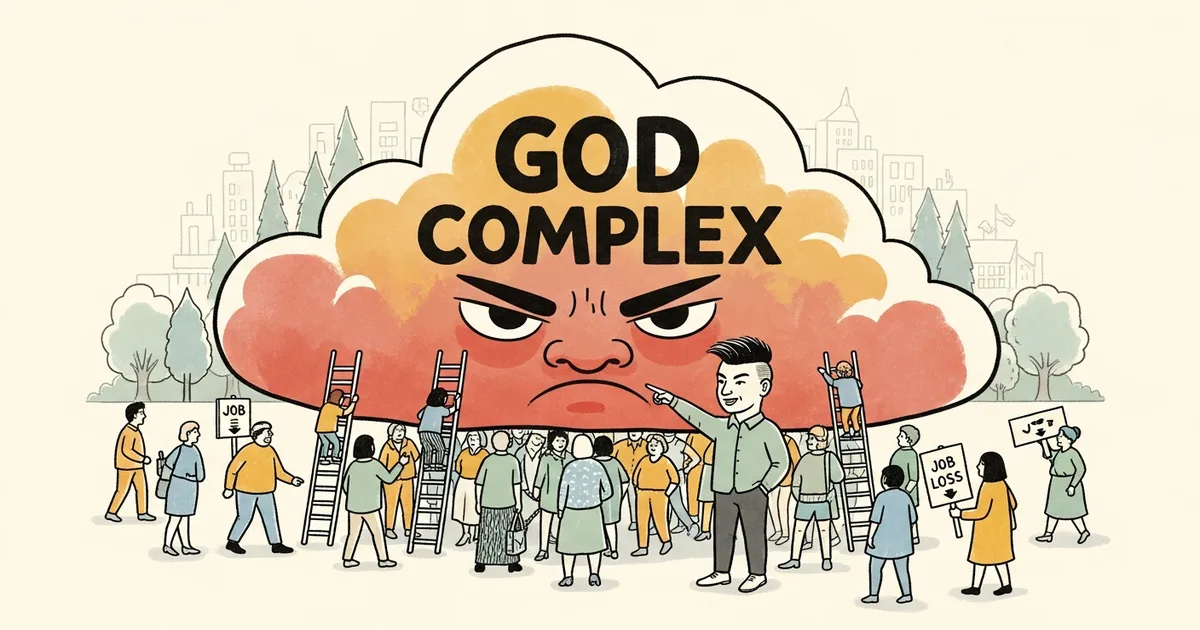
- Nvidia CEO Jensen Huang publicly pushed back on tech CEOs predicting mass AI-driven layoffs, calling the talk a “god complex” that could harm society.
- “Somehow because they became CEOs, you adopt a god complex and before you know it, you know everything,” Huang said in remarks reported May 2, 2026.
- He cited radiology as a cautionary example: Geoffrey Hinton predicted ten years ago that AI would make radiologists obsolete; radiologist shortages persist, and Hinton has acknowledged overweighting image analysis.
- Huang said AI has created more than half a million jobs in recent years and that Nvidia is hiring more engineers than ever.
What Happened
Nvidia CEO Jensen Huang publicly criticized fellow tech executives who predict large-scale AI-driven job losses, in remarks reported May 2, 2026. Huang’s framing was direct: “Somehow because they became CEOs, you adopt a god complex and before you know it, you know everything.” He warned that loose talk about AI replacing massive numbers of jobs could itself cause real societal harm.
Why It Matters
Huang’s intervention lands in a 2026 environment where multiple Fortune-500 CEOs — at IBM, Salesforce, Klarna, Goldman Sachs, and others — have publicly cited AI-productivity gains as drivers of workforce reductions. Huang is the most senior frontier-AI-infrastructure executive to publicly push back on the framing, and Nvidia’s commercial position makes the pushback notable: every job-displacing AI deployment runs on Nvidia silicon. The criticism is that confident CEO predictions of mass job loss are weakly grounded and create real labor-market and policy harm even when they prove inaccurate.
Technical Details
Huang anchored his argument in a specific historical example. Approximately ten years ago, Geoffrey Hinton predicted AI would render radiologists obsolete. AI now appears in nearly every corner of radiology workflow — image triage, anomaly detection, report generation — but the world still has a shortage of radiologists, not a surplus. Hinton has subsequently acknowledged that he placed too much weight on the image-analysis piece of radiology.
Huang’s structural argument is task-versus-purpose: writing code is a task, but it is not the point of being a software engineer. The purpose is solving problems and building new things, of which writing code is one component. He applied the same framing to radiology: the role is diagnosing disease, and reading scans is one input. Huang said AI has created more than 500,000 jobs in recent years and that Nvidia is hiring more engineers than at any prior point.
Who’s Affected
The most direct targets — though Huang did not name them — are CEOs at companies that have explicitly cited AI-productivity gains in workforce-reduction announcements during 2025 and 2026. Workers in roles considered most exposed to AI displacement gain a counter-narrative from the head of the company whose hardware powers the underlying AI. Policymakers debating labor-market interventions in response to AI displacement face a more contested factual environment when the most prominent AI-infrastructure executive publicly disputes the predictions used to justify policy proposals. Nvidia itself benefits commercially from the framing: positioning AI as job-creating rather than job-replacing aligns with the company’s public-relations interest in maintaining policy support for unrestricted AI deployment.
What’s Next
Whether other frontier-lab leaders follow Huang’s framing will be a useful signal. Sam Altman, Sundar Pichai, and Dario Amodei have each made varied statements on AI-and-employment over the past year; explicit alignment with or pushback against Huang’s “god complex” frame would shape the public discussion. Watch for Hinton’s response — Huang’s reference to Hinton’s overweighted prediction comes as Hinton himself has continued public commentary on AI risk through 2026.