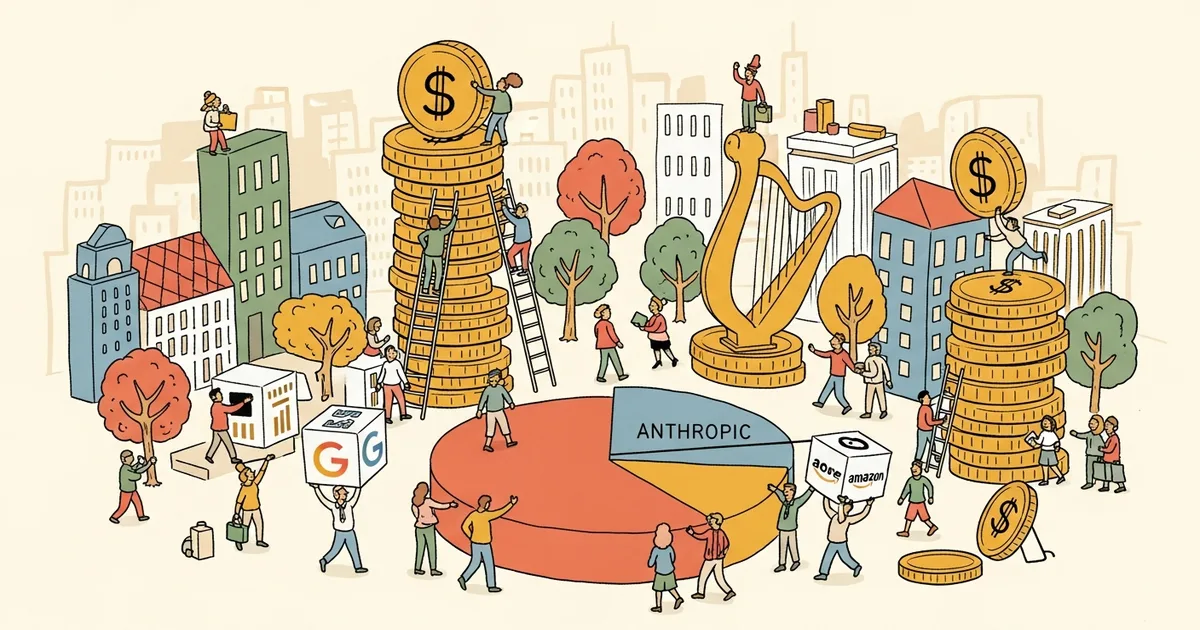
- A Fortune analysis circulated on May 1, 2026 reports that approximately half of Google’s and Amazon’s recent “blowout AI profits” came from mark-to-market gains on their Anthropic equity stakes rather than operating AI revenue.
- The framing distinguishes between equity-method accounting gains (driven by Anthropic’s reported valuation rise) and revenue from each company’s own AI products (Google Cloud Vertex AI, Amazon Bedrock).
- The headline appeared in Fortune’s reporting; full attribution and detailed breakdown should be cross-checked against the original article, since the source URL returned a Google News redirect during research.
- If accurate, the analysis recasts recent earnings narratives that investors had treated as evidence of Google’s and Amazon’s operational AI scale rather than as paper gains on a third-party investment.
What Happened
A Fortune analysis surfaced on May 1, 2026 — distributed via Google News — reporting that roughly half of Google’s and Amazon’s recent quarterly AI-attributed profits came from gains on their equity stakes in Anthropic rather than from each company’s operating AI businesses. The original Fortune URL was redirected through Google News during research, so the specific quarter, exact percentages, and methodology are best confirmed against Fortune’s published article directly.
Why It Matters
Both Google and Amazon have invested billions in Anthropic — Google’s investment surpassed $3 billion across 2023 and 2024 commitments, and Amazon committed up to $4 billion through 2024 with subsequent upsizing. Each holds material equity. As Anthropic’s reported valuation rose during 2025 and 2026 (the company is reportedly weighing a $900B-plus funding round per Bloomberg coverage in late April), mark-to-market gains on those stakes show up in earnings under the same line items investors have read as evidence of AI operational scale. The distinction matters for valuation: paper gains on a single investment are non-recurring, while operating AI revenue is.
Technical Details
Equity-method accounting and fair-value adjustments are the mechanisms by which an investor’s earnings can rise as an investee’s valuation rises. Anthropic remains private, so quarterly mark-to-market involves estimated fair values rather than market prices. Both Google and Amazon disclose Anthropic-related gains in their financial statements, but in line items that are not always cleanly separated from operating AI revenue in summary press coverage.
The Fortune analysis as referenced in headline form does not appear to challenge the existence of Google Cloud’s or AWS’s AI-related operating revenue — both companies have separately reported double-digit cloud growth attributed to AI workloads. The narrower claim is about what fraction of the headline “AI profit” number comes from each source. Independent verification will require Fortune’s underlying breakdown plus reconciliation against the companies’ own quarterly disclosures.
Who’s Affected
Investors who priced Google and Amazon partly on AI-operating profitability now have reason to revisit how those earnings were composed. Anthropic itself benefits indirectly: a higher reported valuation translates into higher reported earnings at its largest investors, which in turn reinforces investor demand for Anthropic-adjacent equity. Microsoft‘s separate equity exposure to OpenAI is the closest comparable structure and faces the same accounting dynamic. Smaller cloud providers without large AI-lab stakes — Oracle, IBM — are paradoxically validated: their AI-attributed profits, where present, are more cleanly operating in nature.
What’s Next
Q2 2026 earnings disclosures from Google and Amazon are the next direct test. Expect both companies to report Anthropic-related gains separately if the Fortune framing gains traction with sell-side analysts. Watch for Anthropic’s reported valuation trajectory through Q3 — if the $900B-plus round materializes, the next Anthropic-mark-to-market quarter will repeat the same dynamic at a larger scale, sharpening the distinction Fortune is drawing.