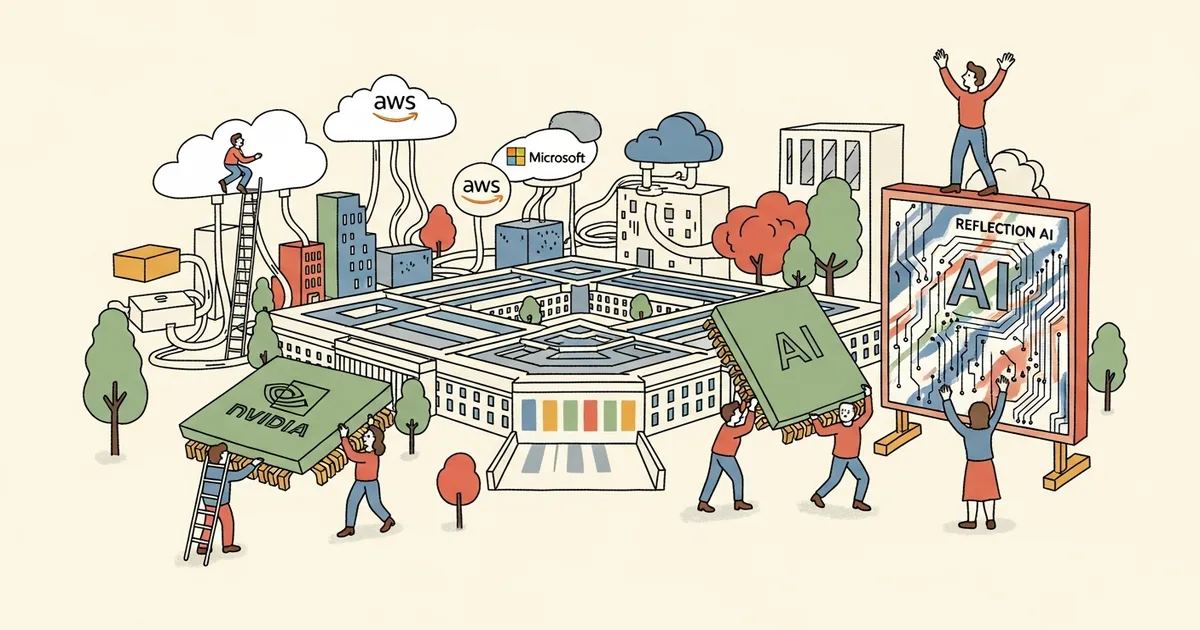
- The Pentagon announced on May 1, 2026 that it has signed AI agreements with Nvidia, Microsoft, AWS, and Reflection AI for deployment on classified networks.
- The deals add to earlier 2026 agreements with Google, SpaceX, and OpenAI, totaling seven announced AI vendors with Pentagon access.
- Models will deploy on Impact Level 6 (IL6) and Impact Level 7 (IL7) classified environments — the highest national-security data tiers.
- The Department says more than 1.3 million DOD personnel have used its enterprise generative-AI platform GenAI.mil for non-classified tasks.
What Happened
The U.S. Department of Defense announced on May 1, 2026 that it has signed agreements with Nvidia, Microsoft, Amazon Web Services, and Reflection AI to deploy their AI hardware and models on classified Pentagon networks for “lawful operational use.” The new contracts follow earlier 2026 deals with Google, SpaceX, and OpenAI. “These agreements accelerate the transformation toward establishing the United States military as an AI-first fighting force and will strengthen our warfighters’ ability to maintain decision superiority across all domains of warfare,” the DOD statement reads.
Why It Matters
The Pentagon’s expanding vendor list is the direct downstream effect of its dispute with Anthropic earlier in 2026. The DOD wanted unrestricted access to Anthropic’s models; Anthropic insisted on guardrails preventing its technology from being used in domestic mass surveillance and autonomous weapons. The Pentagon then designated Anthropic a “supply-chain risk,” and the Trump administration ordered federal agencies to stop using its technology. Anthropic sued and won an injunction against the supply-chain-risk designation in March 2026. The DOD’s response is structural: signing as many AI vendors as possible to remove dependency on any single company.
Technical Details
The companies’ AI hardware and models will deploy on Impact Level 6 (IL6) and Impact Level 7 (IL7) environments. IL6 covers national-security information up to Secret classification; IL7 covers Top Secret. Both require strict physical protection, access controls, and audit trails. The DOD says the deployment is intended to “streamline data synthesis, elevate situational understanding, and augment warfighter decision-making.”
Beyond classified networks, the Pentagon’s enterprise generative-AI platform GenAI.mil now serves more than 1.3 million DOD personnel for non-classified tasks including research, document drafting, and data analysis. “The Department will continue to build an architecture that prevents AI vendor lock-in and ensures long-term flexibility for the Joint Force,” the statement reads, framing the multi-vendor approach as deliberate policy.
Who’s Affected
Nvidia, Microsoft, AWS, and Reflection AI gain access to the largest enterprise AI customer in the world by procurement budget, with comparable footings to Google, SpaceX, and OpenAI. Reflection AI’s inclusion alongside the four hyperscalers is the most notable — the smaller AI lab joins a tier previously reserved for the largest tech companies. Anthropic remains in legal conflict with the DOD, and the company’s Mythos cybersecurity model is publicly available but excluded from these classified contracts.
What’s Next
The DOD has flagged that vendor expansion will continue, with the architecture explicitly designed against lock-in. Watch for additional named vendors over the next quarter, particularly companies with specialized capabilities (vision, speech, simulation) absent from the current roster. Anthropic’s lawsuit and the underlying disagreement over usage-terms language remain unresolved, and the legal outcome will shape what guardrails other vendors can negotiate in future Pentagon contracts.