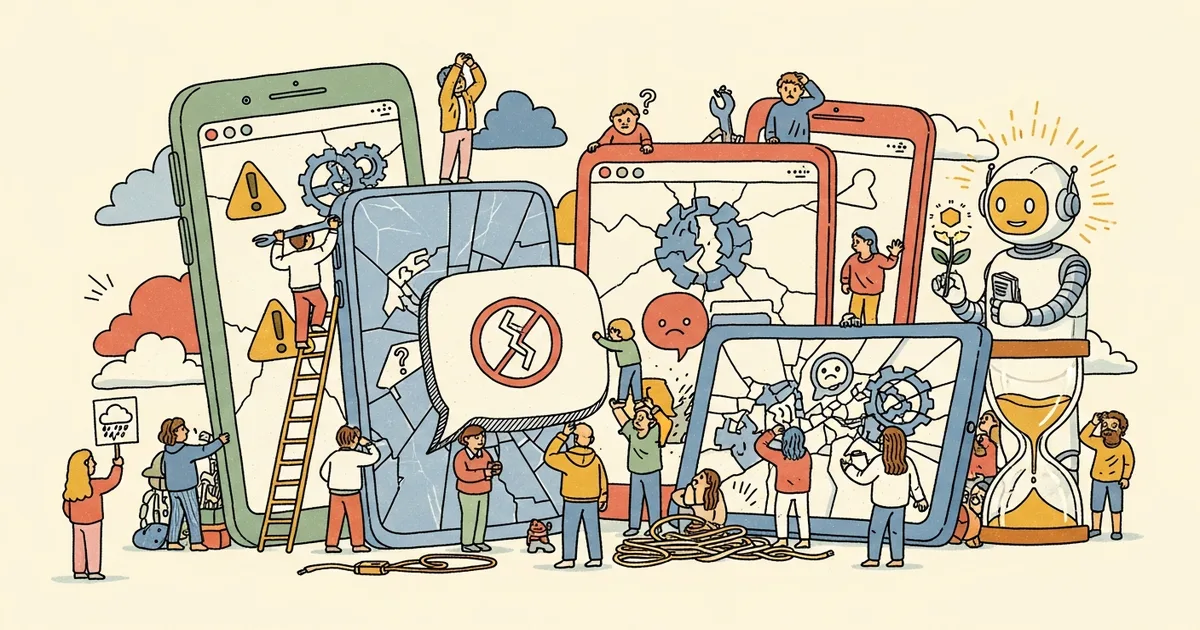
ChatGPT, OpenAI’s flagship conversational AI platform, went down globally on April 20, 2026, beginning at approximately 10:05 AM ET. Downdetector reports surged from zero to more than 13,000 within 15 minutes — one of the steepest spike rates recorded for a major AI service. OpenAI escalated the incident from “degraded performance” to “partial outage” as login, conversations, voice mode, image generation, and Codex all stopped working at the same time.
The timing made it worse. A Monday morning outage hit knowledge workers mid-workflow, producing a flood of posts on X — “ChatGPT is down. WTF. I need to work.” — that surfaced just how load-bearing the platform has become for daily operations. The outage lasted several hours, with no postmortem published at the time of this report.
The April 20, 2026 ChatGPT Outage Timeline
The first reports appeared on Downdetector at approximately 10:05 AM ET on April 20. Within 10 minutes, the count crossed 5,000. By 10:20 AM, it exceeded 13,000. OpenAI’s status page at status.openai.com initially listed “degraded performance” — the platform’s mildest severity classification — before escalating to “partial outage” as the scale of the failure became undeniable.
The gap between the Downdetector spike and the official status change was visible in real time. Users in the UK were reporting complete failures — blank pages, infinite load loops, total timeouts — while OpenAI’s page still showed the lower severity tier. OpenAI had not published a full incident postmortem by the time this article was published.
ChatGPT Down: Five Core Features Broke Simultaneously
The April 20 outage was unusually broad. Unlike most platform incidents that isolate to a single feature or service tier, this event took down every major user-facing capability at once:
- Login — users hit blank screens or infinite loading loops, unable to authenticate
- Conversations — existing threads failed to load; new prompts returned timeouts
- Voice Mode — ChatGPT’s real-time audio interface was completely unavailable
- Image Generation — DALL-E requests returned errors across all subscription tiers
- Codex — OpenAI’s code-generation product, embedded in developer CI pipelines and IDEs, went dark
The cross-segment failure is what made this incident operationally severe. A voice mode outage affects one user segment; a Codex failure stops engineering workflows. Both happening simultaneously — with login broken — meant no user type had any path around the problem.
The UK Was Hit 4.7x Harder Than the United States
Downdetector’s geographic breakdown showed a striking disparity: the United Kingdom logged more than 8,000 outage reports at peak, compared to approximately 1,700 from the United States — a 4.7:1 ratio. Reports also came in from Canada, Australia, and across Western Europe.
The UK-heavy distribution has two plausible explanations. The outage began at 10:05 AM ET, which translates to 3:05 PM in the UK — squarely within peak European working hours, versus relatively early morning for US East Coast users. Separately, routing or infrastructure localization issues may have concentrated the failure in European data centers. The geographic gap reinforces the case for better-distributed AI infrastructure in Europe — a need that projects like Nebius’s planned $10B AI data center in Finland are designed to address.
Without an official postmortem, root cause remains unconfirmed. But the 4.7x UK-to-US ratio is a data point worth tracking: European users appear structurally more exposed to ChatGPT infrastructure events that OpenAI classifies as partial rather than full outages — a classification that may understate the operational impact for UK-based teams.
OpenAI’s Status Page Lagged the Reality
OpenAI’s public status page showed “degraded performance” during the initial phase of the incident — the same classification used for minor slowdowns — while Downdetector was already tracking more than 5,000 user reports. The upgrade to “partial outage” came after the failure was already established at scale.
Status pages serve a dual purpose: informing users and managing incident framing. “Degraded performance” is the softest available label and creates buffer time before a more alarming classification is required. For UK users hitting blank screens at 3 PM on a Monday, the label was an inadequate description of what was happening. OpenAI, which recently structured a major content partnership with Disney, now operates at a scale where enterprise reliability expectations exceed what “degraded performance” language was designed to handle.
Competitors That Stayed Operational: Claude, Gemini, Copilot, Meta AI
All four major ChatGPT alternatives remained fully online throughout the April 20 outage window. Anthropic’s Claude, Google Gemini, Microsoft Copilot, and Meta AI each run on independent infrastructure with no shared dependencies on OpenAI’s systems — which is why a ChatGPT failure does not propagate to them.
The practical limitation is that alternatives are not interchangeable. ChatGPT users without active accounts on competing platforms — or whose workflows rely on ChatGPT-specific integrations such as custom GPTs, persistent memory, or Codex API endpoints — had no immediate fallover. MegaOne AI tracks 139+ AI tools across 17 categories, and the April 20 incident serves as a live stress test for which platform dependencies in any given stack carry genuine continuity risk.
Anthropic has continued to scale its own infrastructure, though it too has navigated incidents — including an accidental source code exposure earlier this year that raised different but equally legitimate reliability questions. No major AI provider has a clean reliability record at this stage of the market.
Single-Platform AI Dependency Is a Structural Risk
The April 20 outage is not primarily a story about ChatGPT’s uptime percentage. It is a story about what happens when a single platform becomes load-bearing infrastructure for knowledge workers, developers, and creative professionals — with no redundancy strategy in place.
The X reaction during the outage — hundreds of variations of “ChatGPT is down, I can’t work” within the first hour — reflects genuine operational dependency, not hyperbole. When login, voice mode, image generation, and code assistance fail simultaneously, the affected user has no fallback that replicates the same interface with the same context. The growing pushback against AI-first workflows takes on different weight when the AI simply stops working mid-Monday and there is no backup plan in place.
Cloud computing teams normalized multi-provider strategies years ago for exactly this reason: single-vendor dependency produces fragile architectures. AI tooling has now crossed the threshold where the same logic applies. The April 20 incident is the clearest demonstration to date that treating any single AI platform as critical infrastructure — without a failover plan — is a live operational risk, not a theoretical one.
How to Reduce ChatGPT Dependency Risk Before the Next Outage
The outage makes the operational response clear:
- Maintain active accounts on at least one alternative — Claude (claude.ai), Gemini (gemini.google.com), or Microsoft Copilot — so login and context-switching are already familiar when an outage forces the decision
- Developers using Codex or the OpenAI API should evaluate and pre-configure fallback integrations (Anthropic’s API, Gemini’s code models) in CI pipelines — not during an outage under pressure
- Enterprise teams should review ChatGPT Enterprise SLA terms carefully — a “partial outage” classification may not trigger uptime commitments even when features are completely unavailable to end users
- Document prompts and workflows in a model-agnostic format — instructions written for ChatGPT typically require minimal changes to run on Claude or Gemini, but only if they were structured portably from the start
ChatGPT will restore full reliability, and OpenAI will publish a postmortem. The more durable question is whether your workflows are structured to survive the next incident — because there will be one, for ChatGPT and for every other platform that has become load-bearing infrastructure.