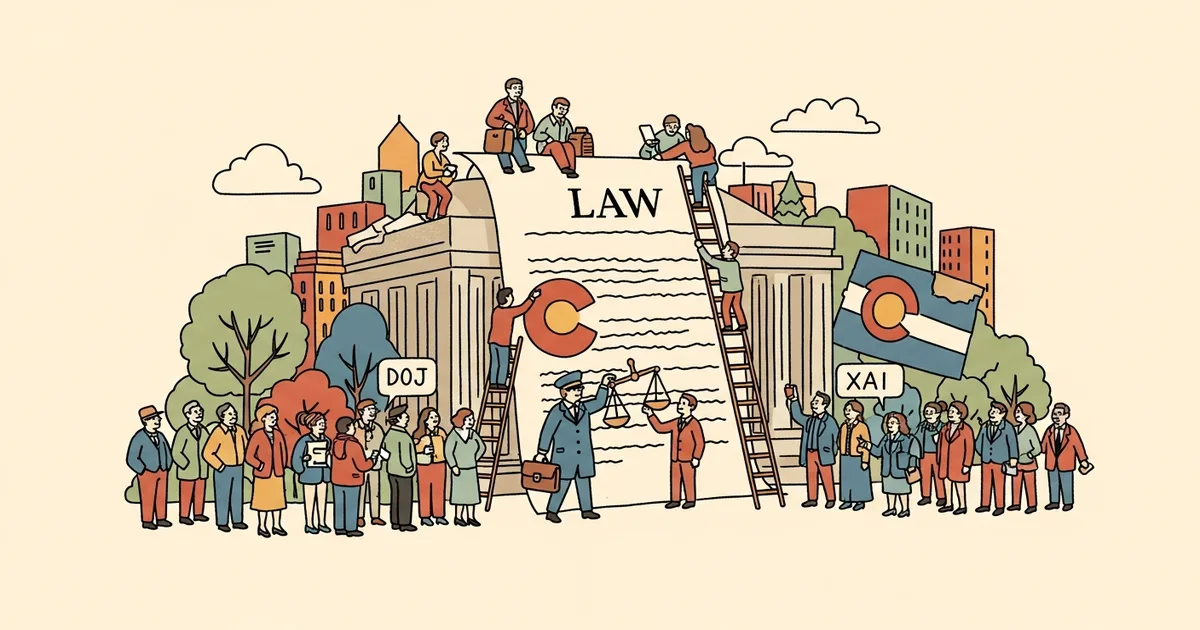
- The U.S. Department of Justice filed to join xAI’s existing legal challenge to Colorado’s Artificial Intelligence Act on April 24, 2026, marking one of the first instances of the Trump administration directly intervening in state AI litigation.
- Colorado’s AI Act (SB 205), signed by Governor Jared Polis in May 2024 and in effect since February 1, 2026, requires deployers and developers of “high-risk” AI systems to prevent algorithmic discrimination in employment, housing, credit, and other consequential decisions.
- The DOJ’s intervention signals a federal posture against state-level AI regulation, even in the absence of a comprehensive federal AI statute.
- A ruling against Colorado could weaken similar AI anti-discrimination bills advancing in more than a dozen other states.
What Happened
The U.S. Department of Justice announced on April 24, 2026 that it was joining Elon Musk’s artificial intelligence company xAI in a federal lawsuit challenging Colorado’s Artificial Intelligence Act (SB 205), according to Bloomberg. The Colorado law, signed by Governor Jared Polis in May 2024 and in effect since February 1, 2026, imposes compliance obligations on companies deploying AI systems that make consequential decisions in areas including employment, credit, and housing. The DOJ’s entry as a party to the lawsuit marks a significant escalation: federal legal resources and the executive branch are now aligned against a state-level AI governance measure.
Why It Matters
Colorado SB 205 was among the first enacted U.S. state laws to impose broad algorithmic discrimination protections across multiple sectors, drawing sustained opposition from the technology industry during its drafting in 2023 and 2024. The law’s passage prompted debate about whether a patchwork of state AI rules would create conflicting compliance burdens for companies operating nationally. The Trump DOJ’s decision to enter the litigation — in the absence of any enacted federal AI statute — effectively asserts a federal interest in limiting state AI regulation, a position with direct consequences for pending AI bills in California, Illinois, and at least a dozen other states.
Technical Details
Colorado SB 205 defines a “high-risk artificial intelligence system” as one that makes or substantially contributes to a “consequential decision” — a material determination affecting a consumer’s access to employment, education enrollment, financial services, essential government services, health care, housing, insurance, or legal services. Deployers of such systems are required to conduct annual impact assessments, maintain written risk management policies aligned with a recognized AI risk framework, and provide consumer-facing disclosures before an AI system contributes to an adverse consequential decision. Developers must supply deployers with documentation identifying known or reasonably foreseeable risks of algorithmic discrimination, which the statute defines as any condition in which an AI system contributes to unlawful differential treatment based on a protected class characteristic. Enforcement authority rests with the Colorado Attorney General; the law does not create a private right of action.
Who’s Affected
AI developers and enterprises deploying automated decision tools in Colorado — including employers using AI-assisted hiring platforms, insurers using algorithmic underwriting models, and lenders using AI-based credit scoring systems — face ongoing compliance obligations if the statute is upheld. xAI, whose Grok large language model launched in November 2023 and has since expanded into enterprise applications, is among the companies contesting the law’s scope and requirements. Colorado consumers in protected classes who might bring algorithmic discrimination complaints would lose those statutory protections if the law is invalidated or substantially narrowed by the court.
What’s Next
The case will proceed in federal district court with the DOJ now positioned as a party, adding federal legal weight to xAI’s constitutional and statutory arguments against the law. Colorado’s Attorney General is expected to defend the statute. A ruling in the plaintiffs’ favor could set a precedent that states cannot enact standalone AI anti-discrimination regimes under existing civil rights frameworks without federal authorization — a determination that would directly reshape the landscape for state AI governance nationwide.