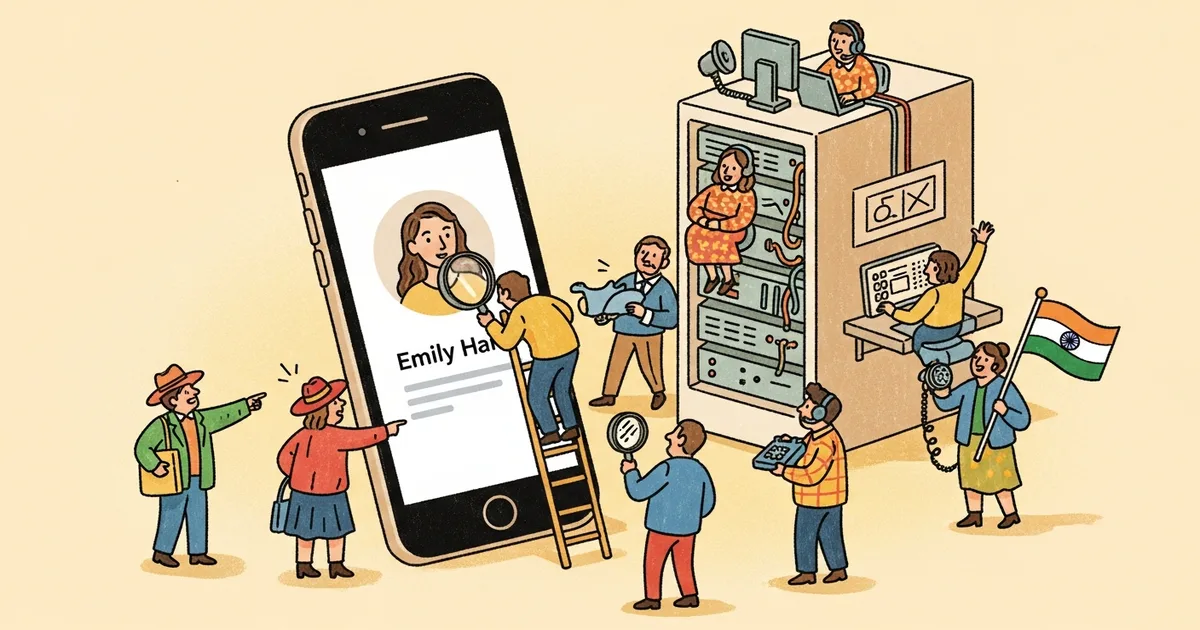
- A 22-year-old Indian medical student known only as “Sam” created and operated Emily Hart, an AI-generated MAGA influencer who accumulated millions of social media views before Instagram removed the account in February 2026 for fraudulent activity.
- Sam used Google’s Gemini AI for audience-targeting strategy and Grok AI for image generation, including explicit content sold via Fanvue, a platform that explicitly permits AI-generated material.
- By Sam’s self-reported account to Wired, the operation reached 10,000 followers within one month and generated thousands of dollars monthly with approximately 30 to 50 minutes of daily work.
- Valerie Wirtschafter, a Brookings Institution fellow studying emerging technology and democracy, told Wired that AI has made fake profiles “more believable,” with a potential amplification effect across platforms.
What Happened
An Indian medical student created and operated Emily Hart, an AI-generated conservative influencer persona that accumulated millions of social media views before Instagram removed the account in February 2026. Wired published its investigation on April 21, 2026; the New York Post covered the findings the same day. The operator, identified only as “Sam,” is a 22-year-old orthopedic surgery student who told Wired he built the account to generate income during medical school and save enough to emigrate to the United States after graduation.
Instagram removed Hart’s profile for “fraudulent” activity under its fraud policy rather than its AI-disclosure requirement. A Facebook account associated with the persona was taken down after Wired’s story was published.
Why It Matters
The Emily Hart case demonstrates how commercially available AI tools can be combined with standard platform monetization systems to construct politically targeted synthetic personas that generate meaningful revenue. The operation required no specialized technical skills: Sam selected his tools — Gemini, Grok, and Fanvue — based on accessibility and policy permissiveness. Earlier documented examples of AI-generated influence operations have typically involved state-level actors; the Hart case involves a single individual motivated by personal financial gain rather than political objectives.
Fanvue has explicitly differentiated its policies from OnlyFans by permitting AI-generated content, creating a distinct monetization pathway for synthetic personas that OnlyFans does not offer.
Technical Details
Sam told Wired he consulted Google’s Gemini AI to determine which audience to target. Gemini reportedly advised that “the conservative audience (especially older men in the US) often has higher disposable income and is more loyal.” He then used Grok AI, developed by xAI, to generate both the public-facing imagery of Hart and explicit images sold via a Fanvue subscription. Sam posted daily content covering Christianity, gun rights, and anti-immigration themes, as well as MAGA-themed merchandise.
By Sam’s self-reported account to Wired, the Instagram profile reached 10,000 followers within one month, with individual reels generating millions of views. He reported spending 30 to 50 minutes per day managing the operation and earning thousands of dollars monthly — figures that are unverified independently of his own statements to the publication.
Who’s Affected
The primary affected group is the followers and paying subscribers who engaged with Hart’s content without knowing the persona was AI-generated and operated abroad. Valerie Wirtschafter, a fellow at the Brookings Institution studying emerging technology and democracy, told Wired that “AI has made them [fake profiles] more believable, and there has perhaps been an amplification of it.” She also noted that AI-generated young conservative women are “more attention-grabbing” given that most women aged 18 to 29 skew liberal, amplifying the persona’s novelty effect.
Platform integrity teams at Instagram and Facebook are affected insofar as their enforcement responded to fraud indicators rather than AI-disclosure violations. Instagram requires creators to label AI-generated content, but the account was removed for impersonation-related fraud — meaning the disclosure framework was not the operative enforcement mechanism, and nominally compliant AI-generated personas would not have triggered the same action.
What’s Next
Sam told Wired he plans to stop producing content under the Emily Hart persona and focus on completing his medical degree. He said he does not intend to run similar accounts going forward, though he maintained, “I don’t feel like I was scamming people.”
The Hart case presents a concrete test for platform AI-disclosure policies: Instagram’s fraud-based removal and Fanvue’s permissive stance toward AI-generated content mean neither platform currently has a proactive mechanism for identifying synthetic persona operations before they reach scale. How platforms revise their detection and disclosure enforcement in response to documented cases like this one remains an open policy question for trust-and-safety teams.