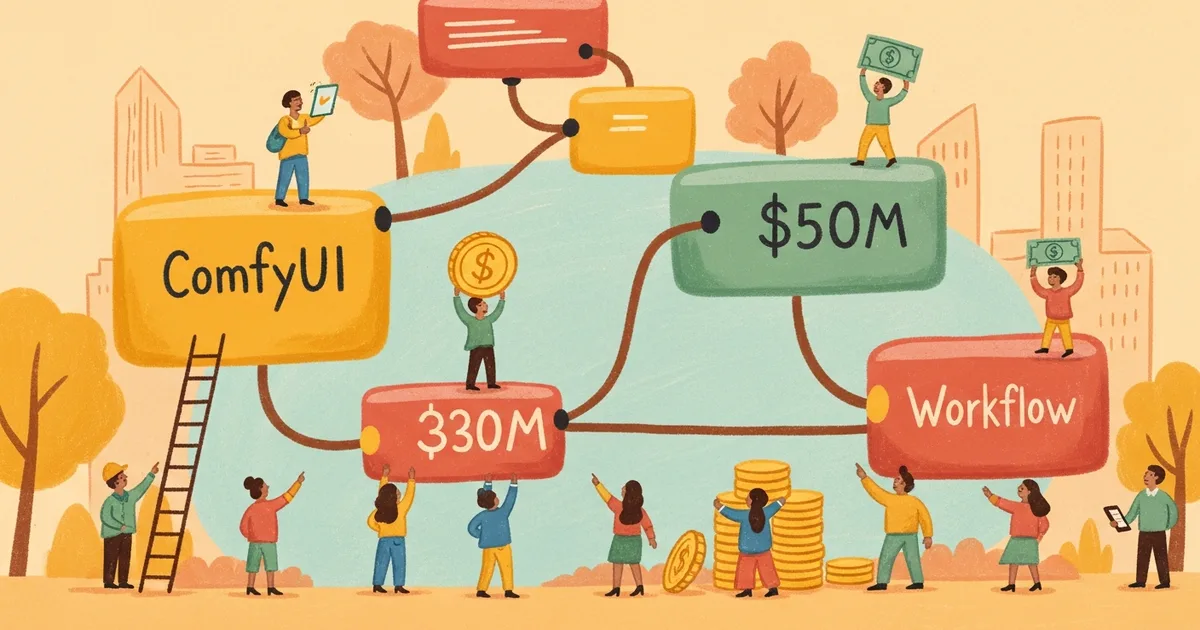
- ComfyUI closed a $30 million funding round led by Craft Ventures at a $500 million valuation on April 24, 2026.
- The platform, which uses a node-based interface for controlling diffusion model pipelines, claims over 4 million users across VFX, animation, advertising, and industrial design.
- Co-founder and CEO Yoland Yan says prompt-based tools deliver outputs that are only “60%–80% there,” with iterative refinement behaving unpredictably.
- Figma acquired ComfyUI competitor Weavy, signaling broader consolidation in AI creative tooling.
What Happened
ComfyUI, a startup building node-based workflow tools for diffusion model generation across image, video, and audio, raised $30 million at a $500 million valuation on April 24, 2026. The round was led by Craft Ventures, with participation from Pace Capital, Chemistry, and TruArrow. The raise roughly triples the company’s implied valuation since its $19 million Series A, which closed in late 2024.
Why It Matters
ComfyUI originated in 2023 as an open-source project responding to a specific deficiency in early diffusion models: the lack of granular per-step control over generation. At launch, tools like Midjourney and OpenAI’s DALL-E produced frequent artifacts, including malformed hands and inconsistent compositions, that creators could not correct without regenerating entire outputs. The continued investment suggests the market sees persistent structural demand for workflow-level precision even as base models improve.
The competitive context has tightened: Figma acquired Weavy, a direct competitor in AI creative workflow tooling, adding platform-backed competition to a space ComfyUI previously dominated among technical artists.
Technical Details
ComfyUI’s interface represents each stage of a diffusion pipeline—denoising passes, conditioning inputs such as ControlNet, upscalers, and image-to-image transformations—as discrete, linkable nodes. Creators assemble custom graphs, which allows modification of a single processing stage without regenerating adjacent steps. This contrasts with prompt-box interfaces, where a change to one part of a text prompt can alter the entire output unpredictably.
CEO Yoland Yan described the limitation to TechCrunch: “If you think about your typical prompt-based solution, like Midjourney or ChatGPT, you ask for something, it [gets only] 60%–80% there. But to change that remaining 20%, you have to try this slot machine.” He characterized iterative prompting as analogous to casino play because it risks overwriting already-satisfactory portions of a generated output.
ComfyUI reports 4 million users and says the platform has penetrated professional pipelines deeply enough that “ComfyUI artist or engineer” has begun appearing as an explicit job title in studio hiring postings.
Who’s Affected
The platform is used across visual effects studios, animation houses, advertising agencies, and industrial design teams—workflows where node-graph interfaces are already standard in tools like Nuke and Houdini. Technical artists and engineers who need reproducible, auditable generation pipelines represent the core user base. Series A backers included Guillermo Rauch, founder of Vercel, alongside Chemistry Ventures and Cursor Capital; the new round adds Craft Ventures and TruArrow.
What’s Next
ComfyUI has not disclosed the specific allocation of the $30 million raise. Yan argued that even as foundational models continue to improve, they will not close the gap for professional production workflows on their own. “In the world where AI slop is going to be everywhere, the Comfy version of human-in-the-loop approach is going to win out most of the eyeballs in the end,” he told TechCrunch.
The company will face pressure to build enterprise-grade infrastructure and sales capacity as it scales beyond its open-source origins, particularly against platform-integrated competitors that can offer lower-friction onboarding for studios already embedded in tools like Figma.