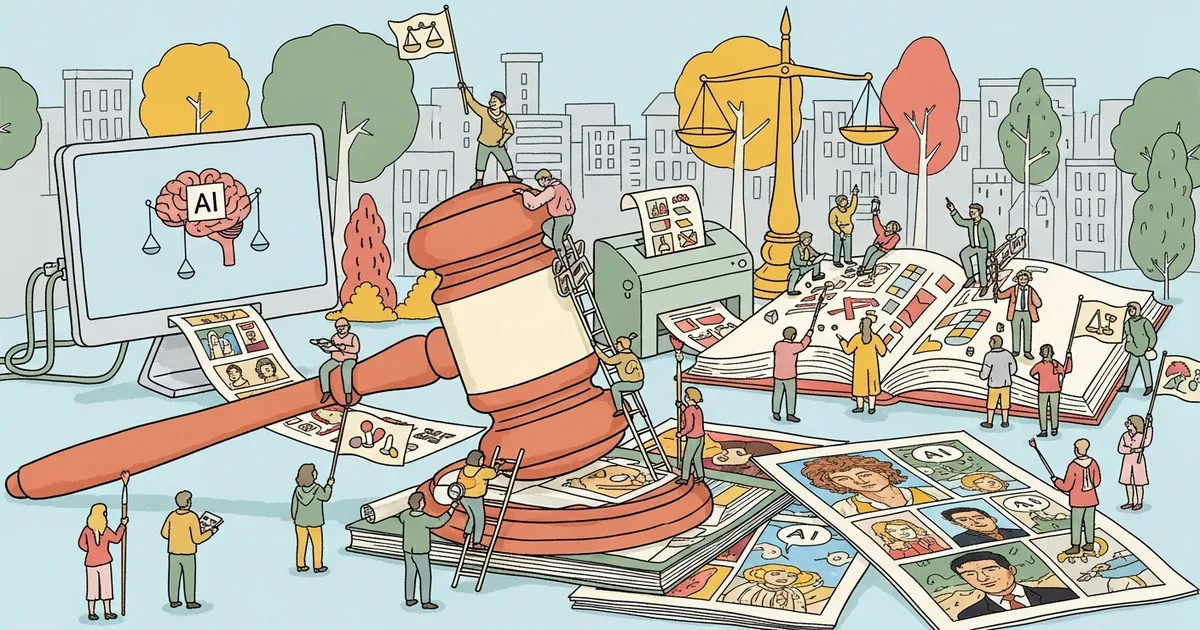
A German Higher Regional Court (Oberlandesgericht) issued a landmark copyright ruling in April 2026: transforming a real photograph into a comic-style image using generative AI is legally permissible under German copyright law, provided only the motif — the subject, composition, and pose — is copied, not the specific artistic expression of the original work. The decision is the first of its kind from a German appellate court, and it cuts directly against the legal theories driving dozens of active AI art copyright cases across Europe and the United States.
The ruling doesn’t say AI art is always legal. It says copying a motif isn’t the same as copying a copyrighted work — and that distinction may be the most consequential legal line drawn in generative AI since the technology went mainstream.
What the Court Actually Decided
The case centered on whether an AI tool could legally take a real photograph and produce a stylized comic-book rendering of its contents. The plaintiff argued that the comic adaptation reproduced the protected elements of the original photo — framing, lighting choices, the specific creative decisions that constitute the work’s copyright.
The court disagreed. Under German copyright law (Urheberrecht), copyright protects the specific creative expression of a work, not the ideas, subjects, or scenes it depicts. A photograph of a person in a particular pose creates copyright in how that pose was captured — the lens choice, depth of field, lighting angle, processing decisions. The motif itself — the person, their arrangement, the scene — is not owned.
The AI, the court found, had copied the motif. The comic adaptation was new creative expression layered over a borrowed subject. That transformation was sufficient to constitute an independent work.
The Motif vs. Expression Distinction, Explained
German copyright doctrine has long recognized this split. Schöpfungshöhe — the creative threshold a work must cross to qualify for protection — applies to the expressive choices an author makes, not to what the author chooses to depict. A painting of the Eiffel Tower doesn’t infringe on photos of the Eiffel Tower because the tower is the motif; the painting’s visual language is new expression.
The AI case extends this logic into generated imagery. When a generative model takes a reference photo and produces a comic adaptation, it does something analogous to what a human comic artist does: uses the real world (or a real image) as a subject reference while creating distinct visual output. The court found no meaningful legal difference between the two workflows.
This is not a small distinction. It directly undermines one of the central arguments in ongoing litigation against AI companies — that AI outputs infringe on training data because they “reproduce” protected works. The German ruling establishes that reproducing a motif is not reproducing a copyright.
Which Court Issued It — and Why That Matters
German Higher Regional Courts (Oberlandesgerichte) sit above district courts and below the Federal Court of Justice (Bundesgerichtshof). Their decisions are binding within their regional circuit and carry significant persuasive weight across German jurisprudence. Courts in IP hubs Hamburg, Munich, and Frankfurt are among the most cited in European copyright litigation.
For the ruling to become binding across all of Germany, the Federal Court of Justice would need to confirm it on appeal. For EU-wide application, the European Court of Justice would need to issue a corresponding interpretation. Neither has happened yet. But German appellate decisions on copyright have historically shaped how EU courts reason about related questions — IP attorneys across the bloc will cite this ruling immediately.
The EU AI Act Is 15 Weeks from Full Application
The ruling arrives at a precise moment of regulatory pressure. The EU AI Act, which entered into force on August 1, 2024, reaches its general application date on August 2, 2026 — roughly 15 weeks from now. From that date, obligations around transparency, conformity assessments, and documentation requirements apply across all covered AI systems in EU member states.
The Act does not resolve copyright directly. It requires providers of general-purpose AI models to publish summaries of training data and comply with EU copyright law — but defers the question of what “comply” means to existing national copyright frameworks. The German ruling feeds directly into that gap: if comic-style adaptations don’t infringe under German copyright, AI systems producing such adaptations face reduced legal exposure in German courts even after August 2026.
What the EU AI Act creates is a transparency floor. What courts create is a liability ceiling. Right now those two tracks are running in parallel, and the German ruling just raised the ceiling for derivative AI outputs. For context on how AI industry deals are navigating similar content-licensing tensions, see how OpenAI’s $1 billion Disney deal drew its own contested lines between licensed transformation and infringement. The EU’s expanding AI infrastructure — including investments like Nebius’s planned $10 billion data center in Finland — will operate under this evolving legal framework from launch.
What This Means for Midjourney, DALL-E, and Stable Diffusion
The three dominant AI image platforms have taken different legal postures since 2022. Stability AI faces Getty Images litigation in both the UK and the US, with Getty arguing that training on its watermarked images constitutes infringement. Midjourney and DeviantArt are defendants in a US class action brought by artists Sarah Andersen, Kelly McKernan, and Karla Ortiz. OpenAI’s DALL-E faces separate claims tied to its training corpus.
The German ruling does not resolve training data liability — it addresses output liability: whether a generated image infringes the copyright in a source image used as a prompt or reference. These are legally distinct questions, but they overlap significantly in how AI companies build their defenses.
If European courts adopt the motif-vs-expression framework broadly, AI platforms could argue that their outputs — even when stylistically derived from reference photographs — don’t reproduce copyrightable expression. That argument is now backed by appellate precedent in a G7 economy. Expect it to appear in EU-jurisdiction filings before the end of Q2 2026.
MegaOne AI tracks 139+ AI tools across 17 categories, including image generation platforms. The legal risk profile of these tools just shifted in Europe.
The Training Data Question Remains Completely Separate
Training a model on millions of copyrighted images without license is a different act from generating a comic adaptation of a single photo. Courts in the UK, US, and EU have not consistently resolved whether training constitutes infringement — and this ruling doesn’t touch it.
The distinction matters because AI platforms face liability at two stages: during training (ingestion of copyrighted data) and during inference (the generated output). This ruling protects the inference stage under specific conditions. The training stage remains in active litigation globally, with no binding resolution in any major jurisdiction as of April 2026.
Artist advocacy groups have specifically called for liability at both stages. The German ruling hands the inference stage to AI platforms on favorable terms. The Humans First movement, which has pushed for mandatory artist compensation frameworks as AI displaces creative workers, will almost certainly challenge this framing — the ruling gives them less ground to stand on than they had last month.
Will Other EU Courts Follow?
There is no mechanism forcing EU member state courts to follow each other’s national copyright decisions. France, Spain, Italy, and the Netherlands each interpret their own copyright law — which must conform to EU directives (particularly the 2019 Copyright in the Digital Single Market Directive) but is applied nationally.
What German courts have is outsized intellectual influence. If the Federal Court of Justice confirms the motif-vs-expression logic on appeal, the probability of cross-border adoption rises substantially. The most direct path to binding EU-wide precedent is a referral to the European Court of Justice — triggerable by either a national court or the European Commission.
Given the financial stakes — the global AI image generation market is on track to exceed $1.5 billion in annual revenue by 2028, according to Grand View Research — a referral within 12 to 18 months is plausible. French and Dutch courts with pending AI art cases will face immediate pressure from litigants citing this decision in their next filings.
The Practical Takeaway
Any AI art platform operating in Germany — or serving German users — now has appellate-level support for the argument that comic-style or heavily stylized adaptations of reference photographs don’t infringe the original’s copyright, as long as the output doesn’t reproduce specific photographic expression: lighting decisions unique to the original, processing style, or distinctive framing choices.
That protection is deliberately narrow. It does not cover outputs that closely mimic a photograph’s visual style wholesale, reproduce recognizable watermarks or textures, or constitute AI-generated likenesses of real people under separate personality rights (Persönlichkeitsrecht) statutes. German personality rights law remains stringent regardless of this copyright ruling — and it applies with full force to AI likeness content.
The Federal Court of Justice will determine whether April 2026 was a turning point or an outlier. Until then, the standard for AI art legality in Europe’s largest economy is clear: transform the motif, create new expression, don’t reproduce what makes the original work original. Every AI art copyright plaintiff in the EU now has to litigate against that framework.