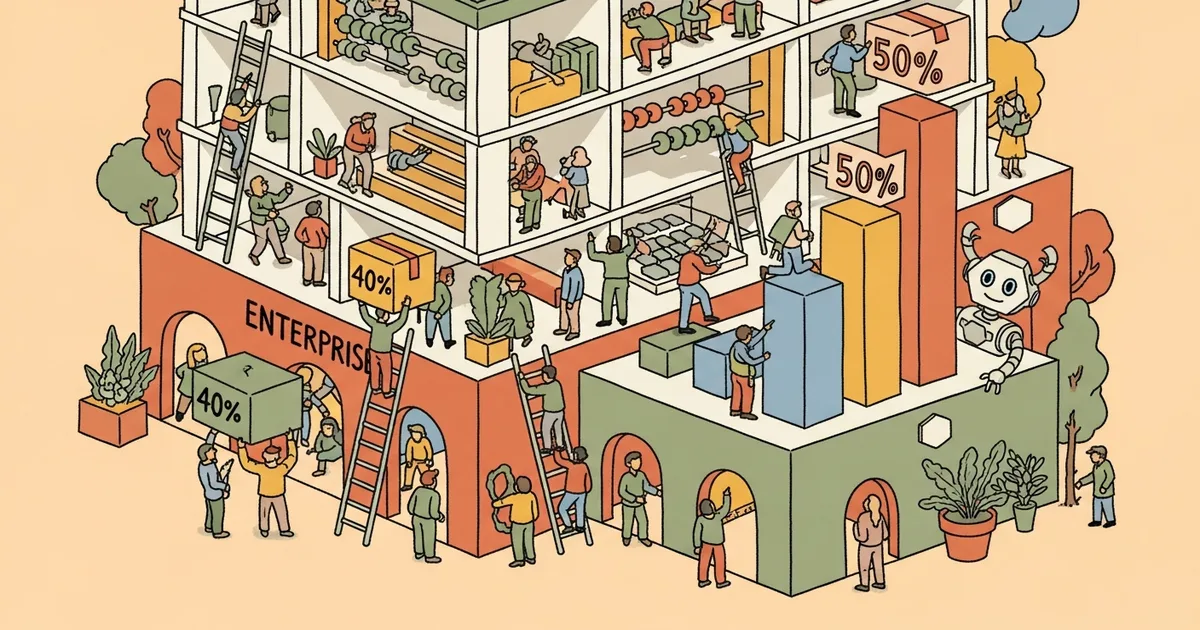
- OpenAI Chief Revenue Officer Denise Dresser told Bloomberg the enterprise business now accounts for 40% of total company revenue.
- Dresser forecast enterprise will reach 50% of revenue by the end of 2026, citing “incredible momentum.”
- The remarks came in an exclusive interview with Bloomberg Television’s Tom Mackenzie, broadcast May 15, 2026.
- OpenAI is privately held and does not publish quarterly financial statements, making the disclosure one of the few public data points on the company’s revenue mix.
What Happened
OpenAI Chief Revenue Officer Denise Dresser disclosed that the company’s enterprise business has reached 40 percent of total revenue and is on pace to exceed 50 percent by year-end, in a Bloomberg Television interview with anchor Tom Mackenzie broadcast on May 15, 2026. Dresser characterized the enterprise unit’s trajectory as having “incredible momentum.” She joined OpenAI from Salesforce in 2024 to build out the enterprise sales motion.
Why It Matters
OpenAI is a private company that does not publish quarterly financial statements, so executive disclosures of revenue mix are rare and closely tracked by investors in OpenAI’s secondary share market and by buyers of OpenAI’s private debt. A 40 percent enterprise share — climbing toward 50 percent — would mark the inflection point at which OpenAI’s revenue base shifts away from consumer ChatGPT subscriptions and toward business contracts that look more like Microsoft Azure or Salesforce sales motions. That mix shift has direct implications for the company’s projected gross margin trajectory, since enterprise contracts typically carry longer commitment periods and higher per-seat pricing.
The disclosure also lands alongside Sea Limited’s confirmed Codex rollout — featured this week in OpenAI’s Executive Function customer-interview series with 87 percent weekly active use among Sea developers — and OpenAI’s separate move to bring Codex to mobile devices. Both announcements function as proof points for the 40-percent enterprise figure Dresser cited.
Technical Details
Dresser’s 40-percent figure is a percentage of total revenue, not a dollar number; OpenAI did not disclose absolute revenue or growth rates in the interview excerpt. The enterprise category as OpenAI defines it includes ChatGPT Enterprise (launched August 2023), ChatGPT Business (launched 2024), the OpenAI API across customer organizations, and bespoke contracts that include the Codex line. The forecast that enterprise will reach 50 percent of revenue by year-end implies either accelerating enterprise growth, decelerating consumer growth, or both. Dresser did not break out which dynamic dominates the trajectory.
Public reporting earlier in 2026 placed OpenAI’s annualized run-rate revenue at roughly $11 billion, which would imply enterprise revenue around $4.4 billion at the 40-percent share Dresser cited and roughly $5.5 billion at the year-end 50-percent target — a forecast that depends on enterprise growth outpacing consumer growth materially through the remainder of the year.
Who’s Affected
Microsoft, OpenAI’s largest commercial partner and Azure-hosting infrastructure provider, benefits directly from enterprise growth that pulls API workloads through Azure. Anthropic, Google DeepMind’s enterprise Gemini sales unit, and AWS Bedrock all compete for the same enterprise spend; Dresser’s 40-percent disclosure becomes a benchmark each will be measured against. OpenAI’s secondary-market share investors gain a fresh data point on the company’s commercial mix. ChatGPT consumer subscribers do not see immediate product changes but do learn that they are a shrinking share of OpenAI’s commercial base. Salesforce — where Dresser previously ran enterprise sales for Slack — gains an indirect signal that the enterprise AI sales motion she built into OpenAI is scaling.
What’s Next
Dresser said the company expects enterprise to cross 50 percent of revenue by end-of-2026; the next public disclosure on this trajectory is unlikely to come before Microsoft’s quarterly earnings or a planned OpenAI investor update later this year. The enterprise category’s profitability versus consumer subscriptions remains undisclosed. Codex’s recent push to mobile and to background-execution modes is expected to become a meaningful enterprise sales hook through the second half of 2026. Investors in OpenAI secondary shares will likely use the 40-percent disclosure as the anchor for revaluing existing position sizes.