- Ilya Sutskever testified Monday in Elon Musk’s trial against OpenAI and Microsoft, defending his role in Sam Altman’s brief 2023 removal as CEO.
- Sutskever disclosed an ownership stake in OpenAI‘s for-profit arm worth approximately $7 billion.
- President Greg Brockman testified earlier that he holds OpenAI shares worth roughly $30 billion.
- Sutskever testified that becoming a for-profit was a “consensus” path, partially undermining Musk’s central claim of broken commitments.
What Happened
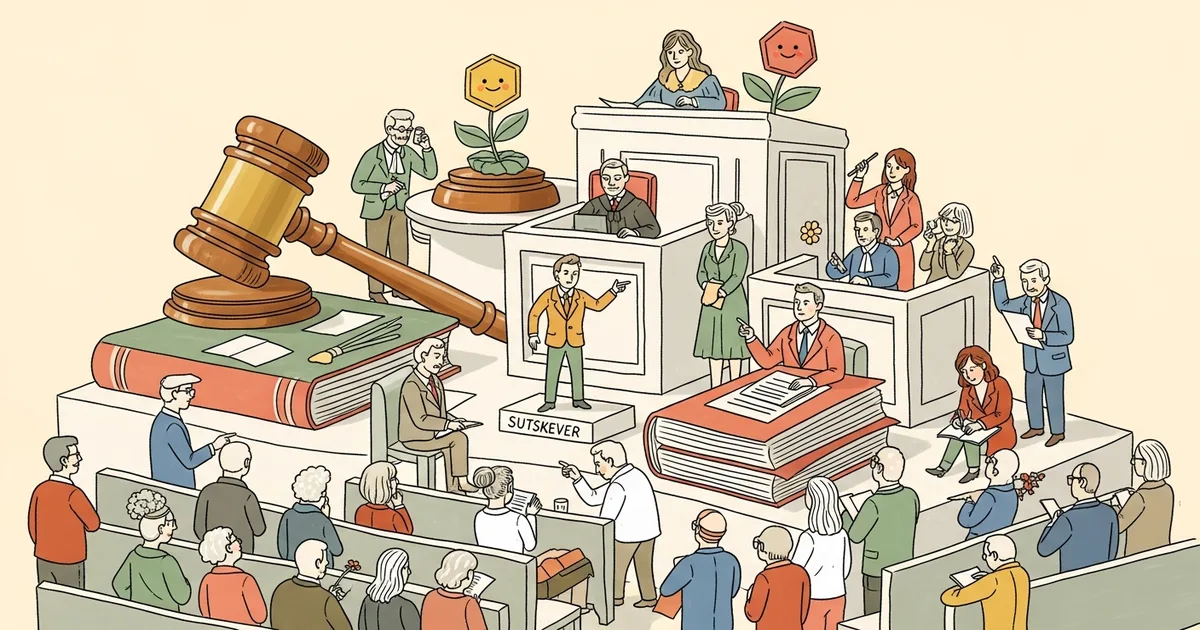
Former OpenAI chief scientist Ilya Sutskever defended his role in Sam Altman’s brief 2023 ouster during testimony in the final stretch of Elon Musk’s trial against OpenAI and Microsoft, Wired reported. Sutskever told the court that he had helped collect evidence against Altman and assisted in drafting a memo to OpenAI’s then-nonprofit board. Microsoft CEO Satya Nadella and OpenAI board chair Bret Taylor also testified Monday.
Why It Matters
Sutskever’s appearance is the most direct account in the public record of the November 2023 board decision that briefly removed Altman, an event that destabilised OpenAI for five days and resulted in the eventual restructuring of its non-profit governance. Sutskever, who joined OpenAI shortly after its founding — turning down what Brockman testified was a $6 million annual compensation offer from Google — left in May 2024 and now runs a competing lab, Safe Superintelligence Inc. His testimony provides Musk’s case with witness-stand support for the contention that Altman’s leadership has been a concern of OpenAI’s senior technical staff.
Technical Details
Sutskever disclosed that his ownership stake in OpenAI’s for-profit arm is currently worth about $7 billion, placing him among the largest individual shareholders. Brockman acknowledged in earlier testimony that his own OpenAI shares are worth approximately $30 billion. Sutskever said, per Wired’s reporting: “I felt a great deal of ownership of OpenAI. I felt like I put my life into it, and I simply cared for it, and I didn’t want it to be destroyed.” When asked by U.S. district judge Yvonne Gonzalez Rogers about how additional computing power changed OpenAI’s capabilities, Sutskever responded: “I would describe it as the difference between an ant and a cat.” Sutskever’s superalignment team — which he had described as doing the most important work at OpenAI “for the long term” — was disbanded in May 2024, shortly after he left the company.
Who’s Affected
Sutskever’s testimony partly undermined Musk’s central claim. Musk alleges that Altman and Brockman violated commitments made when Musk funded the OpenAI nonprofit, but Sutskever testified that the shift to a for-profit was the consensus path because building a computer “as big as the human brain” required “a lot of dollars.” That framing supports OpenAI’s defence that no special commitments to Musk existed. For OpenAI’s broader stakeholders — including the company’s employees, Microsoft, and the investor consortium that funded the $122 billion Series G at an $852 billion valuation — the courtroom disclosures of individual share values clarify the scale of personal wealth tied to the company’s continued growth. Sutskever’s estrangement from Brockman and Altman, an OpenAI lawyer told the court on Monday, has persisted since the 2023 ouster.
What’s Next
The trial is in its final stretch. Closing arguments are expected this week. A ruling on Musk’s claims will follow at an unspecified date, and the broader question of OpenAI’s nonprofit-to-for-profit conversion remains under separate scrutiny from state attorneys general and the Internal Revenue Service. Sutskever continues to lead Safe Superintelligence Inc., the new lab he founded after leaving OpenAI in 2024.