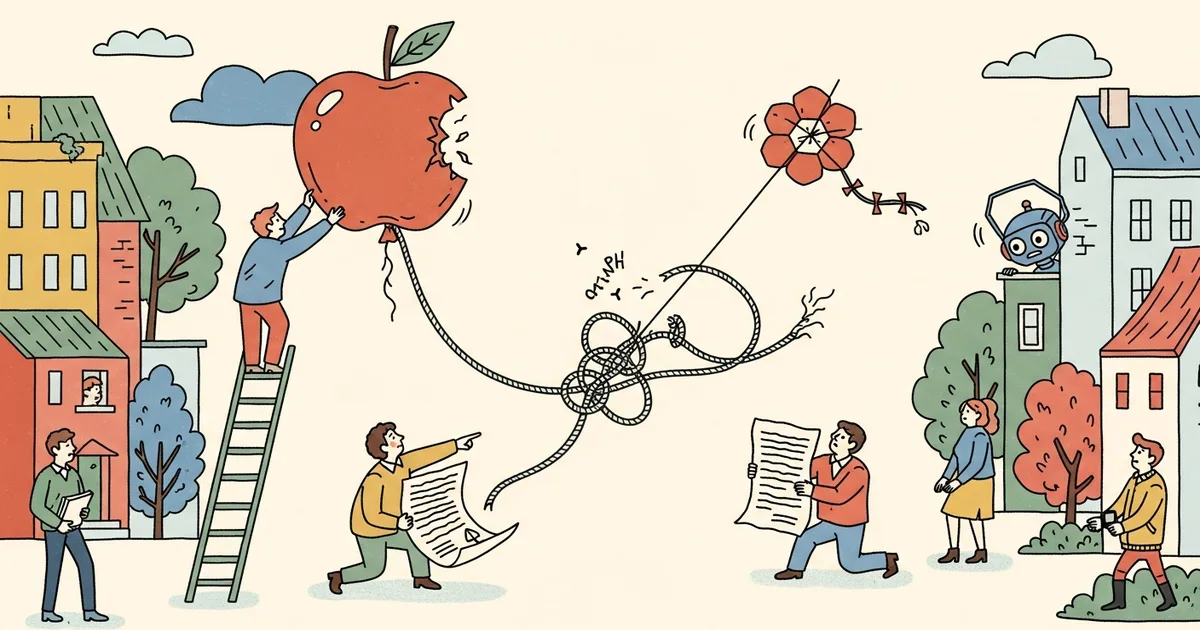
- The Apple-OpenAI partnership announced in June 2024 is fraying and may lead to legal action, Bloomberg reported on May 14, 2026.
- The deal originally embedded ChatGPT as the default external LLM behind Apple Intelligence’s Siri integration.
- The strain coincides with Apple’s accelerated push to use Anthropic’s Claude and on-device models inside Apple Intelligence.
- A formal break would reshape how iOS, iPadOS and macOS hand off complex queries to outside model providers.
What Happened
The partnership between Apple Inc. and OpenAI that powers external ChatGPT access inside Apple Intelligence is fraying and may end in legal action, Bloomberg reported on Thursday. The original deal, announced at Apple’s WWDC in June 2024, made ChatGPT the default external LLM that Apple Intelligence hands off to when Siri’s on-device models cannot answer a query.
Why It Matters
The Apple-OpenAI alliance was the most prominent commercial OEM placement OpenAI has secured. It put ChatGPT in front of more than 1 billion active iPhone users without any direct user signup, effectively making Apple’s distribution OpenAI’s largest consumer surface outside chatgpt.com itself. A break would force both companies into a costly re-negotiation or replacement scenario at the OS layer.
The timing is notable. Apple has been steadily expanding the set of model providers Apple Intelligence can route to. Bloomberg has previously reported that Anthropic’s Claude is being prepared as an alternative or supplementary external model. Apple’s own internal Foundation Models series has also matured through 2025–2026, reducing the percentage of queries that need to leave the device. Apple’s WWDC 2026, scheduled for June, is the most likely venue for any product-level announcement.
Technical Details
Bloomberg’s report did not detail the specific commercial or legal terms at issue between the two companies. Industry analysts have long flagged the structural asymmetry of the original deal: Apple did not pay OpenAI a per-query fee, instead exchanging distribution access for the right to surface ChatGPT branding inside Apple Intelligence. OpenAI bore the inference costs for Apple Intelligence hand-offs. As Apple Intelligence usage scaled through 2025, those inference costs reportedly grew faster than either party initially modelled. A separate dispute over branding and product naming inside iOS has also been a recurring point of friction, per earlier reporting from Bloomberg’s Mark Gurman.
The fraying coincides with a broader recalibration of AI partnerships at OpenAI. Microsoft disclosed in a recent Bloomberg report that it targeted a $92 billion return on its early OpenAI investment. OpenAI has been formalising its commercial relationships ahead of an anticipated 2026 or 2027 IPO. Each existing partnership represents either incremental revenue or distribution at the IPO valuation question.
Who’s Affected
Apple Intelligence users — primarily on iPhone 15 Pro, iPhone 16, iPhone 17, iPad and Mac silicon devices — are the direct end-user population. A switch from ChatGPT to Claude or another model would change the answers users see for complex queries that Siri cannot answer on-device. OpenAI’s investor consortium gains a data point on commercial risk concentration; Apple was one of OpenAI’s most visible distribution channels. Competing model providers — Anthropic, Google (which already powers some Apple Intelligence search hand-offs), Mistral, xAI — gain an opening to fill any gap. Microsoft, with its own deep OpenAI relationship, sits adjacent.
What’s Next
Neither company has publicly confirmed the disputes Bloomberg referenced. Expect formal positions from Apple Intelligence-related WWDC 2026 announcements in early June, and from OpenAI in its next product-cycle communications. Any formal partnership change would likely be disclosed before the iPhone 17 software cycle begins. If litigation is pursued, the most likely venues are U.S. federal court in the Northern District of California (where Apple is headquartered) or Delaware Chancery if the dispute touches on the partnership’s contractual structure.