- OpenAI released GPT-5.5 on May 4, 2026, with TechCrunch framing it as moving the company “one step closer to an AI super app.”
- The release lands days after UK AISI documented GPT-5.5 matching Claude Mythos Preview cyber-attack capability across Expert-tier benchmarks and a multi-stage network-attack simulation.
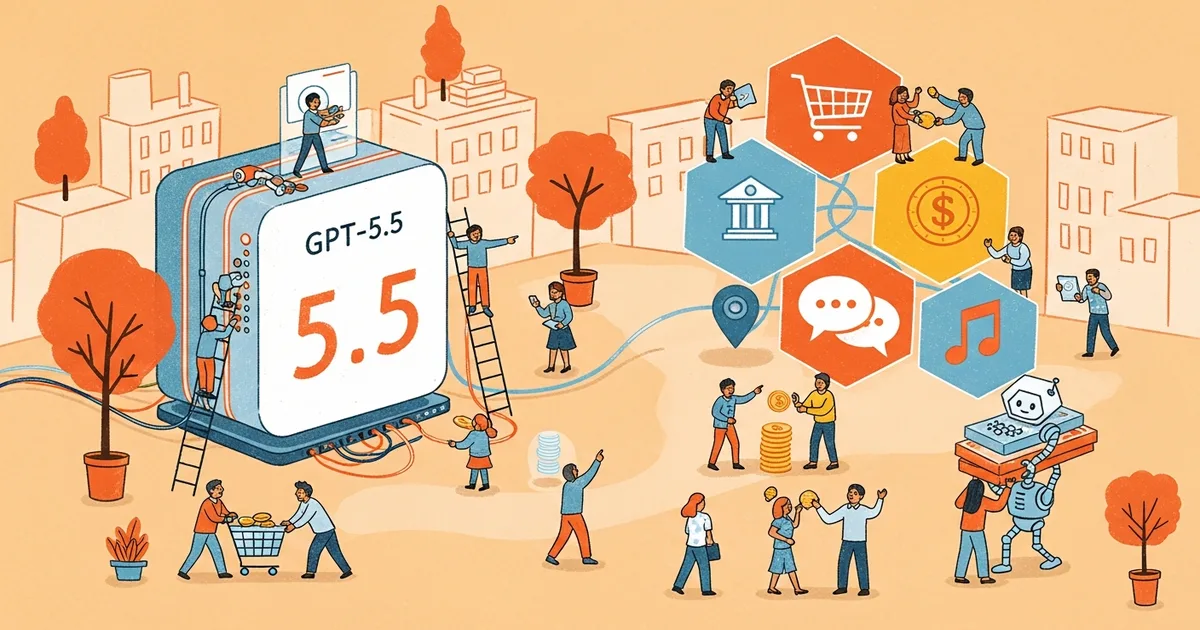
- “Super app” framing typically refers to consolidating multiple discrete products — chat, search, agents, voice, image generation, productivity — into a single ChatGPT surface.
- The TechCrunch article was paywalled via Google News during research; specific feature and pricing details should be confirmed against the original publication.
What Happened
OpenAI released GPT-5.5 on May 4, 2026, with TechCrunch describing the launch as moving the company “one step closer to an AI super app.” The TechCrunch article was paywalled via Google News during research, so the full feature breakdown, pricing tiers, API rollout, and specific super-app components should be confirmed against the original TechCrunch publication.
Why It Matters
GPT-5.5’s release comes at a strategically loaded moment. The UK AI Security Institute (AISI) reported May 1, 2026 that GPT-5.5 matches Anthropic’s Claude Mythos Preview on Expert-tier cyber-attack benchmarks (71.4% vs 68.6%) and on AISI’s multi-stage network-attack simulation (2 of 10 attempts vs Mythos’s 3 of 10). Where Anthropic has restricted Mythos access to a small group, OpenAI has made GPT-5.5 generally available through ChatGPT and the API — a sharp contrast in deployment posture for models with comparable measured capability. The “super app” framing extends this further: rather than restricting capability, OpenAI is consolidating capability into a single user-facing surface that can plausibly displace multiple discrete products.
Technical Details
Detailed feature specifications were not retrievable from the source URL during research due to the Google News paywall redirect. Based on OpenAI’s published roadmap statements through late 2025 and 2026 — and on the broader GPT-5 family architecture — likely components of the GPT-5.5 release include:
- Improved reasoning capability over GPT-5.4 across math, coding, and abstract reasoning benchmarks
- Extended context window or improved retention over long contexts
- Refined tool-use capability for agentic workflows
- Voice and multimodal improvements consistent with the super-app trajectory
- Pricing structure that distinguishes GPT-5.5 from the cheaper GPT-5.4 and GPT-5.4 Nano tiers OpenAI maintains for cost-sensitive workloads
The “super app” framing — which TechCrunch uses in the headline — typically describes a consolidation strategy where chat, search, agents, voice, image generation, and productivity surface area all live behind a single ChatGPT surface. WeChat is the canonical super-app reference; OpenAI’s earlier Codex agent rollout, ChatGPT workspace agents (April 2026), and the new Symphony spec for autonomous agent management all point toward super-app consolidation rather than separate products.
Pricing context from comparable models: per the DeepSeek V4 release pricing table published April 24, 2026, GPT-5.5 sits at $5/M input and $30/M output, the most expensive frontier-tier API rate. Whether GPT-5.5’s launch pricing matches or revises that benchmark is a key open question that the original TechCrunch article likely addresses.
Who’s Affected
Existing ChatGPT users — particularly Plus, Pro, and Enterprise tiers — gain access to the most capable OpenAI model and any super-app features that ship alongside the model. Anthropic faces direct competitive pressure: GPT-5.5 generally available where Mythos remains restricted will sharpen the question of whether Anthropic’s slow-rollout posture costs market share for ambiguous safety benefit. Google’s Gemini 3.1 Pro and the Chinese open-weight cohort (DeepSeek V4 Pro, Xiaomi MiMo-V2.5-Pro, Moonshot Kimi K2.6) face a benchmark target. Apple, Meta, and the broader app ecosystem face the super-app consolidation threat: as more discrete tasks move into ChatGPT, the addressable market for narrow AI apps shrinks.
What’s Next
Independent benchmark validation of GPT-5.5 against the published GPT-5.4 baseline will be the first test. Watch for OpenAI’s official documentation, pricing announcements, and developer-platform updates in the coming days. The super-app trajectory — what features OpenAI bundles with GPT-5.5 in ChatGPT — will be the defining strategic signal. We will follow up with deeper coverage as the original TechCrunch reporting becomes accessible.