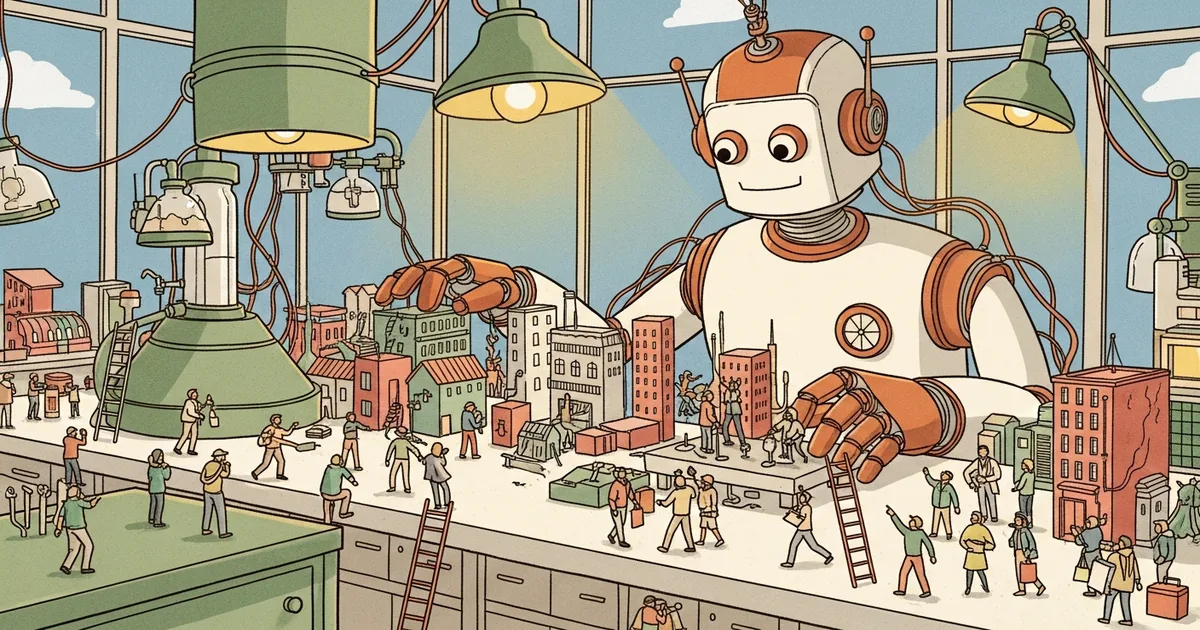
- Luma AI is launching an open research lab that will let anyone train robots on its software, Bloomberg reported.
- The move is a bet on ‘physical AI’ — applying AI models to robots and the real world — which Nvidia CEO Jensen Huang has called the next AI race.
- Luma AI, known for generative video models, is extending from pixels into physical-world AI.
- CEO Amit Jain framed the lab as opening robot-training capability beyond a closed set of labs.
What Happened
Luma AI is launching an open research lab that will allow anyone to train robots on its software, Bloomberg reported, with CEO Amit Jain framing it around the idea that the next AI race is in the physical world. The announcement explicitly echoes Nvidia chief Jensen Huang’s framing of “physical AI” as the coming frontier. Specifics of the lab’s tooling, access model, and partners are in the source reporting.
Why It Matters
Physical AI — using AI models to perceive, plan, and act in the real world via robots and autonomous systems — is rapidly becoming the industry’s next battleground. Luma AI is best known for generative video; pivoting toward an open robot-training lab signals that companies built on world-modeling and video generation see a natural path into embodied AI, where understanding physical dynamics is exactly what video models learn. Opening it to “anyone” is the notable part: it lowers the barrier to robot training that has historically been confined to well-funded labs.
The timing rides a clear industry wave. Physical AI was a centerpiece of Nvidia‘s recent push, which we covered in Nvidia’s GTC Taipei launches including the Cosmos world model. Luma’s lab is another sign that the infrastructure and tooling layer for embodied AI is forming fast.
Technical Details
Training robots requires bridging perception (understanding a scene), world modeling (predicting how actions change the world), and control (producing motor commands). Generative video and world models — Luma’s domain — are increasingly used to generate synthetic training data and simulate scenarios that would be expensive or dangerous to capture in reality. An open lab that lets outside developers train robots on Luma’s software suggests the company is exposing this model stack as a platform rather than keeping it internal. The depth of access — whether it includes simulation, real-robot integration, or pre-trained policies — will determine how useful it is, and those specifics are in the source reporting.
Who’s Affected
Robotics startups and researchers gain a new, openly accessible platform for training, potentially lowering cost and time-to-prototype. Nvidia’s physical-AI ecosystem (Cosmos, robotics platforms) gains a complementary tooling player — and a validation of Huang’s thesis. Incumbent robotics and simulation providers face a new competitor. And generative-AI companies watching the video-to-embodied-AI path gain a reference case in Luma’s expansion, a shift tracked across our AI launches coverage.
What’s Next
Watch for the lab’s access details, supported robots and simulators, and early projects built on it. The key question is whether “anyone can train robots” translates into real adoption or remains aspirational — the gap between an open platform and a usable one is large in robotics. If it works, Luma’s move accelerates the democratization of physical AI; either way, expect more video and world-model companies to follow the same path from screen to physical world through 2026.