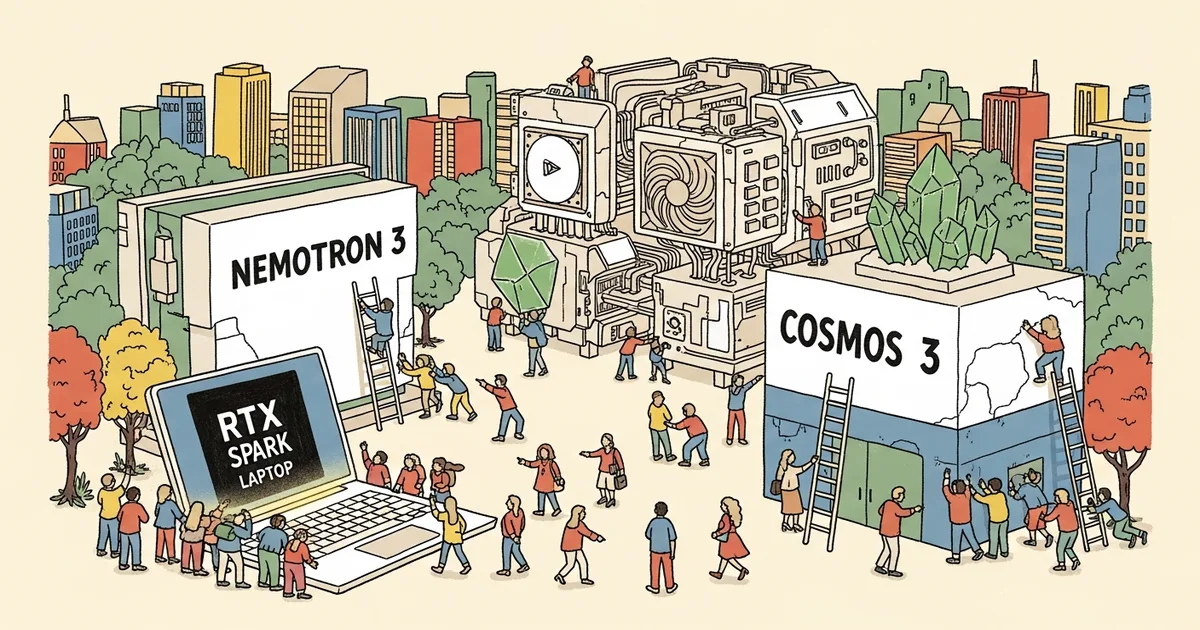
- Nvidia used GTC Taipei to launch RTX Spark, a Grace Blackwell chip for Windows laptops with up to 128GB unified memory and a claimed 1 petaflop of FP4 AI compute, taking on Apple Silicon and Qualcomm Snapdragon.
- RTX Spark targets local AI-agent execution, paired with new security tooling (OpenShell Runtime) for agent isolation; devices from ASUS, Dell, HP, Lenovo, and Microsoft Surface arrive fall 2026.
- Nvidia also unveiled Cosmos 3, an open "omnimodel" world model for robots and autonomous vehicles, plus the Alpamayo 2 Super driving model and an open humanoid-robot reference platform.
- Separately, Nvidia’s Nemotron 3 Ultra (~550B params, ~55B active) became the most capable open US model per Artificial Analysis, scoring 48 — ahead of other US open models but behind China’s Kimi K2.6 (54).
What Happened
Nvidia used its GTC Taipei event to make a broad push across consumer hardware, physical AI, and open models. The headline announcement, reported by The Decoder, is RTX Spark — Nvidia’s first move into Windows laptops, a chip designed to run AI agents locally. Alongside it, Nvidia launched the Cosmos 3 world model for robotics and autonomous systems, and its Nemotron 3 Ultra became the highest-rated open model from a US developer.
Why It Matters
RTX Spark is Nvidia’s most direct assault yet on the PC processor market — territory long held by Intel and AMD, and more recently contested by Qualcomm’s Snapdragon X and Apple Silicon. It is also the hardware payoff for the local-agent thesis: the bet that the next PC upgrade cycle is justified by running AI agents on-device rather than in the cloud. That thesis is exactly what Microsoft and Nvidia signaled they were building toward, and RTX Spark is the silicon that makes it concrete. Cosmos 3 and the robotics stack, meanwhile, extend Nvidia’s grip from training data centers into the "physical AI" layer of robots and vehicles.
Technical Details
At the top end, RTX Spark uses the same GB10 Grace Blackwell Superchip that powers Nvidia’s DGX Spark, but repackaged for consumers: a Blackwell RTX GPU with 6,144 CUDA cores and fifth-gen Tensor Cores, paired with a 20-core Arm-based Grace CPU (co-designed with MediaTek) over NVLink-C2C. Memory is unified between CPU and GPU and tops out at 128GB; variants scale from 16GB up. Nvidia’s headline "1 petaflop" figure refers to FP4 precision with sparsity — a theoretical peak — while real GPU performance sits near a GeForce RTX 5070 Laptop GPU depending on workload. To address the security risk of agents acting with local privileges, Nvidia is shipping OpenShell Runtime for agent isolation and privacy controls.
Cosmos 3 is Nvidia’s next-generation open omnimodel, processing text, images, video, audio, and action data in one system using a mixture-of-transformers approach — one transformer reasons about a scene, a second generates video, descriptions, or motion trajectories. It supports synthetic training-data generation, scene interpretation, and world-state prediction for robots and AVs. Nemotron 3 Ultra, the open model, carries roughly 550 billion total parameters with about 55 billion active, scores 48 on Artificial Analysis’s intelligence ranking (ahead of Gemma 4 31B at 39 and gpt-oss-120b at 33), and exceeds 300 tokens/second on DeepInfra. It ships June 4 on Hugging Face and OpenRouter.
Who’s Affected
Intel, AMD, Qualcomm, and Apple face a credible new competitor in the premium AI-PC tier. OEMs — ASUS, Dell, HP, Lenovo, and Microsoft Surface — get a new flagship silicon option for fall 2026 devices. Robotics and autonomous-vehicle developers gain an open world model (Cosmos 3) and a humanoid reference platform. The open-model community gets a strong new US entry in Nemotron 3 Ultra, even as Chinese open models (Kimi K2.6) retain the lead. It also builds on Nvidia’s broader Taiwan and supply-chain investments, extending its platform reach from the data center to the laptop and the robot.
What’s Next
RTX Spark devices launch in fall 2026; independent benchmarks and battery-life data will determine whether the 1-petaflop claim translates into real-world advantage over Apple and Qualcomm. Nemotron 3 Ultra’s June 4 open release will let researchers verify Artificial Analysis’s scores. And the security model around local agents — OpenShell Runtime in particular — will face scrutiny as agents gain the ability to act on users’ machines. Expect Computex and Build the same week to fill in pricing and availability.