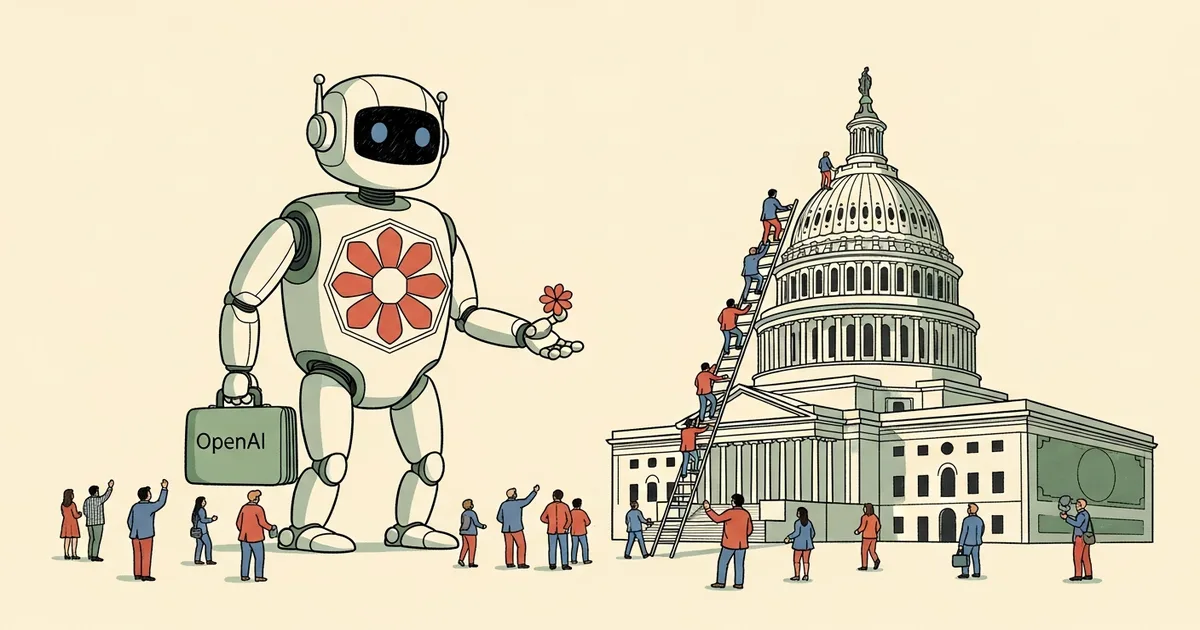
OpenAI is offering the US government a 5% stake in the company as part of its IPO strategy, the Financial Times reported. At OpenAI’s reported valuation of roughly $850 billion to $1 trillion, that stake is worth $42 billion to $50 billion.
The openai government 5 percent stake proposal would make Washington one of the company’s largest shareholders — while the same government finalizes a framework granting itself pre-release review authority over OpenAI’s models.
The valuation math
The size of the transfer is easy to state and hard to contextualize, because nothing comparable exists at this scale.
| OpenAI valuation | Value of 5% |
|---|---|
| $850 billion | $42.5 billion |
| $1 trillion | $50 billion |
For comparison, the entire federal AI research budget across agencies is a small fraction of that figure annually. This is not a grant, a subsidy, or a tax. It is an equity position handed over ahead of a public offering, at no cost to the recipient.
Sam Altman had already floated the concept publicly, as MegaOne AI covered when he called for a US-led AI safety forum and raised a 5% government stake. The FT report moves it from a talking point to an IPO term.
The precedent: golden shares
The structural model is the golden-share arrangement used in the US Steel-Nippon deal, where the federal government retained specific governance rights over a foreign-acquired strategic asset rather than a pure economic interest.
Golden shares typically carry three features: veto rights over defined corporate actions, board or observer access, and protection against transfer of critical assets. Whether OpenAI’s proposal carries governance rights or is economically passive is the single most important unreported detail. A passive 5% is a very large gift. A 5% with veto rights is a change in who controls the company.
Why now: the Fable 5 lesson
The timing is not arbitrary. On June 12, 2026, the Commerce Department ordered Anthropic to cut off foreign-national access to Claude Fable 5. Anthropic could not comply selectively and pulled the model worldwide for 19 days — the sequence MegaOne AI documented in its full Fable 5 suspension timeline.
That established, in public, that a single letter can remove a frontier lab’s flagship product from the market. For a company weeks away from a public listing, that is not a policy risk. It is a disclosable risk factor with a dated precedent attached.
OpenAI filed confidentially for its IPO in June, a week after Anthropic, and has assembled its bank lineup including Citigroup and JPMorgan. Every one of those banks will price regulatory risk into the offering. A government shareholder is the most direct available hedge against it.
The conflict with the 30-day review framework
The White House is finalizing a voluntary framework giving federal agencies up to 30 days to review frontier models before public release, targeted for announcement on August 1, 2026. MegaOne AI’s analysis of the 30-day review framework covers its structure and enforcement backdrop.
Combine the two arrangements and the federal government would simultaneously hold:
- A pre-release review over OpenAI’s core product.
- An equity stake whose value depends on that product shipping.
- An export-control instrument demonstrated capable of taking a competitor’s model offline.
Those three positions are not obviously compatible. A regulator that owns 5% of one participant has a financial interest in outcomes that affect the others — including Anthropic, which is separately litigating against the government over procurement conditions revealed in Pentagon emails.
The critique writes itself: regulatory capture usually requires inference about influence. Here the ownership would be on the cap table.
The Musk trial context
OpenAI’s restructuring has been under legal pressure from Elon Musk’s litigation, which targets the conversion of the original nonprofit structure into a form capable of supporting a public offering. Federal alignment is useful there too — a government shareholder is a government with a direct interest in the restructuring surviving.
That is the least discussed benefit of the proposal and possibly the most immediate one.
Will Anthropic and Google have to match?
Probably not on identical terms, and the reasons are structural rather than principled.
- Google cannot offer 5% of Alphabet. Any equivalent would have to be structured around a subsidiary, which raises its own antitrust and governance problems.
- Anthropic is in active litigation against the government. Offering equity to an adversary mid-suit is not a coherent position, and its own IPO process is proceeding without one.
- Smaller labs have nothing to offer at a scale Washington would notice.
The realistic outcome is not matching but differentiation: one lab with a government shareholder, and everyone else competing against it. Whether that is an advantage or a permanent constraint depends entirely on the governance rights nobody has disclosed yet.
What to watch before the IPO prices
Three specifics will determine whether this is a symbolic alignment gesture or a control transfer:
- Voting rights. Economic-only, or governance-bearing?
- Which entity holds it. Treasury, a sovereign-style vehicle, or an agency with regulatory jurisdiction over OpenAI — the last would be the sharpest conflict.
- Disclosure in the S-1. A confidential filing becomes public before pricing. The stake, if real, has to appear there in enforceable language.
Until the S-1 is public, treat the 5% as a reported proposal rather than a completed transaction. The Financial Times’ technology coverage is at ft.com/technology, and OpenAI’s own announcements are at openai.com/news.