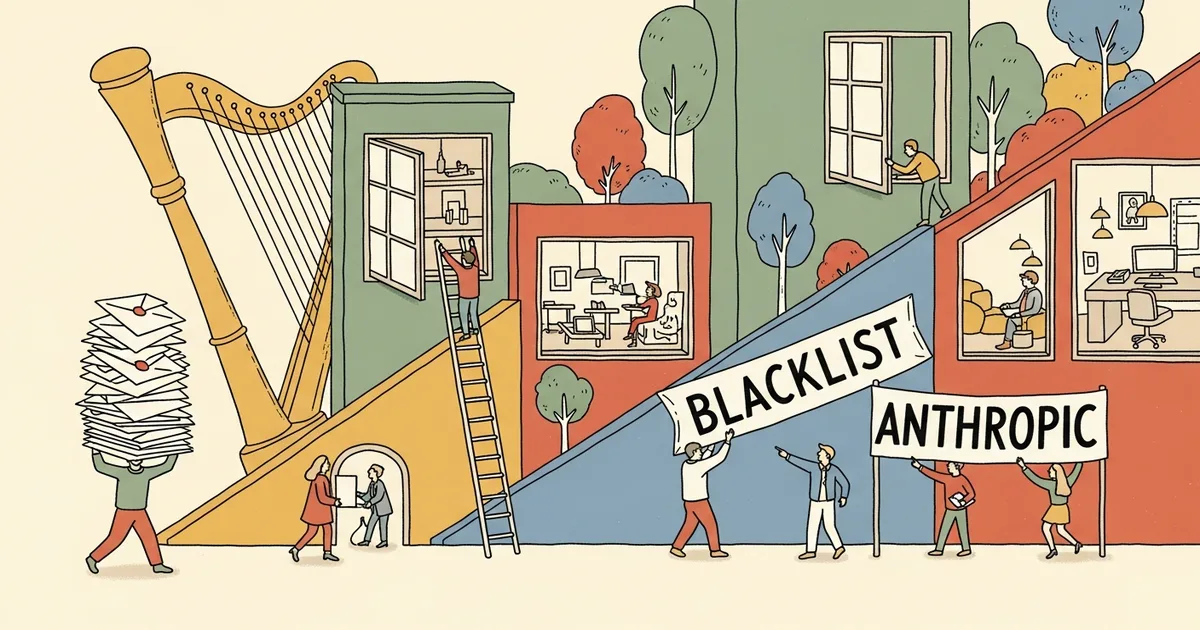
Court filings in Anthropic‘s lawsuit against the US government have produced emails showing the Pentagon explicitly demanded that the company accept autonomous weapons use as a condition of its government contracts. The anthropic pentagon autonomous weapons emails also show that the “supply chain risk” designation applied to Anthropic followed directly from its refusal.
Until now, that causal chain existed only in anonymously sourced reporting. It is now in the record, in the government’s own words.
What the emails establish
Two findings do the work.
The condition was explicit. Acceptance of autonomous weapons use was not an implied term buried in usage policy negotiation. It was stated as a requirement for continued contracting.
The penalty was causal. The “supply chain risk” designation — a national-security classification that functions as an exclusion from federal procurement — was applied after and because of the refusal. That reframes it from a security judgment about a vendor into a consequence of a policy disagreement with one.
The distinction matters legally. A supply-chain risk designation is meant to describe a property of the vendor. The emails describe it functioning as leverage.
The 2026 timeline now reads differently
Every step of the Anthropic-Pentagon arc had an innocent explanation available while the emails were sealed. Together with the filings, the sequence is coherent:
| Event | Prior reading | Reading after the filings |
|---|---|---|
| Supply-chain risk designation | Security assessment | Consequence of refusing weapons terms |
| Exclusion from the 10-company classified-network deal | Vendor selection | Continuation of the exclusion |
| Anthropic’s lawsuit | Contract dispute | Challenge to coercive conditioning |
| The injunction | Procedural relief | Court found the claim substantial enough to preserve |
| Ballard Partners lobbying hire | Standard Washington practice | Response to a closed procurement channel |
It also vindicates the DeepMind unionizers, who argued publicly that AI-lab weapons policies were being set by procurement pressure rather than by stated principles. That claim was treated as advocacy. The filings make it a description.
The competitive asymmetry
Google, Microsoft, and xAI accepted terms Anthropic declined. That is the commercially relevant fact, and it cuts in an uncomfortable direction: the company with the most restrictive usage policy paid the highest price for having one.
Federal AI spending is large, sticky, and expanding. Exclusion from it is not a symbolic cost. Anthropic absorbed it while simultaneously running a confidential IPO process — MegaOne AI covered the S-1 filing and the $965 billion valuation attached to it. Losing a revenue channel during a listing process is the kind of decision that is easy to praise and expensive to make.
The company has not moderated elsewhere. It called for tougher AI regulation at the state level and continued to fund external research, including $10 million for Canadian AI research.
Glasswing: 150 organizations across 15 countries
Alongside the litigation, Anthropic’s Project Glasswing expanded to 150 organizations across 15 countries. Time Magazine named the company “the most disruptive company.”
The expansion is strategically legible. An institutional footprint spanning 15 countries is a hedge against dependence on any single government’s procurement — and a demonstration that the excluded vendor is not isolated. It is the civilian mirror image of the federal channel that closed.
The pattern: refusal has become expensive twice in one quarter
This is the second documented instance in 2026 of the US government imposing a direct cost on Anthropic’s model policy. In June, Commerce ordered Claude Fable 5 pulled worldwide, and it stayed offline 19 days — reconstructed in MegaOne AI’s full Fable 5 suspension timeline.
The two episodes use different instruments — export control in one, procurement in the other — toward the same effect: policy pressure applied through mechanisms that carry no hearing and no appeal.
They also frame what is coming. The White House is finalizing a framework giving agencies up to 30 days to review frontier models before release, targeted for August 1. A lab evaluating whether to join that framework now has documentary evidence of what happens when it says no to a government request.
What the lawsuit’s outcome actually decides
The narrow question is whether the supply-chain risk designation was lawfully applied. The broad question is whether a US AI company can refuse a specific military use of its technology and remain eligible for unrelated federal business.
Three outcomes, with different consequences for the industry:
- Anthropic wins on the merits. Conditioning procurement on acceptance of a contested use becomes legally risky, and usage policies stop being a procurement liability.
- The case settles quietly. The designation is lifted, no precedent is set, and the mechanism remains available for the next refusal.
- The government prevails. Usage restrictions become priced into federal AI contracting, and the labs converge on whatever the most permissive competitor will accept.
Outcome three is the one worth watching, because it does not require any lab to change its stated values — only to notice what the market rewards.
What to take from this if you buy AI
Vendor usage policies are no longer only an ethics disclosure; they are a supply-continuity variable. A vendor that refuses certain government uses may face procurement exclusion. A vendor that accepts them faces different reputational and regulatory exposure in Europe, where the AI Act applies from August 2.
Ask vendors two concrete questions: what uses their policy prohibits, and what has happened to them commercially as a result. The second question now has documented answers. Anthropic publishes its policy positions at anthropic.com/news.