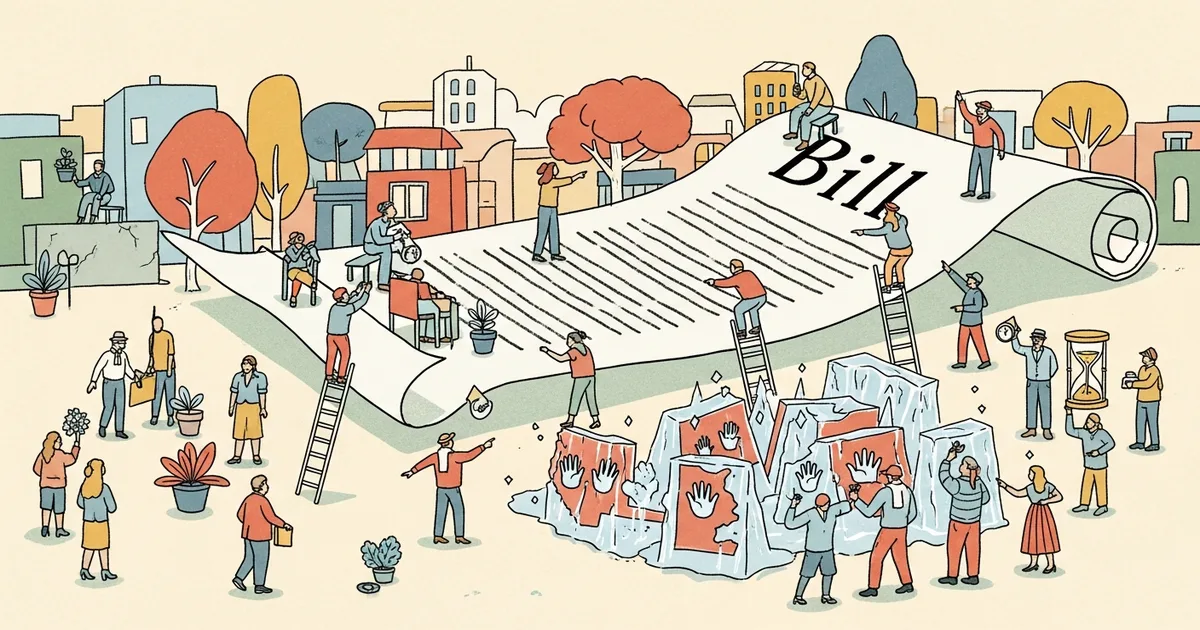
On June 4, 2026, Reps. Jay Obernolte (R-CA) and Lori Trahan (D-MA) released the Great American Artificial Intelligence Act, a 269-page bipartisan discussion draft. Its most consequential provision: a three-year preemption of state AI development laws.
Labor unions rejected it within hours. The AFL-CIO, AFT, and AFA-CWA called it a “hard no,” describing the bill as “a giveaway to the AI industry and a handful of trillion-dollar companies.”
What the bill actually does
| Provision | Effect |
|---|---|
| State-law preemption | Freezes state AI development laws for 3 years |
| Third-party audits | Semi-annual audits of OpenAI, Anthropic, xAI, Google DeepMind |
| CAISI | New Center for AI Standards and Innovation inside NIST |
| CISA extension | Extends the Cybersecurity Information Sharing Act through 2035 |
The three-year state freeze is the fight
Preempting state law for three years would void measures like Colorado’s AI Act and block new ones. Supporters argue a single federal standard beats a 50-state patchwork; opponents argue it strips states of their only current AI protections while federal rules remain voluntary.
Why labor killed it in hours
The unions’ objection is structural: mandatory audits apply to four trillion-dollar labs, but worker protections and state-level safeguards get frozen. To labor, the bill regulates the companies lightly while disarming the states that have moved fastest on AI accountability.
The DOJ Colorado precedent
The bill landed days after the Trump administration’s executive order establishing voluntary federal AI model reviews, and after the DOJ moved in April to block Colorado’s AI Act — the first federal challenge to a state AI law. The legislative push and the legal challenge point the same direction: centralize AI rules in Washington.
Pass or die: what changes either way
If it passes, AI labs get federal preemption and a predictable audit regime; states lose their leverage. If it dies, the patchwork grows and the courts — already busy, as seen in the flood of AI litigation — keep setting the rules case by case. Either way, the venue for AI governance is being decided now.
Track the markup: a discussion draft that unions oppose this loudly rarely survives unchanged, so the preemption clause is the provision to watch.