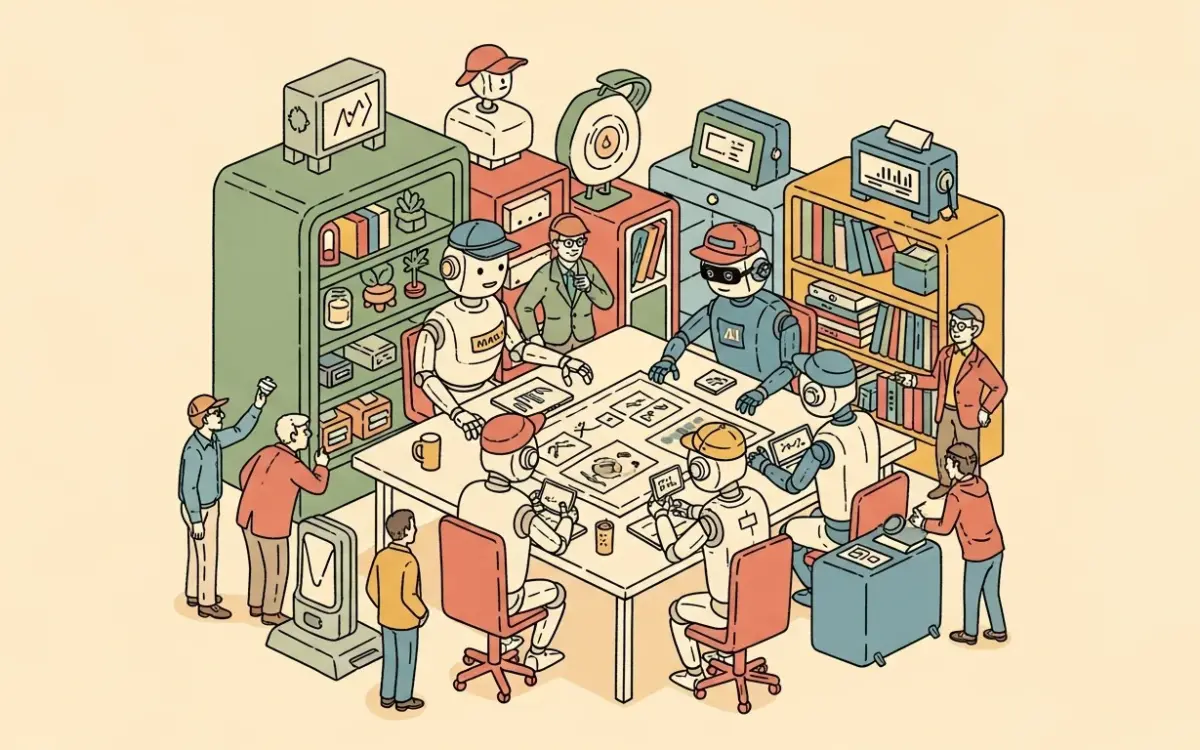
- CrewAI is an open-source multi-agent orchestration framework founded by João Moura that enables teams of AI agents to collaborate on complex tasks autonomously.
- The platform processes over 450 million agentic workflows monthly and claims adoption by 60% of Fortune 500 companies, including DocuSign, IBM, and PwC.
- CrewAI offers three tiers: an open-source framework, a managed cloud platform (AMP Cloud), and an enterprise on-premises deployment option (AMP Factory).
- The framework supports any LLM and integrates with tools like Gmail, Slack, Salesforce, and HubSpot, but enterprise pricing remains opaque.
What Happened
CrewAI, the multi-agent AI framework created by João Moura, has evolved from an open-source project into a full enterprise platform with significant market traction. Moura, who previously served as Director of AI Engineering at Clearbit (acquired by HubSpot), launched CrewAI to address a specific challenge: orchestrating multiple AI agents that can work together on complex, multi-step workflows without constant human supervision.
By October 2024, the company had raised $18 million in funding, including a Series A led by Insight Partners. The platform now processes more than 450 million agentic workflows per month and reports that 60% of Fortune 500 companies use it in some capacity, with over 4,000 new sign-ups occurring weekly.
In 2026, CrewAI launched its most significant product expansion: AMP, the Agent Management Platform. The company positions AMP as “the OS for agents in production,” providing centralized governance, security, and scaling capabilities for enterprise deployments.
Why It Matters
The multi-agent AI framework market is becoming increasingly competitive, with tools like LangGraph, Microsoft’s AutoGen, and custom in-house solutions all competing for developer adoption. CrewAI distinguishes itself through a role-based agent design philosophy where each agent is assigned a specific role, goal, and backstory, enabling collaborative task completion that mirrors how human teams divide and coordinate work.
According to CrewAI’s 2026 State of Agentic AI Survey Report, 100% of surveyed enterprises plan to expand their use of agentic AI this year, and nearly three-quarters consider it a critical priority or strategic imperative. Organizations have automated an average of 31% of their workflows using agentic AI and expect to expand adoption by an additional 33% in 2026. These figures suggest that multi-agent orchestration is moving from experimental to foundational in enterprise technology stacks.
Technical Details
CrewAI’s architecture is built around three core abstractions: Agents (autonomous units with defined roles and capabilities), Tasks (specific objectives assigned to agents with expected outputs), and Crews (coordinated teams of agents working together toward a shared goal). The framework is model-agnostic, supporting OpenAI, Anthropic, open-source models, or any combination through a unified interface.
The platform is available in three tiers. CrewAI OSS is the open-source orchestration framework providing APIs for building agent-driven workflows. CrewAI AMP Cloud is the managed platform featuring a visual editor, AI copilot for no-code agent building, real-time workflow tracing, agent training with human-in-the-loop feedback, and task guardrails for reliability. CrewAI AMP Factory provides enterprise deployment on-premises or in private cloud infrastructure across AWS, Azure, and GCP, with role-based access control and serverless container deployment.
Documented results from enterprise users include DocuSign achieving 75% faster lead contact times, General Assembly reducing curriculum design development time by 90%, PwC increasing code generation accuracy from 10% to 70%, and Brazilian dairy company Piracanjuba reaching 95% accuracy in customer support responses.
Who’s Affected
CrewAI targets three distinct audiences. Individual developers and startups can use the open-source tier to experiment with multi-agent systems at no cost. Mid-market companies benefit from the managed AMP Cloud tier for production workloads without managing infrastructure. Large enterprises including DocuSign, IBM, PwC, and General Assembly use the AMP Factory tier for on-premises deployments requiring strict data governance and compliance controls.
The platform also affects the competitive landscape for other multi-agent frameworks. LangGraph, Microsoft’s AutoGen, and emerging open-source alternatives must now compete against a platform with established enterprise relationships and documented production deployments. For development teams evaluating multi-agent tools, CrewAI’s integrated tooling ecosystem — with pre-built connectors for Gmail, Microsoft Teams, Notion, HubSpot, Salesforce, and Slack — reduces the integration overhead that has historically slowed adoption of orchestration frameworks in enterprise settings.
What’s Next
CrewAI’s trajectory points toward continued expansion into enterprise automation, but the platform faces real limitations. Enterprise pricing is not publicly disclosed, making cost comparison with competitors difficult for prospective buyers. The framework’s effectiveness depends heavily on prompt engineering quality, and complex multi-agent workflows can be difficult to debug when agents produce unexpected outputs. Competing frameworks continue to evolve rapidly, and whether CrewAI can maintain its current market position will depend on how quickly it can deepen its enterprise tooling and address the observability challenges inherent in autonomous multi-agent systems.
Related Reading
- LlamaIndex Review 2026: Data Framework for Building RAG and Knowledge Applications
- LangChain Review 2026: The Developer Framework for Building AI Applications and Agents
- Mimosa Multi-Agent Framework Achieves 43.1% on ScienceAgentBench
- Multi-Agent LLM Framework Fixes Instability in Bayesian Optimization
- ChatGPT Review 2026: GPT-5.4 Delivers Configurable AI Power